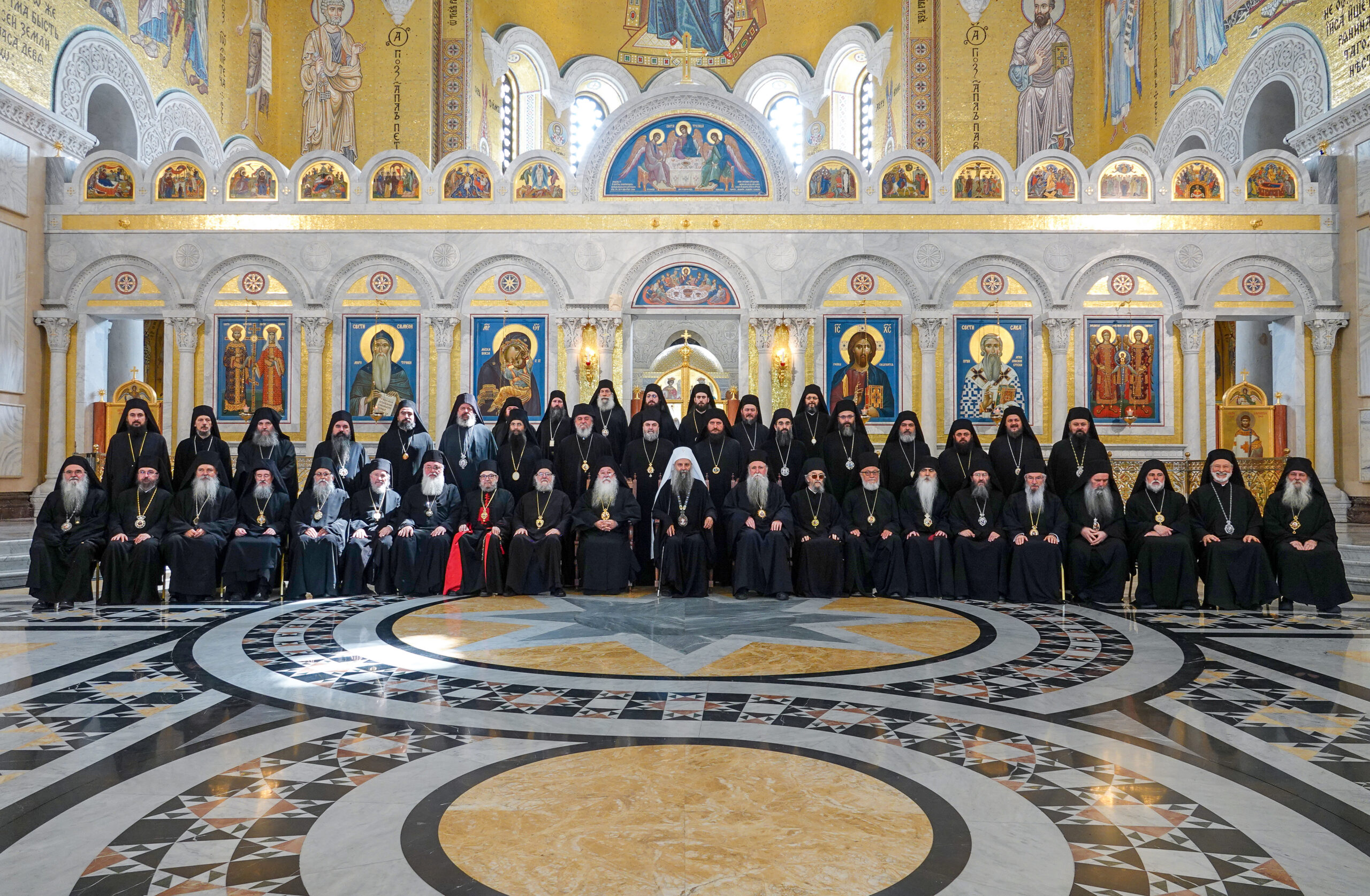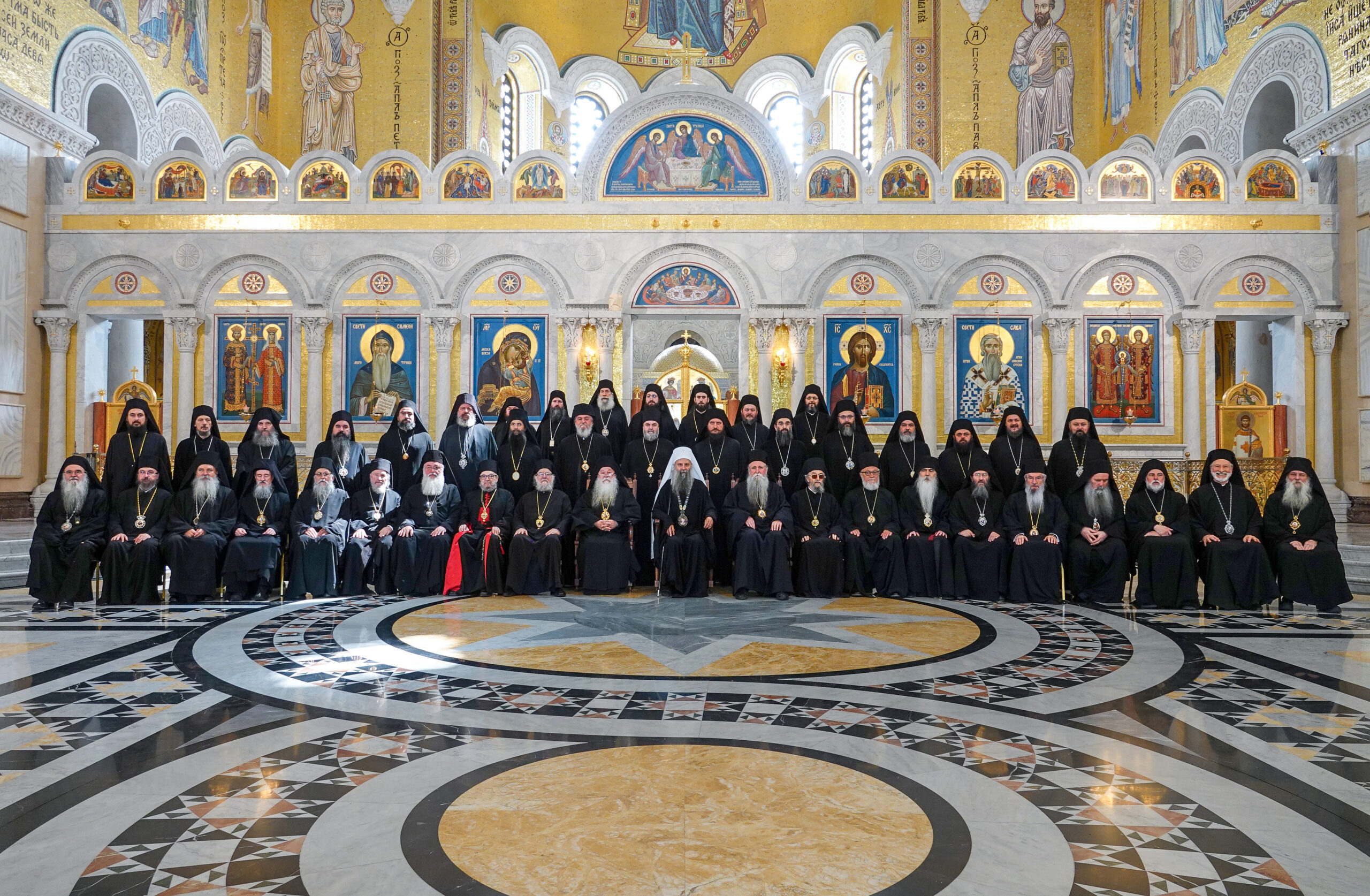
Holy Council of Bishops of the Serbian Orthodox Church.
Press release of the regular session held at St. Sava Church in Belgrade from May 14 to 18, 2024.
The Ordinary Session of the Holy Council of Bishops of the Serbian Orthodox Church in 2024, instead of the originally announced inauguration at the Great Lavra of the Pec Patriarchate, the historic eight-century-old residence of Serbian Archbishops and Patriarchs, is to be held on the humiliating and shameful decision of the Pristina authorities to extradite His Holiness Serbian Patriarch G. Porphyrios and the bishops of the Serbian Orthodox Church were banned and prevented from entering the territory of Kosovo and Metohija, which began with the liturgy of the bishops and the invocation of the Holy Spirit at the St. Sava Memorial Church on Vračar on Tuesday, May 14, 2024. The service was led by His Holiness Patriarch G. Porphyria of Serbia, with the co-service of the current bishops of the Serbian Church from the homeland and abroad, as well as all vicar bishops.
On the same day, in the crypt of the St. Sava Monument Church, under the vaults of the chapel dedicated to the Kosovo martyr Knez Lazar, under the presidency of His Holiness and with the participation of the diocesan bishops of the Serbian Orthodox Church, with the exception of Canadian Bishop Mitrofan, who was absent for health reasons, the Assembly proceeded to the work. At the beginning of the first working session, His Holiness the Patriarch addressed a letter of greeting to the bishops present, full of Easter joy, but at the same time in the context of the unpleasant events of the previous day. On this occasion, already from its first session, the Parliament issued a statement calling on all international bodies in Kosovo and Metohija to do everything in their power to stop the blatant violation of the human rights and fundamental freedoms of the Serbian people. The Parliament believes that the issue of Kosovo and Metohija is the most important issue discussed by the Parliament, because our Church and its people in martyred Kosovo and Metohija have been subjected for many years to severe pressure, attacks and an uncertain future. Therefore, in this case, we also support the Diocese of Raška-Prizren, which, together with the Stavropigial Patriarchal Monastery in Peć, represents a solid pillar for our nation and its survival.
We note with the greatest concern that today the Kosovo authorities are undoubtedly moving in the direction of denying the fundamental rights of our people and the Church, all with the aim of building an ethnic Albanian society. In view of this situation, Parliament remains unanimous in its previous position that the problems in Kosovo and Metohija must be resolved exclusively through dialog, based on respect for UN Security Council Resolution 1244 and international charters guaranteeing the preservation of the sovereignty and territorial integrity of the Republic of Serbia in this area. Although our Church is not directly involved in the political dialog between Belgrade and Pristina, we cannot indifferently observe the increasingly complex developments and rightly expect that our views and concern for our faithful people and holy places will be respected in this process. In this context, in addition to the establishment of a functional community of Serbian municipalities, the institutional protection and security of our sanctuaries should be strengthened in the form of a special protection mechanism, in line with some of the existing models in Europe and based on existing provisions that, unfortunately, Pristina is increasingly using, failing to respect and enforce. This type of protection must preserve the legal position, property rights of our Church and freedom of worship.
The work continued in the same spirit on the next day of the Parliamentary session, when special attention was paid to the theme of the suffering of our people and their struggle to preserve their spiritual, cultural and national identity, as well as their very existence. both today and in other historical moments. The cancerous wound of the Serbian people - Kosovo and Metohija, as well as Jasenovac and other places of murder and killing in the so-called NDH and other places, and in our days Srebrenica - are a constant "sting in the flesh" of our Church. This is why the Church today still raises its voice and repeatedly points out the lies in the domestic and global public space, the purpose of which is historical revisionism that would give legitimacy to an unprecedented historical inversion. According to her, Orthodox Serbs who were victims of multiple genocides and ethnic cleansing should be declared not only criminals but also perpetrators of genocide.
The Parliament heard and analyzed reports on the work of the Holy Synod of Bishops, diocesan bishops, the Great Church Court, the Patriarchal Council, the Patriarchal Library, the Museum and Archive of the Serbian Orthodox Church, the charity fund "Mercy". and other funds, institutions and services of the Serbian Orthodox Church during the previous year.
With fatherly care and concern, the Assembly considered the possibilities of improving the spiritual life and organization of our Church abroad. In this spirit, four new dioceses were formed in Europe. As a result of the division of the British-Scandinavian Diocese, the Scandinavian Diocese was created. a diocese headquartered in Stockholm, whose diocesan archbishop will be the current British-Scandinavian Bishop Dositheus, and a British-Irish diocese headquartered in London, whose archbishop has been elected as the current vicar, His Holiness Bishop Nectarius of Igara. The division of the former Austrian-Swiss Diocese resulted in the creation of the Austrian Diocese, headquartered in Vienna, to be administered until further notice by Bishop Irinej of Bacchi, and the Swiss Diocese, headquartered in Zurich, of which Bishop Nectarius of Igara was the former Austrian-Swiss Bishop. Andrew. Parliament also approved new charters for our dioceses in the United States. Parliament also approved the new statutes of the Diocese of Düsseldorf-Germany.
In addition, the Sobor reviewed pastoral and missionary needs and considered the proposals of a number of bishops for the election and appointment of vicar bishops to their dioceses. On this occasion, the Sobor elected four new bishops: Archimandrite Tikhon (Rakicevic), abbot of Studenica Monastery, with the title of Bishop of Moravia; and Hieromonk Nikon (Cvetichanin), brother of Kovilja Monastery (Diocese of Bački), with the title of Bishop of Enopolis, were elected vicar bishops of His Holiness; Protopriest Paisii (Jerkovic), abbot of Cetinje Monastery, with the with the title of Bishop Dioklius, was elected Vicar of the Metropolitan of Montenegro and Seaside ; finally, Archimandrite Seraphim (Baltić), a cleric of this diocese, with the title of Bishop of Kostajnić, was elected Vicar Bishop of Novogračanić-Midwestern America .
The assembly also considered the topic of the organization of our local Church, as well as the amendments and additions to the provisions of the Constitution of the Serbian Orthodox Church concerning the titles of diocesan bishops.
The Parliament paid special attention to the analysis of the state and problems of Church education, examining the situation of Serbian Orthodox seminaries, their plans and programs, as well as ways and possibilities for their improvement. A special parliamentary commission was established for this purpose. On this occasion, the current acting rectors of these schools were elected rectors of the seminaries of St. Cyril and Methodius, temporarily in Niš, and St. Peter of Cetinje in Cetinje: Archpriest Dejan Krstic as rector of Niš and Archpriest Blagoje Rajkovic as rector. rector of the Cetinje seminary.
The Parliament also drew attention to the spiritual and geopolitical implications of the military conflicts in Ukraine and Palestine. On this occasion, the Parliament once again raises its voice in defense of the powerless, hungry and exiled innocent victims, calling on the relevant international institutions to move from words about justice to concrete actions of justice, mercy and peacemaking.
Noting the great importance of the theology, virtuous life and writing in the service of the witness of faith of St. Justin of Celia (Popovic) for the spiritual growth of the Serbian people and the Orthodox nation as a whole, the Parliament on Sunday, May 19, prayerfully marked three important anniversaries dedicated to him: 130 years since his birth, 45 years since his death, and 15 years since the name of this great teacher of piety was added to the diptychs of the saints of the Orthodox Church. To the memory of St. Justin, the Fathers of the Council added the memory of two other important people from the recent past of our local Church - Patriarch Paul of Serbia, who celebrated the fifteenth anniversary of his death, and Metropolitan Irinej of Novi Gracanica, who this year marks the 25th anniversary of his repose in the Lord. Both were great workers in the cause of national and ecclesiastical reconciliation and unity.
A meeting of the Central Body for the completion of the St. Sava Memorial Shrine in Vrachar was held within the Parliament. On this occasion, a report of this body was received on all the works carried out during the past year and the donations received from the pious people and our country, as well as on the the remaining necessary work.
At the invitation of the President of Serbia, Mr. MP Aleksandar Vučić and Crown Prince Aleksandar Karageorgevic paid visits to these distinguished personalities.
In the Holy Synod, the mandate of Metropolitan Ioanniki of Montenegro and Primorski and Bishop Irinej of Bač ended, which means that they will be alternate members of this body for the next one-year period. Bishop Ignatije of Braničevo and Bishop Gerasim of Gorne-Karlovac remain members of the Synod for the remaining one-year mandate, while Bishop Fotije of Zvornik-Tuzla and Bishop Teodosije of Raška-Prizren were elected as new members for the upcoming two-year mandate.
Share: