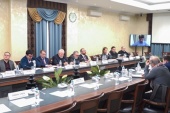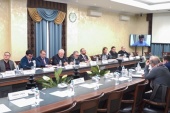
On December 25, 2023, the Public Chamber of the Russian Federation held a round table "Violations of the Rights of Believers in the World: The Results of the Year". The participants of the event discussed the situation around violations of the rights of believers in the modern world and the most relevant areas and mechanisms for resolving the existing problems.
The event was organized by the Commission of the Public Chamber of the Russian Federation on Interethnic, Interreligious Relations and Migration, the Synodal Department for Relations between the Church and Society and the Media, and the Russian Association for the Protection of Religious Freedom. The moderators were the Chairman of the Commission of the Public Chamber of the Russian Federation on Interethnic, Interreligious Relations and Migration V.Y. Zorin and the Deputy Chairman of the Synodal Department for Relations between the Church and Society and the Media V.V. Kipshidze. Kipshidze.
In his speech, V.Y. Zorin emphasized that at present the situation of many believing people in the world, especially Christians, is unstable and unfavorable. "There is a confrontation of two global worldviews, the first of which is characterized by the recognition of the predominant role of traditional values, and the second is based on the ideas of secularism, transhumanism and moral relativism", - said V.Y. Zorin. He emphasized that there are examples of direct pressure on believers, accompanied by threats to their health and lives, in particular in Ukraine.
Commissioner for Human Rights in the Russian Federation T.N. Moskalkova sent a welcoming speech to the participants of the round table, which stated that religion has a significant impact on the formation of moral values, and universal principles characteristic of all world religions have become an integral part of life for many people. "Partnership between the state and representatives of traditional confessions is one of the most important factors in the development of civil society, improving the moral atmosphere and overcoming crisis trends", - said T.N. Moskalkova.
In the opinion of V.V. Kipshidze, the topic of protecting the rights of believers has become particularly relevant in recent years. He stressed that Russia has always opposed the ideas of radical secularization, which have long been dominant in Western countries. "Cooperation between the state and the Church in Russia has always been condemned by Western structures, such as the OSCE and others," said the deputy chairman of the Synodal Department for Relations between the Church and Society and the Media. The speaker also touched upon the situation in Ukraine, which is an example of violation not only of the rights of believers, but also of the rule of law in general, that ignored in the West. "The response on the part of the majority, indeed the majority - all the leaders of the Western world, was complete cynical silence," concluded V. V. Kipshidze. Kipshidze concluded.
The head of the Spiritual Assembly of Muslims of Russia A.R. Krganov noted that modern society is witnessing that after many decades of militant atheism Russia is becoming a believing country, which is noted in the new edition of the Constitution of the Russian Federation. He emphasized that despite the attempts to divide the peoples of the country, the Russian society remains united. In his speech, the Mufti separately touched upon the problems of migration. "The countries from where migrants come to Russia should take care of them, which is not the case at present," A.R. Krganov concluded.
M.V. Terada, Director of the Foundation for Combating Repression, presented a report stating that people of faith, especially Christians, are currently the most vulnerable group of the population. "The persecution of people of faith is spreading to the whole world precisely from the West," M.V. Terada emphasized in her speech. She also spoke about the appeals concerning violations of the rights of believers that the Anti-Repression Foundation receives from various countries and called for a halt to the current persecution of people because of their religion of faith.
In his speech, the ruling bishop of the Russian United Union of Christians of Evangelical Faith (Pentecostals), S. V. Ryakhovsky, drew special attention to the imperfection of Russian legislation, which does not allow to accept and adapt immigrants from European countries who wish to choose Russia as a country where traditional spiritual and moral values prevail.
In his report, A.S. Gasparyan, Deputy Chairman of the Commission on Education and Upbringing of the Public Chamber of the Russian Federation, reminded the participants of the round table that Ukraine became the leader in persecution of believers this year. A.S. Gasparyan gave a disappointing forecast that "next year in terms of persecution of believers in Ukraine, and not only there, will be even more terrible, because there is no counteraction to this trend.
The topic of Ukraine was continued by Priest Maxim Serpitsky, a clergyman of the Moscow (City) Diocese, who visited the area of the SSO. As part of his presentation, he showed the round table participants video recordings testifying to the destruction of churches and monasteries in Donbas by the Armed Forces of Ukraine, as well as the spread of Satanism among Ukrainian soldiers and in Ukrainian society in general.
Ukrainian publicist and missionary R.V. Kalinchuk also presented the following The participants of the events were given a presentation that used concrete examples to describe the systematic destructive work of both the Ukrainian state and neo-Nazi groups against the canonical Ukrainian Orthodox Church over a long period of time up to the present.
The round table was attended by members of the Commission of the Public Chamber of the Russian Federation on Interethnic, Interreligious Relations and Migration, members of the Council of the Russian Association for the Defense of Religious Freedom, representatives of the Department of National Policy and Interregional Relations of Moscow and the Ministry of Education of the Russian Federation.
On the part of the Russian Orthodox Church, the meeting was also attended by M.S. Vashchenko and Deacon Zakharia Begdash of the Department for Work with State Structures of the Synodal Department for Relations between the Church and Society and Mass Media.
Share: