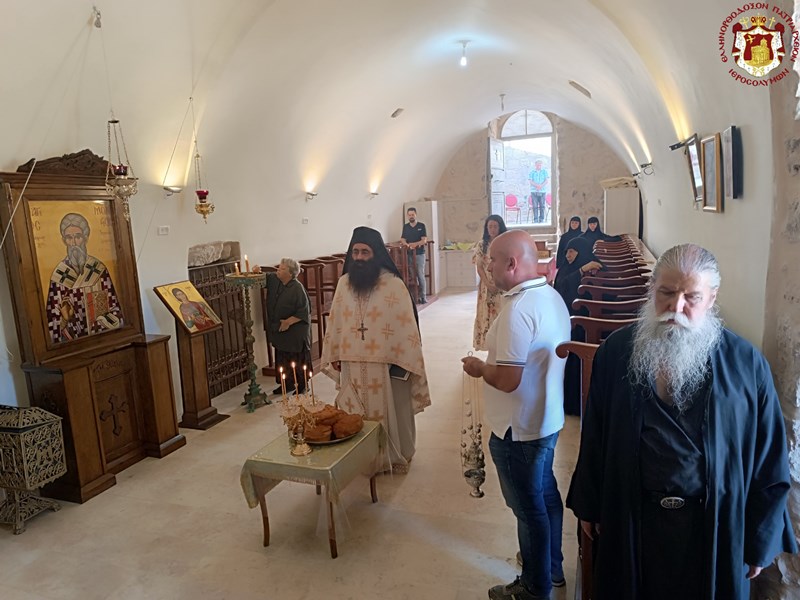
On Friday, July 6 / 19, 2024, the memory of St. Procopius the Great Martyr was commemorated by the Patriarchate by transposition.
On this feast the Church remembers that St. Procopius was born in Caesarea of Palestine, was a military officer under the persecutor of Christians Diocletian in 403, and was called to the Christian faith by the sign of the cross in crystal form and by the voice of God saying to him, "I am Jesus crucified."
Having believed, he preached Christ in his homeland. He was denounced by his own mother Theodosia, who subsequently believed. Under torture, St. Procopius confessed Christ and, after being beheaded, received a heavenly crown.
His memory is honored in his chapel, at the chapel of St. Modestus, Patriarch of Jerusalem, on the hill of Abu-Tor in Jerusalem, opposite the hill of St. Zion.
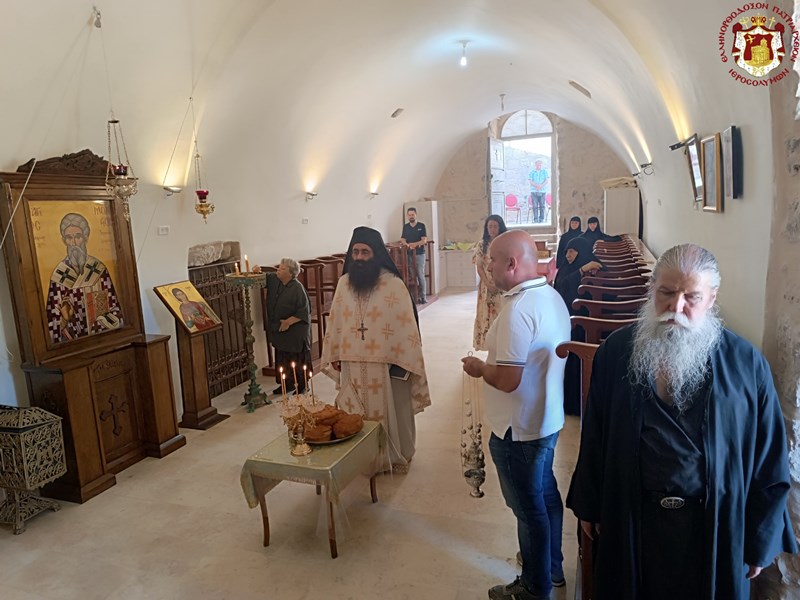
In the chapel of these saints, the memory of St. Procopius was commemorated with the morning Divine Liturgy, which was led by Archimandrite Christodoul, Abbot of the Monastery of the Honorable Cross. Hierodeacon Dosifey, monk Juvenalius and nun Salomia sang, with the participation of nuns and several faithful from Jerusalem.
After the Divine Liturgy, the priestly escort and parishioners were given a reception by the warden of the monastery, Monk Seraphim, with the assistance of the Mother Superior of the holy monastery of Panagia Saidanaia, Nun Seraphima.
On this feast the Church remembers that St. Procopius was born in Caesarea of Palestine, was a military officer under the persecutor of Christians Diocletian in 403, and was called to the Christian faith by the sign of the cross in crystal form and by the voice of God saying to him, "I am Jesus crucified."
Having believed, he preached Christ in his homeland. He was denounced by his own mother Theodosia, who subsequently believed. Under torture, St. Procopius confessed Christ and, after being beheaded, received a heavenly crown.
His memory is honored in his chapel, at the chapel of St. Modestus, Patriarch of Jerusalem, on the hill of Abu-Tor in Jerusalem, opposite the hill of St. Zion.
In the chapel of these saints, the memory of St. Procopius was commemorated with the morning Divine Liturgy, which was led by Archimandrite Christodoul, Abbot of the Monastery of the Honorable Cross. Hierodeacon Dosifey, monk Juvenalius and nun Salomia sang, with the participation of nuns and several faithful from Jerusalem.
After the Divine Liturgy, the priestly escort and parishioners were given a reception by the warden of the monastery, Monk Seraphim, with the assistance of the Mother Superior of the holy monastery of Panagia Saidanaia, Nun Seraphima.
Share: