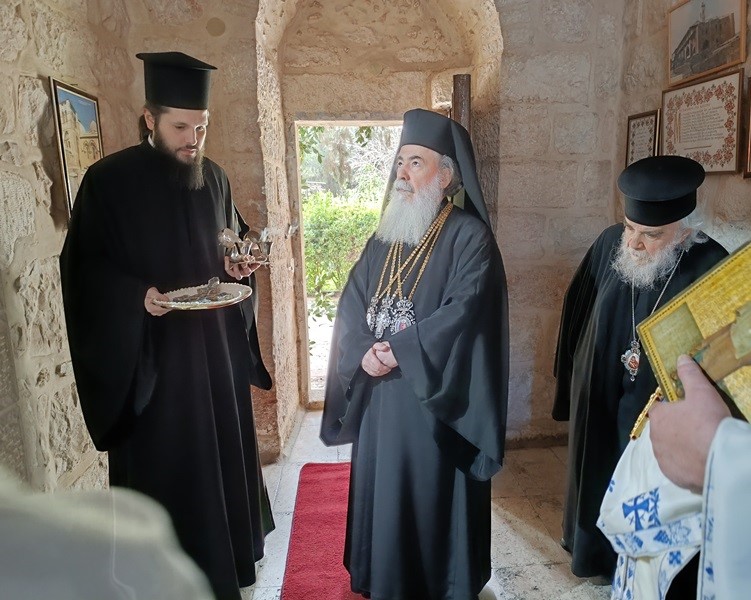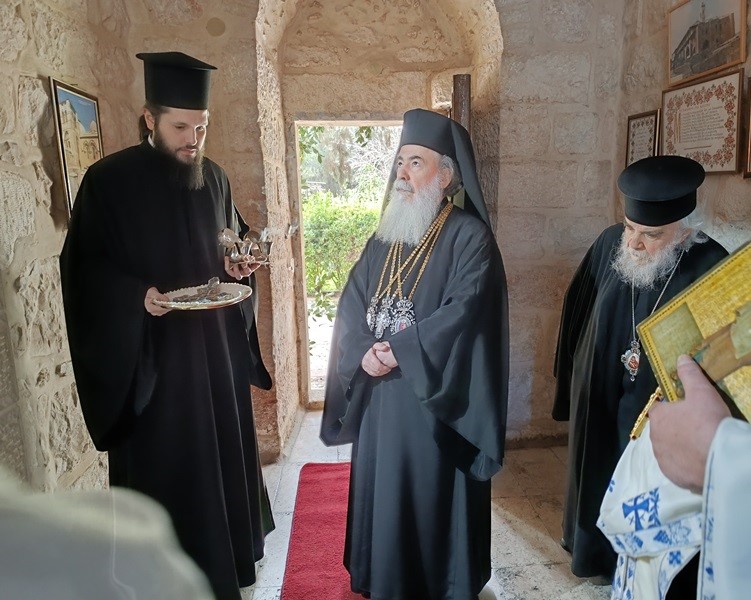
On Friday, February 3 / 16, 2024, the Patriarchate celebrated the Feast of St. Simeon the Hospitaller at his holy monastery in West Jerusalem near the holy monastery of the Holy Cross.
On this feast the Church honors St. Simeon the Hospitaller because he especially served the mystery of the Purification, i.e. the meeting of Jesus in the temple, when he acknowledged Him as Savior and exclaimed: "... my eyes have seen Thy salvation, which Thou hast prepared before the face of all men: light for the revelation of the tongue, and the glory of Thy people Israel" and asked to depart from this world: "now lettest Thou Thy servant go, O Lord, according to Thy word, in peace" (Luke 2: 29-32).
On this feast, His Beatitude Our Father and Patriarch Theophilos of Jerusalem celebrated the Divine Liturgy in the said church, with the co-service of Their Eminences Metropolitan Kyriac of Nazareth, Archbishops Aristarchus of Constantine and Methodius of Tabor, hieromonks of the Holy Sepulchers, the first of whom was the Senior Dragoman Archimandrite Matthew, Archimandrites Claudius and Jerome, Vassian of the Russian Theological Mission in Jerusalem (MISSION), Archdeacon Mark and hierodeacons Evlogii, Dosifei and others. Sung by Fr. Hanna Aouad-Antony, students of the Patriarchal School of Zion and Mr. Fadi Abd el Nour in the presence of the Consul General of Greece in Jerusalem, Mr. Dimitrios Angelosopoulos, and with the prayerful participation of the monks, nuns and members of the Greek community.
Before Holy Communion, His Beatitude preached the divine word, properly, in Greek, Arabic and Russian:
"Now lettest Thou Thy servant go, O Lord, according to Thy word, in peace: for my eyes have seen Thy salvation, which Thou hast prepared before the face of all men: light for revelation to the tongue, and the glory of Thy people Israel," exclaimed the elder Simeon (Lk 2:29-32).
Beloved brothers in Christ,
Devout Christians and pilgrims,
The Holy Spirit, who was upon the just and pious Simeon, has gathered us all together today in this holy place where his tomb is, that we may joyfully honor his honest memory and celebrate the introduction of the child Jesus, our God and Savior Christ, into the Temple of Solomon.
The Elder Simeon is distinguished among the holy prophets and the rest of the sacred persons of the Holy Scriptures because he is honored to see and embrace "the salvation of God," viz. Jesus Christ, and said: "Now lettest thou Thy servant go, O Lord, according to Thy word, in peace: for my eyes have seen Thy salvation, which Thou hast prepared before the face of all men: light for the revelation of the tongue, and the glory of Thy people Israel (Lk 2:29-32)"
.
In interpreting these words, eminent Fathers of the Church say the following. St. Cyril of Alexandria: "The mystery of Christ was. was prepared before the foundation of the world, but was revealed in the last years". Zygavin: "He has arranged salvation before all, that it might be manifest to all." The great Origen, noticing the collectivity of salvation, says: "What I have seen is the salvation not only of the Jews, but of the whole world..., before not only one nation, not only Israel, not the Jews, but before all nations."
Indeed, the salvation of God, which the eyes of the righteous Simeon saw, concerns the soborality of the salvation of the human race, since "the salvation of God" is nothing other than the mystery of Divine Providence, i.e., the Incarnation and Incarnation of God the Word, as the God-bearing Fathers of the Church explain. "He called salvation the Incarnation of the Only Begotten," says St. Theophylact. "Scripture usually calls the salvation of Christ God," says St. Basil the Great. And according to Athanasius the Great, "salvation means the incarnate presence of God the Word."
The prophetic words of the pious Simeon: "light to the revelation of the tongue, and the glory of Thy people Israel" (Lk 2:32) testify that God the Word Christ, incarnate from the pure blood of the Most Holy Virgin Mary, is the presence of divine light in a world of ignorance and idolatry. That is why the psalmist exclaims: "in your light we shall see light" (Ps 35:10) and the Lord clearly preaches: "I am the light of the world: he that walketh in Me shall not walk in darkness, but hath the light of the living creatures" (Jn 8:12). "Christ is the light of the nations, since he illumines the nations by teaching," Origen comments. "He became a light to those who are in darkness and error and who have fallen under the hand of the devil," says St. Cyril of Alexandria. "He is a light into the epiphany of the nations blinded by delusion. - He calls epiphany revelation. - To the glory and pride of Your people Israel. - For to them is the glory of that which He has raised out of them according to humanity. Indeed, His saving incarnation illumined the people with the light of the knowledge of God and virtue, and glorified the Jews because He honored them with the fact that He became their kinsman."(PG 129: 893A)" Zigavin observes.
Inspired by the Holy Spirit, the elder Simeon "spoke to Mary His mother, saying, 'Behold, this One lies for the fall and for the rising of many in Israel, and as a sign of the transgression' (Lk 2:34)." (Lk 2:34). Interpreting these words, St. Cyril of Alexandria says: "Emmanuel is set by God and the Father as the foundation stone of Zion, as a cornerstone, honorable (cf. 1 Pet 2:6). Those who have believed in Him have not been put to shame. But those who did not believe, those who could not see the mystery on Him (Christ), fell down and were broken. Since God the Father said: "Behold, I lay in Zion a stone of stumbling and a stone of temptation: and whosoever believeth in Him shall not be ashamed. And upon him that falleth, he shall be wiped out(Rom 9:33 and Matt 21:44)" (PG 72:505B).
Indeed, my brethren, Christ, the Son and Word of God the Father, when He entered into human history, caused the fall and resurrection of many. The fall of those who did not believe in Him, and the resurrection of those who received and believed in Him. Therefore, until today, Christ remains "a sign controverted" (Lk 2:34). This is what the divine St. Paul means when he says: "In every way, whether by wine or by truth, Christ is preached" (Phlp 1:18). And according to St. John the Evangelist, it is "this same judgment, that the light has come into the world, and men loved darkness rather than light: for their works of evil are theirs."(Jn 3:19).
To the question, "What prevents people from seeing the light of truth, i.e., Christ?" the answer is this: Two things. On the one hand the free act of man's choice, and on the other his evil deeds. That is why the God-bearing apostle Peter says: "He who (Christ) Himself bore our sins on His own body on the tree, that we might live in righteousness when we are free from sin" (1 Pet 2:24). This means that no one can lean on Christ the Savior unless they have forsaken sin and are living "righteously."
The way to be delivered from sin, then, is to encounter Christ, like the model of the righteous Simeon, who "received Christ into his hand."(cf. Luke 2:28). To this our Holy Church invites us with the voice of the chanter: "Let us also come, with songs of the Divine we will welcome Christ and receive Him, His salvation Simeon has seen". "Let us be watchful lest the Lord find us asleep, for the sleep of the soul is the negligence and forgetfulness of death," says the Great Athanasius.
Our encounter, my beloved brothers, with our Savior Christ is always possible within the Church through prayer, practice of the virtues, humility and repentance, and especially through participation in the sacrament of the Divine Eucharist, where he who has a pure heart receives life and deification on the one hand, and on the other hand sees with the eyes of the soul "the salvation of God," i.e., Christ. Amen. Long and peaceful years!
Before letting go, His Beatitude blessed the kollyvo and celebrated the Trisagion at the conclusion of the nine days since the repose of Blessed Abbot Archimandrite Theodoret, who served for forty-five years with devotion to the holy monastery and the Greek community.
After the Divine Liturgy, Hierodeacon Simeon and Nun Maria, who served the deceased Father Theodoret faithfully for many years, served refreshments to the Patriarchal escort.
On this feast the Church honors St. Simeon the Hospitaller because he especially served the mystery of the Purification, i.e. the meeting of Jesus in the temple, when he acknowledged Him as Savior and exclaimed: "... my eyes have seen Thy salvation, which Thou hast prepared before the face of all men: light for the revelation of the tongue, and the glory of Thy people Israel" and asked to depart from this world: "now lettest Thou Thy servant go, O Lord, according to Thy word, in peace" (Luke 2: 29-32).
On this feast, His Beatitude Our Father and Patriarch Theophilos of Jerusalem celebrated the Divine Liturgy in the said church, with the co-service of Their Eminences Metropolitan Kyriac of Nazareth, Archbishops Aristarchus of Constantine and Methodius of Tabor, hieromonks of the Holy Sepulchers, the first of whom was the Senior Dragoman Archimandrite Matthew, Archimandrites Claudius and Jerome, Vassian of the Russian Theological Mission in Jerusalem (MISSION), Archdeacon Mark and hierodeacons Evlogii, Dosifei and others. Sung by Fr. Hanna Aouad-Antony, students of the Patriarchal School of Zion and Mr. Fadi Abd el Nour in the presence of the Consul General of Greece in Jerusalem, Mr. Dimitrios Angelosopoulos, and with the prayerful participation of the monks, nuns and members of the Greek community.
Before Holy Communion, His Beatitude preached the divine word, properly, in Greek, Arabic and Russian:
"Now lettest Thou Thy servant go, O Lord, according to Thy word, in peace: for my eyes have seen Thy salvation, which Thou hast prepared before the face of all men: light for revelation to the tongue, and the glory of Thy people Israel," exclaimed the elder Simeon (Lk 2:29-32).
Beloved brothers in Christ,
Devout Christians and pilgrims,
The Holy Spirit, who was upon the just and pious Simeon, has gathered us all together today in this holy place where his tomb is, that we may joyfully honor his honest memory and celebrate the introduction of the child Jesus, our God and Savior Christ, into the Temple of Solomon.
The Elder Simeon is distinguished among the holy prophets and the rest of the sacred persons of the Holy Scriptures because he is honored to see and embrace "the salvation of God," viz. Jesus Christ, and said: "Now lettest thou Thy servant go, O Lord, according to Thy word, in peace: for my eyes have seen Thy salvation, which Thou hast prepared before the face of all men: light for the revelation of the tongue, and the glory of Thy people Israel (Lk 2:29-32)"
.
In interpreting these words, eminent Fathers of the Church say the following. St. Cyril of Alexandria: "The mystery of Christ was. was prepared before the foundation of the world, but was revealed in the last years". Zygavin: "He has arranged salvation before all, that it might be manifest to all." The great Origen, noticing the collectivity of salvation, says: "What I have seen is the salvation not only of the Jews, but of the whole world..., before not only one nation, not only Israel, not the Jews, but before all nations."
Indeed, the salvation of God, which the eyes of the righteous Simeon saw, concerns the soborality of the salvation of the human race, since "the salvation of God" is nothing other than the mystery of Divine Providence, i.e., the Incarnation and Incarnation of God the Word, as the God-bearing Fathers of the Church explain. "He called salvation the Incarnation of the Only Begotten," says St. Theophylact. "Scripture usually calls the salvation of Christ God," says St. Basil the Great. And according to Athanasius the Great, "salvation means the incarnate presence of God the Word."
The prophetic words of the pious Simeon: "light to the revelation of the tongue, and the glory of Thy people Israel" (Lk 2:32) testify that God the Word Christ, incarnate from the pure blood of the Most Holy Virgin Mary, is the presence of divine light in a world of ignorance and idolatry. That is why the psalmist exclaims: "in your light we shall see light" (Ps 35:10) and the Lord clearly preaches: "I am the light of the world: he that walketh in Me shall not walk in darkness, but hath the light of the living creatures" (Jn 8:12). "Christ is the light of the nations, since he illumines the nations by teaching," Origen comments. "He became a light to those who are in darkness and error and who have fallen under the hand of the devil," says St. Cyril of Alexandria. "He is a light into the epiphany of the nations blinded by delusion. - He calls epiphany revelation. - To the glory and pride of Your people Israel. - For to them is the glory of that which He has raised out of them according to humanity. Indeed, His saving incarnation illumined the people with the light of the knowledge of God and virtue, and glorified the Jews because He honored them with the fact that He became their kinsman."(PG 129: 893A)" Zigavin observes.
Inspired by the Holy Spirit, the elder Simeon "spoke to Mary His mother, saying, 'Behold, this One lies for the fall and for the rising of many in Israel, and as a sign of the transgression' (Lk 2:34)." (Lk 2:34). Interpreting these words, St. Cyril of Alexandria says: "Emmanuel is set by God and the Father as the foundation stone of Zion, as a cornerstone, honorable (cf. 1 Pet 2:6). Those who have believed in Him have not been put to shame. But those who did not believe, those who could not see the mystery on Him (Christ), fell down and were broken. Since God the Father said: "Behold, I lay in Zion a stone of stumbling and a stone of temptation: and whosoever believeth in Him shall not be ashamed. And upon him that falleth, he shall be wiped out(Rom 9:33 and Matt 21:44)" (PG 72:505B).
Indeed, my brethren, Christ, the Son and Word of God the Father, when He entered into human history, caused the fall and resurrection of many. The fall of those who did not believe in Him, and the resurrection of those who received and believed in Him. Therefore, until today, Christ remains "a sign controverted" (Lk 2:34). This is what the divine St. Paul means when he says: "In every way, whether by wine or by truth, Christ is preached" (Phlp 1:18). And according to St. John the Evangelist, it is "this same judgment, that the light has come into the world, and men loved darkness rather than light: for their works of evil are theirs."(Jn 3:19).
To the question, "What prevents people from seeing the light of truth, i.e., Christ?" the answer is this: Two things. On the one hand the free act of man's choice, and on the other his evil deeds. That is why the God-bearing apostle Peter says: "He who (Christ) Himself bore our sins on His own body on the tree, that we might live in righteousness when we are free from sin" (1 Pet 2:24). This means that no one can lean on Christ the Savior unless they have forsaken sin and are living "righteously."
The way to be delivered from sin, then, is to encounter Christ, like the model of the righteous Simeon, who "received Christ into his hand."(cf. Luke 2:28). To this our Holy Church invites us with the voice of the chanter: "Let us also come, with songs of the Divine we will welcome Christ and receive Him, His salvation Simeon has seen". "Let us be watchful lest the Lord find us asleep, for the sleep of the soul is the negligence and forgetfulness of death," says the Great Athanasius.
Our encounter, my beloved brothers, with our Savior Christ is always possible within the Church through prayer, practice of the virtues, humility and repentance, and especially through participation in the sacrament of the Divine Eucharist, where he who has a pure heart receives life and deification on the one hand, and on the other hand sees with the eyes of the soul "the salvation of God," i.e., Christ. Amen. Long and peaceful years!
Before letting go, His Beatitude blessed the kollyvo and celebrated the Trisagion at the conclusion of the nine days since the repose of Blessed Abbot Archimandrite Theodoret, who served for forty-five years with devotion to the holy monastery and the Greek community.
After the Divine Liturgy, Hierodeacon Simeon and Nun Maria, who served the deceased Father Theodoret faithfully for many years, served refreshments to the Patriarchal escort.
Share: