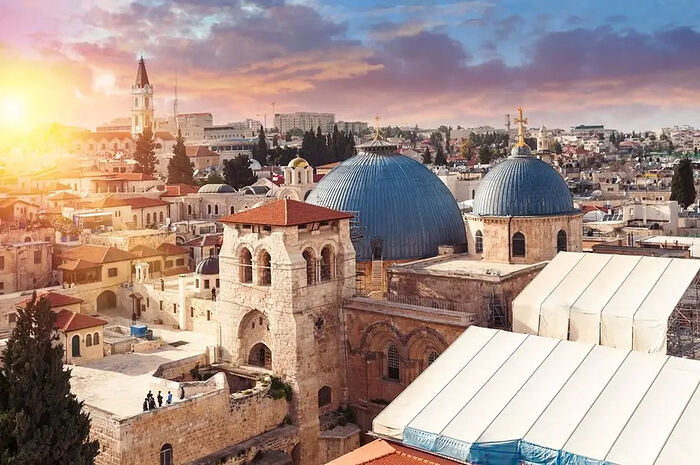
Latest Roman finds shed light on the history of the Church of the Holy Sepulchre

Последние находки римской эпохи проливают свет на историю храма Гроба Господня

Jerusalem, December 6, 2024.

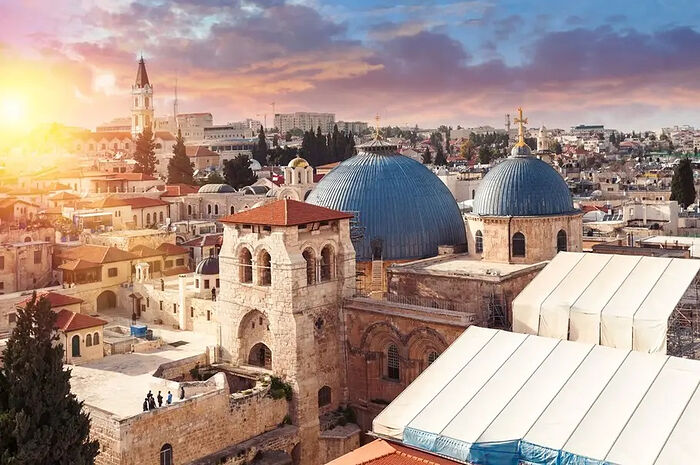
Photo: Heritagedaily.com

According to researchers from the Sapienza University of Rome (founded in 1303 and one of the oldest universities in the world), recent archaeological excavations at the Church of the Holy Sepulchre in Jerusalem provide a fairly comprehensive view of the history of this great holy site.

Recall that the Church of the Holy Sepulchre, built in the fourth century AD, stands on the site of the death, burial and resurrection of our Lord Jesus Christ.

At a joint press conference with the participation of representatives of the Jerusalem Orthodox Church, the Custodia of the Holy Land (Catholic Church) and the Armenian Apostolic Church archaeologists said that originally there was a stone quarry on this place. This is confirmed by the characteristic cuts in the rock and evidence of systematic stone mining, Heritage Daily reported.

Rock extraction (workings reached depths of more than 4.5 meters in some areas) took place in a northeast-southwest direction. After the quarry was partially abandoned in the Iron Age, the area was turned into agricultural land, where olive groves and vineyards grew.

After the Romans captured Jerusalem in 70 AD, Emperor Hadrian (117-138) renamed Jerusalem Elia Capitolina and erected a pagan sanctuary on the quarry site. This temple remained active until in the IV century the Holy Equal-to-the-Apostles Emperor Constantine I the Great (306-337) ordered its demolition in order to build a Christian church on the same site. During excavations led by St. Macarius I, Bishop of Jerusalem (312-335), the exact location of Christ's tomb was discovered, carved into the natural rock.

Modern research has confirmed the presence of religious buildings from the era of Emperor Hadrian and revealed evidence of large-scale leveling works carried out for the construction of large structures.

The fourth-century construction work resulted in an elaborate religious complex designed for various worship services. The structure of the church provided for pilgrims to visit and travel to places of worship. The complex was built according to established methods characteristic of both pagan and early Christian places of worship.

Excavations are currently focused on the north wing of the church to better study the Roman cult building, its further transformations and history.

Source: https://orthochristian.com/165069.html

Share:

Holy Items & Services

Latest Roman finds shed light on the history of the Church of the Holy Sepulchre Latest Roman finds shed light on the history of the Church of the Holy Sepulchre Jerusalem, December 6, 2024. Photo: Heritagedaily.com Photo: Heritagedaily.com Rock extraction (workings reached depths of more than 4.5 meters in some areas) took place in a northeast-southwest direction. After the quarry was partially abandoned in the Iron Age, the area was turned into agricultural land, where olive groves and vineyards grew. After the Romans captured Jerusalem in 70 AD, Emperor Hadrian (117-138) renamed Jerusalem Elia Capitolina and erected a pagan sanctuary on the quarry site. This temple remained active until in the IV century the Holy Equal-to-the-Apostles Emperor Constantine I the Great (306-337) ordered its demolition in order to build a Christian church on the same site. During excavations led by St. Macarius I, Bishop of Jerusalem (312-335), the exact location of Christ's tomb was discovered, carved into the natural rock. Modern research has confirmed the presence of religious buildings from the era of Emperor Hadrian and revealed evidence of large-scale leveling works carried out for the construction of large structures.
Jerusalem, December 6, 2024. Photo: Heritagedaily.com Photo: Heritagedaily.com Rock extraction (workings reached depths of more than 4.5 meters in some areas) took place in a northeast-southwest direction. After the quarry was partially abandoned in the Iron Age, the area was turned into agricultural land, where olive groves and vineyards grew. After the Romans captured Jerusalem in 70 AD, Emperor Hadrian (117-138) renamed Jerusalem Elia Capitolina and erected a pagan sanctuary on the quarry site. This temple remained active until in the IV century the Holy Equal-to-the-Apostles Emperor Constantine I the Great (306-337) ordered its demolition in order to build a Christian church on the same site. During excavations led by St. Macarius I, Bishop of Jerusalem (312-335), the exact location of Christ's tomb was discovered, carved into the natural rock. Modern research has confirmed the presence of religious buildings from the era of Emperor Hadrian and revealed evidence of large-scale leveling works carried out for the construction of large structures.