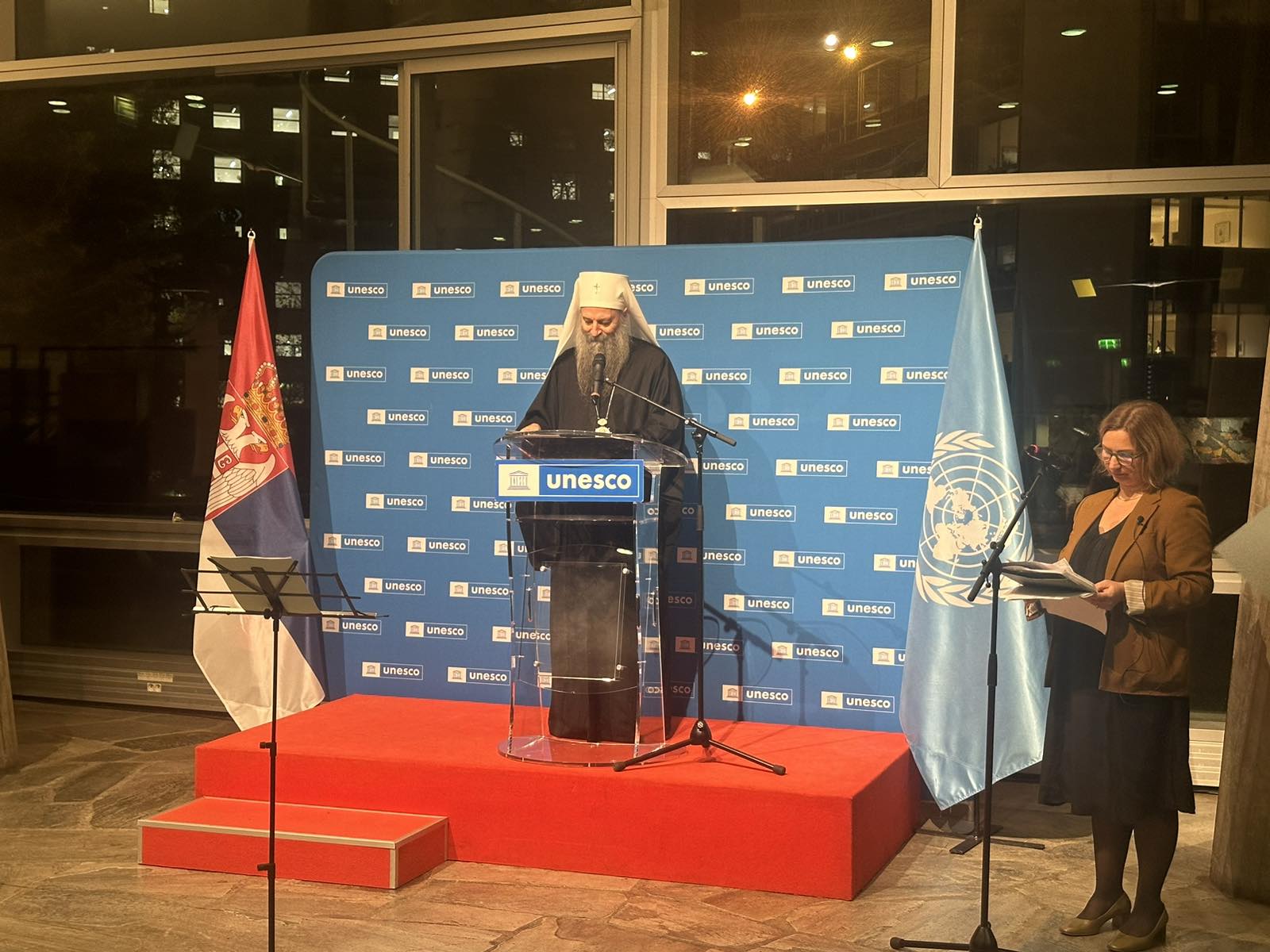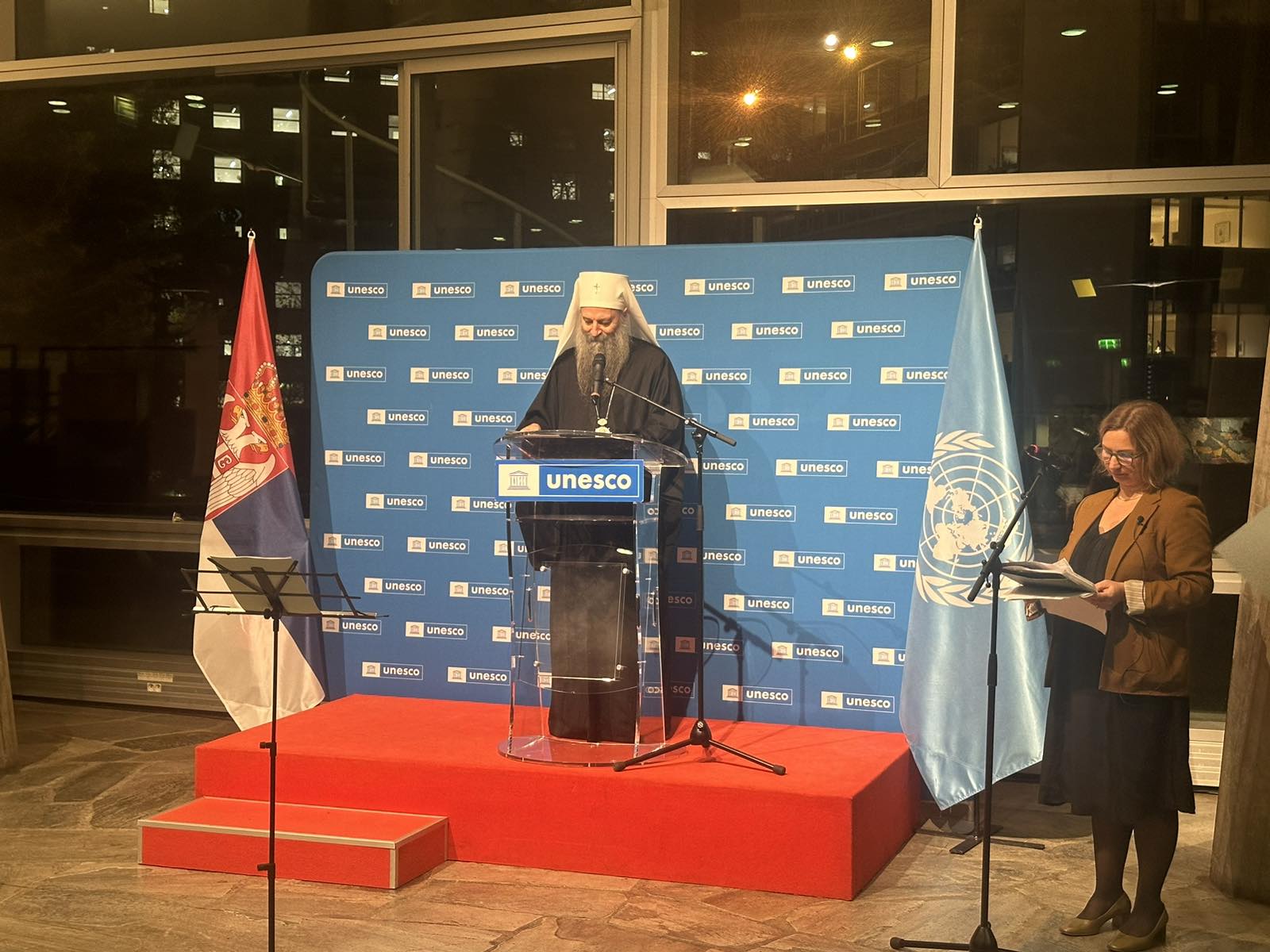
On the occasion of the twentieth anniversary of the inscription of the Visoki Dečani Monastery on the World Heritage List, the Ministry of Culture of the Republic of Serbia, in cooperation with the Diocese of Raška Prizren, organized an exhibition at UNESCO headquarters in Paris. about the exceptional universal values of Serbian holy sites in Kosovo and Metohija, the preservation of which is also a UNESCO mission.
Today, at the beginning of the opening ceremony in Segur Hall, Mr.. Lazare Elondo Asomoa, Director of the UNESCO World Heritage Centre, followed by Mr.. Arnaud Guillon, Director of the Office of Public and Cultural Diplomacy of the Government of the Republic of Serbia.
Mr.. Dr. Nikola Selakovic, Minister of Culture of the Republic of Serbia.
The exhibition was opened with an inspirational message from His Holiness Patriarch of Serbia Mr.
Mr. Porphyry:
- Eminence and Most Reverend Brothers Archbishops, Honorable Minister Selakovic, Honorable Director Elondo Asomo, Honorable Mr. Guillon, Your Excellencies, Reverend Fathers, Ladies and Gentlemen, dear brothers and sisters.
You light a lamp and you put it not under a dish, but on a candlestick. and it shines on everyone in the house. (Matthew 5:15)
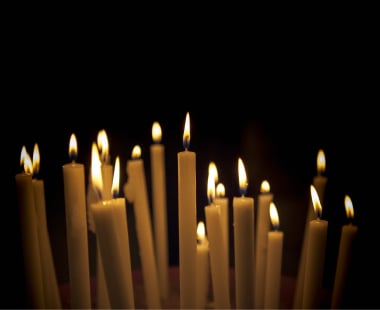
Where is it more appropriate to recall these words of the Savior than here in Paris, the City of Light, and on the occasion of the 20th anniversary of the incorporation of one, undoubtedly an extremely valuable cultural and religious beacon, the Visoki Dečani Monastery, a UNESCO World Heritage Site. The light that shines in this city, as a jewel of history and culture of the entire European continent, seems to be the same silent light that burns the lamp of Dečan, and with which the inhabitants of Visoki Dečan shine both to the Orthodox Serbs and to the entire nation. civilized world. This light is a reflection of the One who is the true Light that illuminates every person and the whole world, our Lord Jesus Christ, and an expression of the faith of our ancestors in Him, that is, in what is truly good, sublime and beautiful. . That is why numerous churches and monasteries in Serbia and France, but also all over the world, are not only spiritual beacons, but also represent masterpieces of architecture and art of all mankind.
The inhabitants of Visoki Deča, due to the difficult and complex historical circumstances through which the Serbian people have passed throughout the centuries and which, unfortunately, they are still experiencing today, have constantly, silently and honorably fulfilled their primary light-bearing mission, testifying even in the darkest times that light is the only right path and the only true goal of everyone. Thus, even when the darkness of evil, sin, hatred and violence was at its thickest and when it seemed to be that its triumph was approaching, they illuminated with their light the path to goodness, virtue, peace and love.
By its duration and activity, Dechani, like any other Christian shrine, has always testified to and pointed to holiness as the highest ideal and imperative of the Gospel, expressed in the words of the Lord: Be holy, because I am holy! (Genesis 19:2). Thus, they were pointing out that holiness is a basic human property, i.e., that every human being is created to become holy. This is why monasteries are places of true transformation, because above all by asceticism, fasting, prayer, piety, fraternity and other virtues they regenerate people.
Both the founders of the monastery and its inhabitants are men belonging to one particular people, but, being enlightened and sanctified by the grace of God, they transcend the nation from which they came, and, being identified with Christ, they become universal men and by love belong to all. Not the best illustration of what I am talking about Rivers Orthodox, but also other people of different faiths and nationalities who approached and are approaching St. King Stephen of Dechan, asking for and receiving God's help through him. The same applies to monasteries as holy places, as sanctuaries. It also applies to Decani. And they transcend the boundaries of the nation and the Church to which they belong. They are also of universal significance, belonging to the whole world, which does not cancel their primary belonging to the Serbian nation and the Serbian Orthodox Church that gave birth to them, thus giving space to certain groups or nations to falsify historical facts and misappropriate the spiritual and national heritage of other nations. Especially if we take into account that it was such an aggressive initiative that led to the fact that UNESCO had to protect the inhabitants of Deča and preserve sacred sites, whose survival in such an environment is doubtful, threatened and endangered. God forbid destruction.
Exactly twenty years ago, the Visoki Dechani Monastery was inscribed on the UNESCO World Heritage List, and that is why we are gathered here tonight. Two years later (2006) three more Serbian shrines in the territory of Kosovo and Metohija (Peć Patriarchate, Gracanica and Our Lady of Levishka) were also placed on the List of World Heritage in Danger. By placing Visoki Dečani and the other three Serbian shrines mentioned above under its protection, UNESCO has shown their universal significance for the entire civilized world, while preserving them for future generations, for all those who seek peace, strive for good and love. light. For this reason, both as a nation and as a Church, we are immensely grateful to UNESCO, which through its activities has proved the truth of the words of the Gospel that light shines in the darkness and darkness does not overcome it. unknown number of times (Jn 1, 5). May that quiet and inexhaustible light with which the people of Visoki Dechan illuminate the whole world fill all of us gathered here, all the people of the neighborhood of Dechan and the whole world, and may it always guide us through life. I hereby declare today's exhibition open.
***
At the end of the opening ceremony, the choir of the Cyril and Methodius Theological Seminary of Prizren performed a half-hour concert. The official opening ceremony was attended by His Eminence Metropolitan of Raško-Prizren, Mr. Theodosius; His Holiness the Bishop of Paris and Western Europe Mr. Justin; Protodeacon Radomir Vrucinic, Rector of St. Sava Seminary; Protodeacon Dragan Radic, Professor at the Orthodox Theological Faculty in Belgrade.
The monasteries of Visoki Dečani, Pečka Patriarsija, Gračanica and the Church of Our Lady of Leviška in Prizren are the highest achievements of Serbian medieval art and Christian shrines of the highest rank, of special significance for Serbian ecclesiastical and national history, as well as, most importantly, for the life of the Serbian Church. Orthodox Church. These sanctuaries are first-class cultural monuments chosen to represent the extent of Serbian artistic creativity in the territory of Kosovo and Metohija in the Middle Ages. Their histories are intertwined and closely linked thanks to their founders, and in many ways to the artists and builders who demonstrated their distinctive artistic style and sometimes left their signatures on these monuments. All four monuments were commissioned by Serbian secular and ecclesiastical figures.
Serbian cultural heritage in Kosovo and Metohija is still the most threatened cultural heritage in all of Europe. Despite the legacy of four magnificent sites that are part of the UNESCO World Heritage Site of exceptional universal value, constant attacks on Serbian heritage in Kosovo and Metohija, renaming attempts and falsification of history have become daily occurrences. Attacks on believers and Serbian Orthodox Church sites in Kosovo and Metohija continue and hamper daily life, as well as activities related to the protection of movable and immovable cultural heritage of the Republic of Serbia. In 2023 and 2024 alone, there were 31 attacks, most of which were aimed at destroying and desecrating the religious and cultural values.
***
UNESCO (United Nations Educational, Scientific and Cultural Organization) is an organization of the United Nations system whose main purpose is to establish and maintain world peace through international cooperation in science, culture and education. It was founded on November 16, 1945 in Paris. Today, the organization has 193 member countries and 11 associate members, which participate in the work of the organization through five main programmes: education, natural sciences, social sciences, culture, communication and information. The World Heritage Programme is one of UNESCO's most recognizable programmes. It was established by the Convention concerning the Protection of the World Cultural and Natural Heritage on November 16, 1972. To date, it has been ratified by 193 countries around the world. World Heritage is actually a list of places nominated by the UNESCO World Heritage Committee to preserve those sites of cultural or natural significance. Today, there are 1172 sites on this list, of which 869 are of cultural significance, 213 are of natural significance, and 39 are areas of both cultural and natural heritage. Serbia has been a member of UNESCO since 2000, and five sites have been inscribed on the list settlements of cultural significance in our country. These are: Gamzigrad, Studenica Monastery, Stari Ras and Sopočani, Serbian medieval monasteries in Kosovo and Metohija and tombstones, stecci. The list of natural riches awaits 12 localities.
Today, at the beginning of the opening ceremony in Segur Hall, Mr.. Lazare Elondo Asomoa, Director of the UNESCO World Heritage Centre, followed by Mr.. Arnaud Guillon, Director of the Office of Public and Cultural Diplomacy of the Government of the Republic of Serbia.
Mr.. Dr. Nikola Selakovic, Minister of Culture of the Republic of Serbia.
The exhibition was opened with an inspirational message from His Holiness Patriarch of Serbia Mr.
Mr. Porphyry:
- Eminence and Most Reverend Brothers Archbishops, Honorable Minister Selakovic, Honorable Director Elondo Asomo, Honorable Mr. Guillon, Your Excellencies, Reverend Fathers, Ladies and Gentlemen, dear brothers and sisters.
You light a lamp and you put it not under a dish, but on a candlestick. and it shines on everyone in the house. (Matthew 5:15)
Where is it more appropriate to recall these words of the Savior than here in Paris, the City of Light, and on the occasion of the 20th anniversary of the incorporation of one, undoubtedly an extremely valuable cultural and religious beacon, the Visoki Dečani Monastery, a UNESCO World Heritage Site. The light that shines in this city, as a jewel of history and culture of the entire European continent, seems to be the same silent light that burns the lamp of Dečan, and with which the inhabitants of Visoki Dečan shine both to the Orthodox Serbs and to the entire nation. civilized world. This light is a reflection of the One who is the true Light that illuminates every person and the whole world, our Lord Jesus Christ, and an expression of the faith of our ancestors in Him, that is, in what is truly good, sublime and beautiful. . That is why numerous churches and monasteries in Serbia and France, but also all over the world, are not only spiritual beacons, but also represent masterpieces of architecture and art of all mankind.
The inhabitants of Visoki Deča, due to the difficult and complex historical circumstances through which the Serbian people have passed throughout the centuries and which, unfortunately, they are still experiencing today, have constantly, silently and honorably fulfilled their primary light-bearing mission, testifying even in the darkest times that light is the only right path and the only true goal of everyone. Thus, even when the darkness of evil, sin, hatred and violence was at its thickest and when it seemed to be that its triumph was approaching, they illuminated with their light the path to goodness, virtue, peace and love.
By its duration and activity, Dechani, like any other Christian shrine, has always testified to and pointed to holiness as the highest ideal and imperative of the Gospel, expressed in the words of the Lord: Be holy, because I am holy! (Genesis 19:2). Thus, they were pointing out that holiness is a basic human property, i.e., that every human being is created to become holy. This is why monasteries are places of true transformation, because above all by asceticism, fasting, prayer, piety, fraternity and other virtues they regenerate people.
Both the founders of the monastery and its inhabitants are men belonging to one particular people, but, being enlightened and sanctified by the grace of God, they transcend the nation from which they came, and, being identified with Christ, they become universal men and by love belong to all. Not the best illustration of what I am talking about Rivers Orthodox, but also other people of different faiths and nationalities who approached and are approaching St. King Stephen of Dechan, asking for and receiving God's help through him. The same applies to monasteries as holy places, as sanctuaries. It also applies to Decani. And they transcend the boundaries of the nation and the Church to which they belong. They are also of universal significance, belonging to the whole world, which does not cancel their primary belonging to the Serbian nation and the Serbian Orthodox Church that gave birth to them, thus giving space to certain groups or nations to falsify historical facts and misappropriate the spiritual and national heritage of other nations. Especially if we take into account that it was such an aggressive initiative that led to the fact that UNESCO had to protect the inhabitants of Deča and preserve sacred sites, whose survival in such an environment is doubtful, threatened and endangered. God forbid destruction.
Exactly twenty years ago, the Visoki Dechani Monastery was inscribed on the UNESCO World Heritage List, and that is why we are gathered here tonight. Two years later (2006) three more Serbian shrines in the territory of Kosovo and Metohija (Peć Patriarchate, Gracanica and Our Lady of Levishka) were also placed on the List of World Heritage in Danger. By placing Visoki Dečani and the other three Serbian shrines mentioned above under its protection, UNESCO has shown their universal significance for the entire civilized world, while preserving them for future generations, for all those who seek peace, strive for good and love. light. For this reason, both as a nation and as a Church, we are immensely grateful to UNESCO, which through its activities has proved the truth of the words of the Gospel that light shines in the darkness and darkness does not overcome it. unknown number of times (Jn 1, 5). May that quiet and inexhaustible light with which the people of Visoki Dechan illuminate the whole world fill all of us gathered here, all the people of the neighborhood of Dechan and the whole world, and may it always guide us through life. I hereby declare today's exhibition open.
***
At the end of the opening ceremony, the choir of the Cyril and Methodius Theological Seminary of Prizren performed a half-hour concert. The official opening ceremony was attended by His Eminence Metropolitan of Raško-Prizren, Mr. Theodosius; His Holiness the Bishop of Paris and Western Europe Mr. Justin; Protodeacon Radomir Vrucinic, Rector of St. Sava Seminary; Protodeacon Dragan Radic, Professor at the Orthodox Theological Faculty in Belgrade.
The monasteries of Visoki Dečani, Pečka Patriarsija, Gračanica and the Church of Our Lady of Leviška in Prizren are the highest achievements of Serbian medieval art and Christian shrines of the highest rank, of special significance for Serbian ecclesiastical and national history, as well as, most importantly, for the life of the Serbian Church. Orthodox Church. These sanctuaries are first-class cultural monuments chosen to represent the extent of Serbian artistic creativity in the territory of Kosovo and Metohija in the Middle Ages. Their histories are intertwined and closely linked thanks to their founders, and in many ways to the artists and builders who demonstrated their distinctive artistic style and sometimes left their signatures on these monuments. All four monuments were commissioned by Serbian secular and ecclesiastical figures.
Serbian cultural heritage in Kosovo and Metohija is still the most threatened cultural heritage in all of Europe. Despite the legacy of four magnificent sites that are part of the UNESCO World Heritage Site of exceptional universal value, constant attacks on Serbian heritage in Kosovo and Metohija, renaming attempts and falsification of history have become daily occurrences. Attacks on believers and Serbian Orthodox Church sites in Kosovo and Metohija continue and hamper daily life, as well as activities related to the protection of movable and immovable cultural heritage of the Republic of Serbia. In 2023 and 2024 alone, there were 31 attacks, most of which were aimed at destroying and desecrating the religious and cultural values.
***
UNESCO (United Nations Educational, Scientific and Cultural Organization) is an organization of the United Nations system whose main purpose is to establish and maintain world peace through international cooperation in science, culture and education. It was founded on November 16, 1945 in Paris. Today, the organization has 193 member countries and 11 associate members, which participate in the work of the organization through five main programmes: education, natural sciences, social sciences, culture, communication and information. The World Heritage Programme is one of UNESCO's most recognizable programmes. It was established by the Convention concerning the Protection of the World Cultural and Natural Heritage on November 16, 1972. To date, it has been ratified by 193 countries around the world. World Heritage is actually a list of places nominated by the UNESCO World Heritage Committee to preserve those sites of cultural or natural significance. Today, there are 1172 sites on this list, of which 869 are of cultural significance, 213 are of natural significance, and 39 are areas of both cultural and natural heritage. Serbia has been a member of UNESCO since 2000, and five sites have been inscribed on the list settlements of cultural significance in our country. These are: Gamzigrad, Studenica Monastery, Stari Ras and Sopočani, Serbian medieval monasteries in Kosovo and Metohija and tombstones, stecci. The list of natural riches awaits 12 localities.
Share: