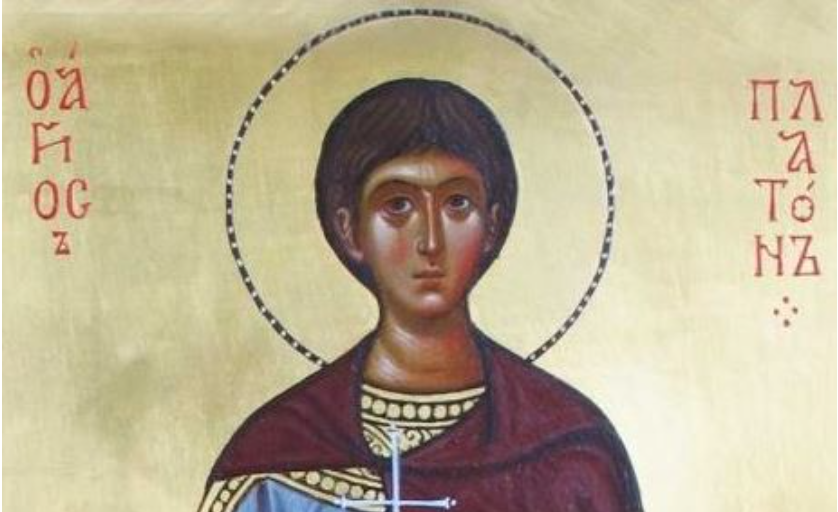
Today the Church honors the memory of the holy martyrs Plato, who lived in Ankara in the 3rd century, and Romanus, who lived in Antioch in the 4th century
.
Plato, a young man, was arrested by the pagans for vigorously proclaiming his faith in Jesus Christ, with the result that he was brought before Agrippino, who, seeing his appearance and knowing that he possessed great wealth, tried to attract him with flattery. But St. Plato refused and continued to proclaim his faith in the one true God. After the governor saw that he had failed to convert him, he threatened him with martyrdom. Despite all this, he remained steadfast in his faith, so it was ordered that he be beheaded (306 AD ).
Today we also honor the memory of the New Martyr Anastasios of Paramythia of Epirus, who was sacrificed in 1750. For his effective resistance to the Turks who were attacking young Christian women of his village with immoral acts, he was arrested and brought before the local pasha on the false charge that he had promised to eradicate Mohammedanism. Anastasius was subjected to many tortures to convert him, but in all things he showed indescribable patience. Eventually he was executed by beheading.
The two parallel narratives are proof that the Christian faith flourished not only in the first one century A.D.. centuries, but also in every era. The Gospel continues to inspire and give birth to Saints who, through their life and death for love of Christ, become mentors to resisting youth and to every struggling person.
The difference between new martyrs and national martyrs is subtle. The criterion is the extremity of sacrifice on the one hand of Faith and the cause of the Gospel and on the other hand the experience of martyrdom due to fierce love for the salvation of the country and the actions and struggles of the clergy and lay patriot. against Turkish tyranny.
.
Plato, a young man, was arrested by the pagans for vigorously proclaiming his faith in Jesus Christ, with the result that he was brought before Agrippino, who, seeing his appearance and knowing that he possessed great wealth, tried to attract him with flattery. But St. Plato refused and continued to proclaim his faith in the one true God. After the governor saw that he had failed to convert him, he threatened him with martyrdom. Despite all this, he remained steadfast in his faith, so it was ordered that he be beheaded (306 AD ).
Today we also honor the memory of the New Martyr Anastasios of Paramythia of Epirus, who was sacrificed in 1750. For his effective resistance to the Turks who were attacking young Christian women of his village with immoral acts, he was arrested and brought before the local pasha on the false charge that he had promised to eradicate Mohammedanism. Anastasius was subjected to many tortures to convert him, but in all things he showed indescribable patience. Eventually he was executed by beheading.
The two parallel narratives are proof that the Christian faith flourished not only in the first one century A.D.. centuries, but also in every era. The Gospel continues to inspire and give birth to Saints who, through their life and death for love of Christ, become mentors to resisting youth and to every struggling person.
The difference between new martyrs and national martyrs is subtle. The criterion is the extremity of sacrifice on the one hand of Faith and the cause of the Gospel and on the other hand the experience of martyrdom due to fierce love for the salvation of the country and the actions and struggles of the clergy and lay patriot. against Turkish tyranny.
Share: