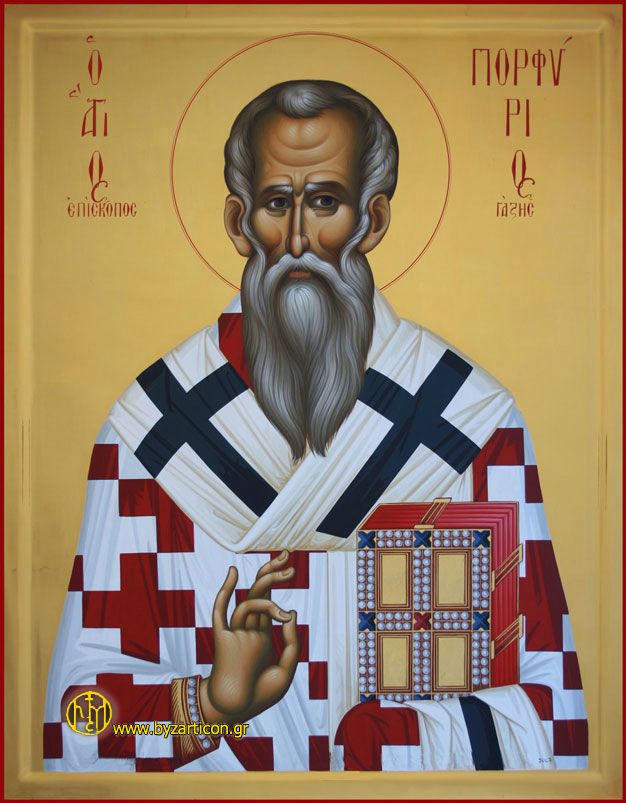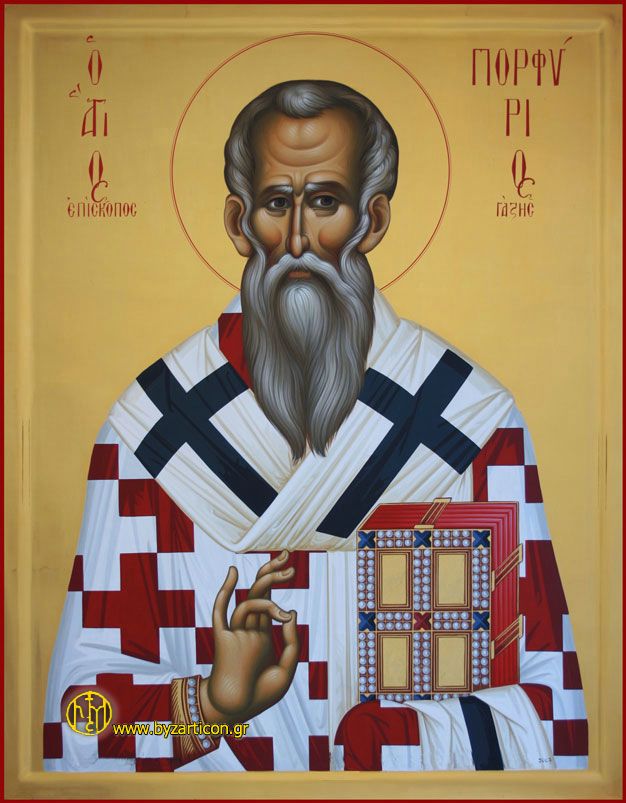
Today, February 26, our Holy Church honors the memory of St. Porphyrius, Bishop of Gazia, St. Photinia the Samaritan and her children, and the martyr Theoklitus.
St. Porphyrius was born in Thessalonica. Leaving both parents and wealth, during the reigns of Arcadius and Honorius, he retired to the Egyptian desert, where he became a monk in a hermitage.
After a stay of five years he came to Jerusalem and preached the Gospel of Christ to the Jews and Greeks. There he became seriously ill, but in spite of his illness he did not fail to visit the Church of the Resurrection and other holy pilgrimages daily, causing the admiration of the other pilgrims. Among them was Mark, his later biographer, who also made the pilgrimage from Asia to Jerusalem, and from then on they were linked for life. He even proved to be a faithful and helpful partner.
In 392 A.D. he was ordained an Elder, and in 395 A.D. he was ordained Bishop of Gaza. In order for St. Porphyrius to protect his flock from the injustices of pagans and pans, he did not hesitate to go to Constantinople and asked for help from Emperor Arcadius (395-408 A.D.) and Empress Eudoxia. By his action the Marneion, i.e., the famous temple of the inhabitants of Gaza, was demolished and in its place a pericallian temple was rebuilt at the expense of Empress Eudoxia, who sent to Gaza for this purpose by the Antiochian architect Rufinus. This temple, called the Eudoxian temple, had 32 large columns of Caristian marble and was inaugurated on Easter 407 A.D.
.
Later St. Porphyrius endeavored to establish his episcopate. The biographer of Mark vividly describes his charitable and missionary activities.
He rested in the Lord in 420 AD. after a brief illness, at the age of 72.
Bishop Grigoriou of Mesaori
St. Porphyrius was born in Thessalonica. Leaving both parents and wealth, during the reigns of Arcadius and Honorius, he retired to the Egyptian desert, where he became a monk in a hermitage.
After a stay of five years he came to Jerusalem and preached the Gospel of Christ to the Jews and Greeks. There he became seriously ill, but in spite of his illness he did not fail to visit the Church of the Resurrection and other holy pilgrimages daily, causing the admiration of the other pilgrims. Among them was Mark, his later biographer, who also made the pilgrimage from Asia to Jerusalem, and from then on they were linked for life. He even proved to be a faithful and helpful partner.
In 392 A.D. he was ordained an Elder, and in 395 A.D. he was ordained Bishop of Gaza. In order for St. Porphyrius to protect his flock from the injustices of pagans and pans, he did not hesitate to go to Constantinople and asked for help from Emperor Arcadius (395-408 A.D.) and Empress Eudoxia. By his action the Marneion, i.e., the famous temple of the inhabitants of Gaza, was demolished and in its place a pericallian temple was rebuilt at the expense of Empress Eudoxia, who sent to Gaza for this purpose by the Antiochian architect Rufinus. This temple, called the Eudoxian temple, had 32 large columns of Caristian marble and was inaugurated on Easter 407 A.D.
.
Later St. Porphyrius endeavored to establish his episcopate. The biographer of Mark vividly describes his charitable and missionary activities.
He rested in the Lord in 420 AD. after a brief illness, at the age of 72.
Bishop Grigoriou of Mesaori
Share: