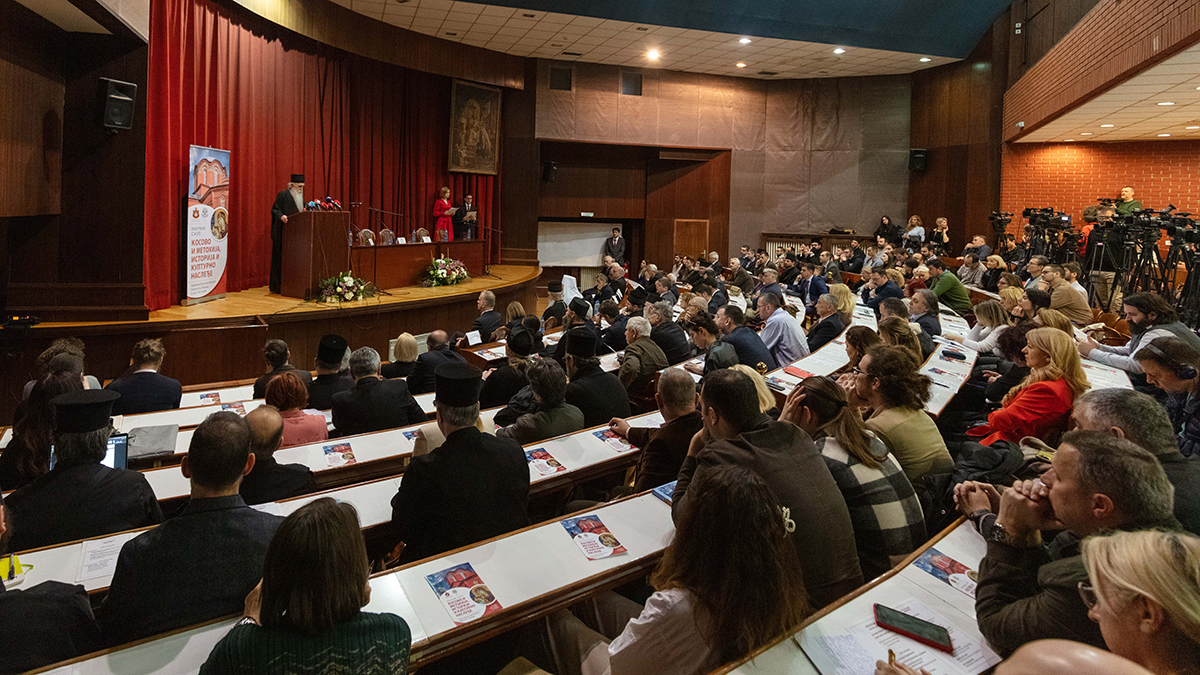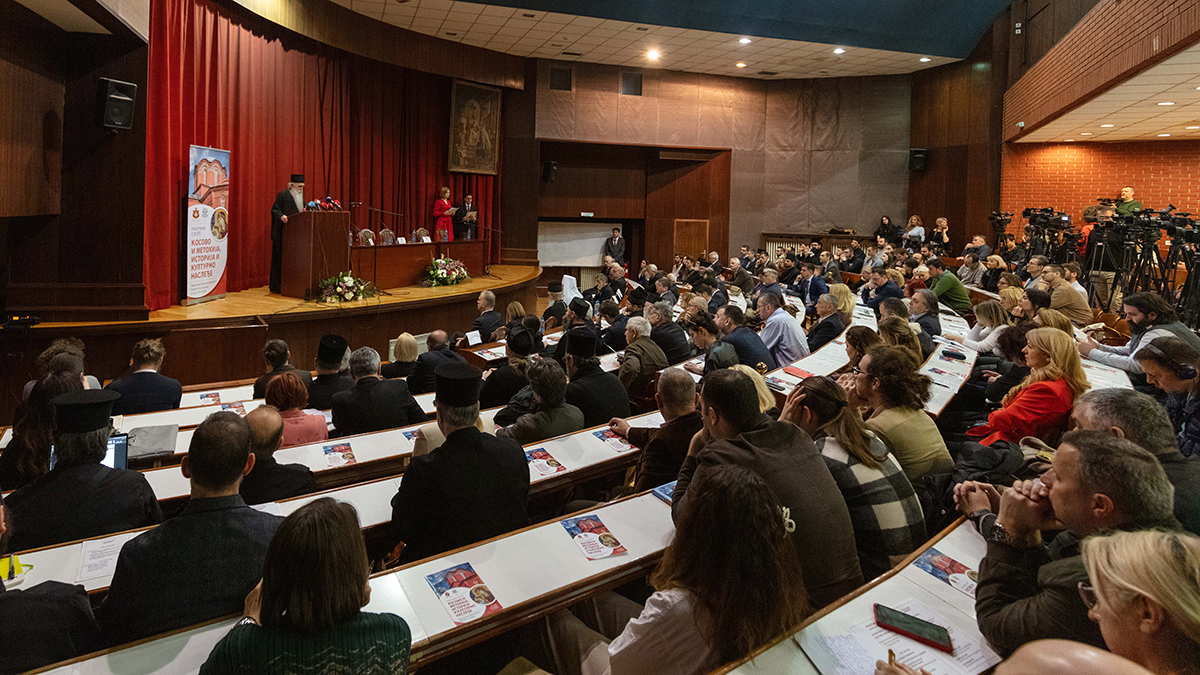
His Holiness the Serbian Patriarch Mr. Porfiry opened the conference at the Orthodox Theological Faculty of the University of Belgrade on March 2 6, 2024. Porphyrios opened a conference organized by the Information Service of the Serbian Orthodox Church and Matica Srpska, entitled "Kosovo and Metohija - History and Cultural Heritage", at the Orthodox Theological Faculty of the University of Belgrade on March 2, 6, 2024.
Welcoming the present archbishops, ministers, representatives of the most important institutions of society and state, prominent professors and experts of various specialties related to the theme of the conference, Patriarch Porphyrios, among other things, emphasized:
- After eight centuries of continuous presence on the territory of Kosovo and Metohija, the Serbian Orthodox Church cannot be a party to any political negotiations and agreements on the status of Kosovo and Metohija. Respect for and protection of human rights and, especially, religious rights represent a universal civilizational value, as these rights belong to everyone and must be guaranteed to the Serbian Church and its faithful people. Thus, universal human and religious rights and freedoms cannot be part of status negotiations and political agreements, but are implied and guaranteed by international legal instruments.
Patriarch Porphyrios' full statement can be read HERE .
In his welcoming address In his letter to the participants of the scientific meeting, His Eminence Bishop of Raška-Prizren, Mr... Mr. Teodosije noted that the Church plays a key role in the survival of our people and the preservation of Kosovo and Metohija, as the territory where the historical and spiritual consciousness of the Serbian people was built and developed, as the spiritual axis around which the people have always gathered in difficult moments and to which they have always returned after all historical wanderings: - That is why the monastery of the Peć Patriarchate was and remains the spiritual capital not only of our Church, with the throne of the Serbian Patriarch and the tombs of his holy predecessors who marked our history, but also the spiritual capital of all Serbs, wherever they live today. Vysoki Dečani, Gračanica, Our Lady of Leviška, Sveti Archangeli, Dević, Gorioč, Zočište, Banjska, Sokolica, Draganac and others represent lighted candles that illuminate the path of our nation. They also give it the strength to endure all the trials and show itself worthy of its ancestors," emphasized Bishop Teodosije.
Prof. Dr. Jovan Delic, Vice-President of Matica Srpska, addressed the audience on behalf of the rightfully absent President of this renowned institution, Prof. Dr. Dragan Stanić, in his letter of welcome, emphasized that Matica Srpska is now, as always, under the Serbian Government. Orthodox Church: - As the oldest Serbian educational institution, Matica Srpska was established to remember and protect all of Serbia. The Serbian people and its Matica Srpska with its annals, which will celebrate 200 years of existence in 2026, have no right to forget and will never forget that Kosovo and Metohija is home to two of its imperial capitals: Prizren and Pristina and one of God's Patriarchates, the Patriarchate of Pec. Matica Srpska, with its chronicles and its Svetosava Church, with faith in God and in Serbia, is waiting for the resurrection of Christ, being in a constant struggle according to His verses: Let the impossible be impossible, let there be a constant struggle.
His Eminence Bishop of Bac g -n . Irinej, who noted that the entire local Church of Sveti Sava is making great efforts in our time to restore the real meaning and the real meaning of the Kosovo Covenant in the widest circles of its faithful people, as well as the guiding ideas of our entire history, measuring our Serbian Kosovo Covenant by the standard of the New Covenant as the eternal and final Covenant between God and humanity.
- The meaning and content of the Covenant or Testament is love, which presupposes the absolute freedom of man, and its goal is absolute, complete love, love between God and man, and such a love, which will be manifested only in the Person of the God-man Christ. In His person, God and man forever together and one, not merging, changing or mingling, but also not dividing or separating. Therefore, He is the High Priest and the Sacrifice, the Lamb and the Shepherd. He Himself says: There is no greater love than to lay down one's life for one's friends (John 15:13)," Bishop Irenaeus reminded and explained what the Kosovo Covenant is in the light of the New Testament:
- We all know that our people compare the personality of the holy Prince Lazarus, his behavior before the battle of Kosovo with the events of the New Testament. It is no coincidence that in folk poetry we have the "Prince's Supper," which is really a projection of Christ's Last Supper before suffering. Then we have all those words which, according to folklore, are exchanged between Lazarus and his great men and heroes about faith and unbelief ... We also have those classic words with which St. Prince Lazarus expresses the essence of the Kosovo covenant: " The kingdom of the earth is for the few, but the kingdom of heaven is always and forever", and that we must decide for him in order to be faithful to God, that is, to our salvation in Christ, in the Church... One thing is certain, that our people, as a Christian nation, unmistakably felt the spiritual essence of Lazarus' determination and his person and the spiritual essence of what happened on the Kosovo field on the day of that battle in 1389. . From then until today, and I am personally convinced that as long as there are Serbs on this planet and the as long as they are Orthodox, they will live by this Kosovo covenant.
The first session of the scientific meeting was opened by Dr. Dejan Radicevic with a presentation on "Evidence of archaeology in the territory of Kosovo and Metohija from prehistoric times to the Middle Ages", and on this occasion he gave a comprehensive presentation of archaeological discoveries and findings in the area of Kosovo and Metohija from the oldest known times to the period of the Serbian medieval state. At the same time, he familiarized the audience with the beginning and progress of archaeological excavations in Kosovo and Metohija, paying special attention to the current situation, which has a great impact on further research. Archaeological excavations, as well as archaeological findings, according to Mr.. Radićević, will play a significant role in the establishment and future of Serbian heritage in Kosovo and Metohija.
Dr. Srdjan Pirivatric, speaking about the territory of Kosovo and Metohija in the Middle Ages under Byzantine, Bulgarian and Serbian rule, began with the decline of antiquity and the dawn of the early Middle Ages and the era of Byzantine Emperor Justinian. : - His efforts to build new and rebuild existing fortifications in the interior of the Danubian frontier to protect the empire from attacks from the north, of which the foundation of Justinian's city of Prima has a special place, failed in the face of invasions. or immigration of Slavs and Avars. The process of retreat of the real imperial power in the vast territory of the central regions of the Balkan Peninsula and its reduction to a number of fortress cities on the Mediterranean coast was accompanied by the slowing down or stopping of Romanization and Hellenization. Throughout the territory of Kosovo and Metohija, one can observe a layer of Old Slavic toponyms that are directly related to the Roman period and testify to the contact between the old and the new population, while there is no evidence of Albanian, i.e. pre-Albanian or pro-Albanian elements.
Archpriest-Stavrophor Vladimir Vukašinović spoke about the contribution of the Serbian Orthodox Church to the development of medicine in the territory of Kosovo and Metohija in the Middle Ages. Prof. Vukašinović began his presentation by stating that the contribution of the Serbian Church to the development and survival of the Serbian state is beyond doubt. This can be seen in the establishment and development of social and medical services - in short, in the charitable activities of the Serbian Church, based on Byzantine models. Two monasteries in Constantinople, where hospitals and orphanages were located, namely the Monastery of Our Lady of Evergetis and the Monastery of Christ Pandokrator, served as templates for our community. Based on these patterns, provisions are created The Code of Laws and the Dusan Code regulating these matters. The influence of these monasteries on Serbia was exercised through St. Sava, and later through St. Stephen of Dečan and Emperor Dušan. The charitable activities of the Serbian Church in the Middle Ages were carried out both in Kosovo and Metohija and outside its canonical territory. St. King Milutin built hospitals in Constantinople and Jerusalem. In the end, Prof. Vukašinović concluded that on the basis of all knowledge and historical facts it is clear that the medical and humanitarian activities of the Serbian Church in Kosovo and Metohija were not only great, but also unique.
The second session began with a presentation by Academician Ljubodrag Dimić on the territory of Kosovo and Metohija in the politics of Serbia, the Kingdom of the Slovak Republic and Yugoslavia (1912-1945). Recalling that the Serbs, through uprisings, revolts, revolutions, failures and rebellions during the XIX century, at the cost of great sacrifices, managed to achieve liberation from Turkish rule and the recognition of the Serbian state at the Berlin Congress in 1878, Academician Dimic emphasized: - On the other hand, social reality has sent Albanians in the opposite direction. They assume the role of the last defense of the Ottoman Empire in the Balkans, which brings them into conflict with other Balkan peoples, and this is facilitated by the completion of the process of Islamization, the end of the process of invasion of the most influential Albanian families into the federal system of Turkish administration and full economic, social and religious identification with the Ottoman state, i.e. with Turkish political and religious interests.
Dr. Vojislav Pavlovic spoke on the topic of Kosovo and Metohija in the policy of Josip Broz Tito, who stressed that Albanian communists, as well as many prominent members of the Communist Party of Yugoslavia, supported the annexation of the territory of Kosovo and Metohija to Albania. - The territory was granted autonomy, although, according to Enver Hoxha, Tito agreed with the annexation of Kosovo and Metohija to Albania," Dr. Pavlovic noted, recalling that the communist authorities in Yugoslavia divided the Serbian people along republican and provincial borders, and that thousands of Serbian families were forbidden to return to their homes in Kosovo and Metohija.
Speaking about the Autonomy of Kosovo and Metohija (1945-1989), Dr. Igor Vukadinović recalled the testimony of Vladimir Bakarić, the first member of the Croatian Communist Party, that he, Josip Broz and Edward Kardel put forward the idea of the Autonomy of Kosovo and Metohija in 1944. - The autonomy was a kind of compensation for Albanians who were not annexed to Albania. As a rule, European States rejected proposals to grant autonomy to national minorities because they saw it as a threat to their sovereignty and integrity. However, the Communist authorities, led by Tito, implemented it, while rejecting a proposal to create a Serbian autonomous region in Croatia. It was noted that the Serbian Communists did not oppose this policy, but consistently and loyally pursued it.
Academician Dragan Vojvodic started the third session with a presentation on the cultural heritage of Kosovo and Metohija, emphasizing that the sacred and non-sacred cultural heritage of the Serbian people in Kosovo and Metohija is equally threatened and neglected: - Serbian cultural heritage is a synthesis of Byzantine and Western art. Nothing like it can be found anywhere else in the world. These monuments are Serbian not only because they were created by Serbs, but also because they are at the core of the Serbian state and cultural national consciousness. They represent a distinctive feature of the Serbian nation.
In his presentation on "Destruction and appropriation of cultural heritage in Kosovo and Metohija and the Middle East", Dr. Dragan Simeunovic compared the destruction of Serbian cultural heritage that has occurred and is occurring in Kosovo and Metohija to the by the destruction perpetrated by the Islamic State in Iraq. and Syria: - The recipe is the same: what is a symbol of a nation's faith and culture is first destroyed and then appropriated and repurposed. What the Islamic State and so-called Kosovo have in common is that they were created by terrorist organizations. Both are illegitimate and illegitimate creations in terms of their origin (through brutal violence), in the way they function (also through violence) and because they are not recognized by the people who live there or by the international community.
The scientific meeting ended with a presentation by Dr. Darko Tanaskovic on "Strategy for the theft and protection of Serbian cultural heritage in Kosovo and Metohija" . - There are several types of strategic fragmentation of our culture. The first is destruction, which generates fear and an atmosphere of instability; the second is appropriation, i.e. albanization; and the third type is prospectively the most dangerous and is the declaration of the temples and buildings of the Serbian Orthodox Church as the culture of Kosovo, the common culture of all "citizens of Kosovo", not the Serbian Orthodox Church and the Serbian people. - Dr. Tanaskovic noted.
The conclusions of the scientific meeting "Kosovo and Metohija - History and Cultural Heritage", as well as the materials of the conference will be presented at the conference. as well as the proceedings of the conference will be published at a later date.
Share: