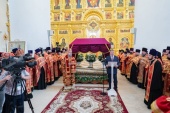
The relics of Blessed Prince Michael of Tver were transferred to the restored Spaso-Preobrazhensky Cathedral of Tver

Мощи благоверного князя Михаила Тверского перенесены в восстановленный Спасо-Преображенский кафедральный собор Твери

On June 12, 2024, the feast of Easter, the relics of the heavenly patron saint of Tver, the Blessed Grand Duke Michael of Tver, were solemnly transferred from the Resurrection Cathedral to the Cathedral of the Transfiguration of the Savior being prepared for the Great Consecration.

In the morning in the Resurrection Cathedral of Tver the Divine Liturgy was celebrated in the Easter rite, which was led by Metropolitan Amvrosy of Tver and Kashin, accompanied by Bishop Adrian of Rzhevsk and Toropets, Bishop Filaret of Bezhetsk and Udomel and clergy of the Tver Metropolitanate.

The abbesses of Tver monasteries, Governor Igor Rudenya, State Duma deputies Sergei Veremeenko and Yulia Saranova, Speaker of the regional parliament Sergei Golubev, heads of departments, heads of municipalities, clergy, families of war veterans and large families, representatives of public organizations of the region, residents and guests of Tver, and guests from Moscow prayed at the service.

At the Litany of Supplication prayers were offered for the sick, for the Fatherland, and a prayer for Holy Russia was read.

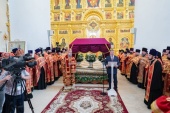
After the The liturgy began the procession with the holy relics, which went through the main streets of Tver and ended at the Transfiguration Cathedral on Cathedral Square in Tver. The relics were taken into the church and placed in the middle of the cathedral. Throughout the procession was broadcasted in the social network «VKontakte».

.

The prayer procession was attended by bishops and clergy, monks and laymen, the governor of the region Igor Rudenya, heads of districts and representatives of all branches of government, numerous pilgrims.

A prayer service was held in the Cathedral of the Transfiguration of the Savior, after which Metropolitan Ambrosius addressed the audience with a welcoming speech, in which, in particular, said:

«Today, by the grace of God, we have become participants in a great event — the transfer of the relics of the Holy Blessed Prince Michael of Tver to their historical place of presence — to the Transfiguration Cathedral. This is not just a historical event, but also deeply spiritual and significant for all of us, for Orthodoxy in our land, for our city and the entire Russian land.

Saint Blessed Prince Michael Yaroslavich of Tver — a man whose name evokes gratitude among all the inhabitants of our ancient and holy land. He was the first Russian He was the prince who defeated the Horde in open battle, and his victory presented him with a difficult moral choice: to preserve his life or to save the inhabitants of his native city from plunder and violence. He chose the second, sacrificing himself for the sake of his people, and with this feat wrote his name in the annals of great Russian history.

Saint Michael of Tver stands in the same row with such heroes of the Russian land as saints Alexander Nevsky and Dmitry Donskoy. His life and death — is an example of selflessness, courage and faithfulness to his principles and beliefs. He drove the threat away from Tver, paying for it with his life, and grateful descendants honor his name to this day. He lived as a Christian and died as a Christian martyr.

In 1549 the Russian Orthodox Church canonized Mikhail Yaroslavich in the countenance of the blessed. This act of recognizing his sainthood became an important milestone for all believers. The relics of the holy prince were a source of miracles and consolation for many generations of Tverites, strengthening them in their faith and giving them hope in difficult times.

Today we return his holy relics to the Cathedral of the Transfiguration of the Savior, built by him, destroyed in the twentieth century by mad people, and now again restored after many years of neglect. This event not only symbolizes the rebirth of the ancient The transfer of the relics of the saint to the cathedral and the return to it of the remains of the noble prince, but also closes the chain of history, informing us of the circle of historical events that has passed, of the beginnings of the return of the spirit and faith of our pious ancestors to the land of Tver and the restoration of the unity of our community of people who believe in Christ.

The transfer of relics of a saint in the Church is always an event deeply rooted in the traditions of our faith. Such events often become separate days of remembrance for the saint. You and I are — witnesses and participants. This event will go down in the annals of our Church and our city. From now on, we will annually celebrate the day of the return of the relics of St. Michael of Tver to their historical place with a cathedral service.

Today we see how the memory of the feat of St. Michael of Tver continues to live and inspire new and new generations of people. On the main square of our city there is a monument to him, the city square bears his name, the Cathedral of the Transfiguration, built by him once, has been revived on Cathedral Square, at the entrance to the cathedral there is a monument with the image of St. Michael together with St. Simeon, the first bishop of Tver. And all of us gathered now at his holy relics are also his memory and his continuation on earth. He and his holy wife, the Blessed Princess and Nun Anna Kashinskaya, — the brightest example to emulate, an example of unity, love, large family and fidelity.

Let us ask the Lord to grant us peace, unity and prosperity through the prayers of the holy prince Michael of Tver. May our celebration today be the beginning of a new spiritual revival for the city of Tver, the Tver region and our entire Fatherland. May the blessing of the Lord be with all the participants of this event.

The Governor of the Tver region congratulated everyone on the historic event.

After the service was over, tents were opened on Sobornaya Square with a meal for all participants of the event.

At the end of the service, tents were opened with a meal for all participants of the event.

Akathist was read continuously in front of the relics in the cathedral while the participants of the procession laid their hands on the relics.

Akathist was read in front of the relics in the cathedral.

***

After the murder of Prince Michael of Tver, the naked body of the martyr was thrown into desecration, then it was covered with clothes and placed on a large board tied to a cart. During the night two watchmen were assigned to guard the body, but they were overcome with fear and ran away. In the morning his body was not found on the plank. That same night many people, not only Orthodox, but also Tatars, saw how two light clouds shone on the place where the body of the martyr lay, and, although many beasts of prey prowled the steppe, not one of them was able to find the body of the martyr. touched him.

The body of the Prince of Tver by order of the Moscow Grand Duke Yuri Danilovich was originally taken to Moscow, placed in the Spassky Monastery and only at the request of Princess Anna, the widow of the deceased, was given to Tver. The remains of Michael of Tver were brought to his hometown in 1319 and were met by the inhabitants near the Archangel Monastery. The Passion-Bearer was buried with a large crowd of Tverites in the Transfiguration Cathedral — in the right part of the church, next to Bishop Simeon (however, on the hay, which was arranged over the relics of the saint in 1902, as the date of the transfer of his body from Moscow to Tver, the year 1320 is indicated).

After the burial of the body of the martyr remained under the spud almost a century, but about 1411 the relics were raised and placed in the temple for the worship of the faithful; the official canonization at that time had not yet taken place, but Tverites venerated him as a locally venerated saint. At the Council of 1549 was established all-Russian celebration of the memory of Prince Michael Yaroslavich of Tver.

The recovered relics of the saint for some time were in a stone tomb. On September 30, 1654 they were transferred into a wooden tomb decorated with «inside from the outside veleplepne zhazhe dostoit».

The relics of the saint were for some time kept in a stone tomb.

In 1655, the city was affected by the On September 30, the day of the remembrance of the transfer of the body of St. John the Baptist from Moscow to Tver. Archbishop Lavrentiy of Tver called the people to a week of fasting, repentance and prayer for deliverance from the calamity, and on September 30, the day of commemoration of the transfer of the body of the prince from Moscow to Tver, he transferred his relics into a new, specially arranged, wooden frame. After that the holy remains were taken out of the cathedral, solemnly carried in a procession around the city, and by the faith of the Tverites a miracle happened: the epidemic subsided. To commemorate this event Archbishop Lawrence established that every year on September 30th a vigil to St. Michael of Tver should be celebrated in the city, and this custom was preserved in the pre-revolutionary era: on this day a special polyelaic service was served in the churches of Tver.

In February and May 1919, on the initiative of the atheist authorities in the Tver diocese there was a notorious campaign of autopsy and examination of relics, the results of which were covered in detail in the local press. The local authorities kept the dates of the autopsies secret for as long as possible, so that the religious community would not have time to mobilize and fight back against the blasphemous actions. In a series of such actions on May 18, 1919, the main shrine of the Tver cathedral was inspected — the remains of Blessed Prince Michael. Yaroslavich Tversky.

After the revolution and the tragic events of the Great Patriotic War, the relics of Prince Michael of Tver were lost. The silver casket in which the relics of Prince Michael of Tver rested for many years has been preserved. This jewel of the Tver land was kept in the museum during the Soviet times.

The ark with the relics of Prince Michael of Tver was returned to the Tver region by His Holiness Patriarch Kirill of Moscow and All Russia on December 4, 2018.

>

Tver Diocese/Patriarchy.ru

Share:
The relics of Blessed Prince Michael of Tver were transferred to the restored Spaso-Preobrazhensky Cathedral of Tver The relics of Blessed Prince Michael of Tver were transferred to the restored Spaso-Preobrazhensky Cathedral of Tver On June 12, 2024, the feast of Easter, the relics of the heavenly patron saint of Tver, the Blessed Grand Duke Michael of Tver, were solemnly transferred from the Resurrection Cathedral to the Cathedral of the Transfiguration of the Savior being prepared for the Great Consecration. In the morning in the Resurrection Cathedral of Tver the Divine Liturgy was celebrated in the Easter rite, which was led by Metropolitan Amvrosy of Tver and Kashin, accompanied by Bishop Adrian of Rzhevsk and Toropets, Bishop Filaret of Bezhetsk and Udomel and clergy of the Tver Metropolitanate. The abbesses of Tver monasteries, Governor Igor Rudenya, State Duma deputies Sergei Veremeenko and Yulia Saranova, Speaker of the regional parliament Sergei Golubev, heads of departments, heads of municipalities, clergy, families of war veterans and large families, representatives of public organizations of the region, residents and guests of Tver, and guests from Moscow prayed at the service. At the Litany of Supplication prayers were offered for the sick, for the Fatherland, and a prayer for Holy Russia was read. After the The liturgy began the procession with the holy relics, which went through the main streets of Tver and ended at the Transfiguration Cathedral on Cathedral Square in Tver. The relics were taken into the church and placed in the middle of the cathedral. Throughout the procession was broadcasted in the social network «VKontakte». . The prayer procession was attended by bishops and clergy, monks and laymen, the governor of the region Igor Rudenya, heads of districts and representatives of all branches of government, numerous pilgrims. A prayer service was held in the Cathedral of the Transfiguration of the Savior, after which Metropolitan Ambrosius addressed the audience with a welcoming speech, in which, in particular, said: «Today, by the grace of God, we have become participants in a great event — the transfer of the relics of the Holy Blessed Prince Michael of Tver to their historical place of presence — to the Transfiguration Cathedral. This is not just a historical event, but also deeply spiritual and significant for all of us, for Orthodoxy in our land, for our city and the entire Russian land. Saint Blessed Prince Michael Yaroslavich of Tver — a man whose name evokes gratitude among all the inhabitants of our ancient and holy land. He was the first Russian He was the prince who defeated the Horde in open battle, and his victory presented him with a difficult moral choice: to preserve his life or to save the inhabitants of his native city from plunder and violence. He chose the second, sacrificing himself for the sake of his people, and with this feat wrote his name in the annals of great Russian history. Saint Michael of Tver stands in the same row with such heroes of the Russian land as saints Alexander Nevsky and Dmitry Donskoy. His life and death — is an example of selflessness, courage and faithfulness to his principles and beliefs. He drove the threat away from Tver, paying for it with his life, and grateful descendants honor his name to this day. He lived as a Christian and died as a Christian martyr. In 1549 the Russian Orthodox Church canonized Mikhail Yaroslavich in the countenance of the blessed. This act of recognizing his sainthood became an important milestone for all believers. The relics of the holy prince were a source of miracles and consolation for many generations of Tverites, strengthening them in their faith and giving them hope in difficult times. Today we return his holy relics to the Cathedral of the Transfiguration of the Savior, built by him, destroyed in the twentieth century by mad people, and now again restored after many years of neglect. This event not only symbolizes the rebirth of the ancient The transfer of the relics of the saint to the cathedral and the return to it of the remains of the noble prince, but also closes the chain of history, informing us of the circle of historical events that has passed, of the beginnings of the return of the spirit and faith of our pious ancestors to the land of Tver and the restoration of the unity of our community of people who believe in Christ. The transfer of relics of a saint in the Church is always an event deeply rooted in the traditions of our faith. Such events often become separate days of remembrance for the saint. You and I are — witnesses and participants. This event will go down in the annals of our Church and our city. From now on, we will annually celebrate the day of the return of the relics of St. Michael of Tver to their historical place with a cathedral service. Today we see how the memory of the feat of St. Michael of Tver continues to live and inspire new and new generations of people. On the main square of our city there is a monument to him, the city square bears his name, the Cathedral of the Transfiguration, built by him once, has been revived on Cathedral Square, at the entrance to the cathedral there is a monument with the image of St. Michael together with St. Simeon, the first bishop of Tver. And all of us gathered now at his holy relics are also his memory and his continuation on earth. He and his holy wife, the Blessed Princess and Nun Anna Kashinskaya, — the brightest example to emulate, an example of unity, love, large family and fidelity. Let us ask the Lord to grant us peace, unity and prosperity through the prayers of the holy prince Michael of Tver. May our celebration today be the beginning of a new spiritual revival for the city of Tver, the Tver region and our entire Fatherland. May the blessing of the Lord be with all the participants of this event. The Governor of the Tver region congratulated everyone on the historic event. After the service was over, tents were opened on Sobornaya Square with a meal for all participants of the event. At the end of the service, tents were opened with a meal for all participants of the event. Akathist was read continuously in front of the relics in the cathedral while the participants of the procession laid their hands on the relics. Akathist was read in front of the relics in the cathedral. *** After the murder of Prince Michael of Tver, the naked body of the martyr was thrown into desecration, then it was covered with clothes and placed on a large board tied to a cart. During the night two watchmen were assigned to guard the body, but they were overcome with fear and ran away. In the morning his body was not found on the plank. That same night many people, not only Orthodox, but also Tatars, saw how two light clouds shone on the place where the body of the martyr lay, and, although many beasts of prey prowled the steppe, not one of them was able to find the body of the martyr. touched him. The body of the Prince of Tver by order of the Moscow Grand Duke Yuri Danilovich was originally taken to Moscow, placed in the Spassky Monastery and only at the request of Princess Anna, the widow of the deceased, was given to Tver. The remains of Michael of Tver were brought to his hometown in 1319 and were met by the inhabitants near the Archangel Monastery. The Passion-Bearer was buried with a large crowd of Tverites in the Transfiguration Cathedral — in the right part of the church, next to Bishop Simeon (however, on the hay, which was arranged over the relics of the saint in 1902, as the date of the transfer of his body from Moscow to Tver, the year 1320 is indicated). After the burial of the body of the martyr remained under the spud almost a century, but about 1411 the relics were raised and placed in the temple for the worship of the faithful; the official canonization at that time had not yet taken place, but Tverites venerated him as a locally venerated saint. At the Council of 1549 was established all-Russian celebration of the memory of Prince Michael Yaroslavich of Tver. The recovered relics of the saint for some time were in a stone tomb. On September 30, 1654 they were transferred into a wooden tomb decorated with «inside from the outside veleplepne zhazhe dostoit». The relics of the saint were for some time kept in a stone tomb. In 1655, the city was affected by the On September 30, the day of the remembrance of the transfer of the body of St. John the Baptist from Moscow to Tver. Archbishop Lavrentiy of Tver called the people to a week of fasting, repentance and prayer for deliverance from the calamity, and on September 30, the day of commemoration of the transfer of the body of the prince from Moscow to Tver, he transferred his relics into a new, specially arranged, wooden frame. After that the holy remains were taken out of the cathedral, solemnly carried in a procession around the city, and by the faith of the Tverites a miracle happened: the epidemic subsided. To commemorate this event Archbishop Lawrence established that every year on September 30th a vigil to St. Michael of Tver should be celebrated in the city, and this custom was preserved in the pre-revolutionary era: on this day a special polyelaic service was served in the churches of Tver. In February and May 1919, on the initiative of the atheist authorities in the Tver diocese there was a notorious campaign of autopsy and examination of relics, the results of which were covered in detail in the local press. The local authorities kept the dates of the autopsies secret for as long as possible, so that the religious community would not have time to mobilize and fight back against the blasphemous actions. In a series of such actions on May 18, 1919, the main shrine of the Tver cathedral was inspected — the remains of Blessed Prince Michael. Yaroslavich Tversky. After the revolution and the tragic events of the Great Patriotic War, the relics of Prince Michael of Tver were lost. The silver casket in which the relics of Prince Michael of Tver rested for many years has been preserved. This jewel of the Tver land was kept in the museum during the Soviet times. The ark with the relics of Prince Michael of Tver was returned to the Tver region by His Holiness Patriarch Kirill of Moscow and All Russia on December 4, 2018.> Tver Diocese/Patriarchy.ru
On June 12, 2024, the feast of Easter, the relics of the heavenly patron saint of Tver, the Blessed Grand Duke Michael of Tver, were solemnly transferred from the Resurrection Cathedral to the Cathedral of the Transfiguration of the Savior being prepared for the Great Consecration. In the morning in the Resurrection Cathedral of Tver the Divine Liturgy was celebrated in the Easter rite, which was led by Metropolitan Amvrosy of Tver and Kashin, accompanied by Bishop Adrian of Rzhevsk and Toropets, Bishop Filaret of Bezhetsk and Udomel and clergy of the Tver Metropolitanate. The abbesses of Tver monasteries, Governor Igor Rudenya, State Duma deputies Sergei Veremeenko and Yulia Saranova, Speaker of the regional parliament Sergei Golubev, heads of departments, heads of municipalities, clergy, families of war veterans and large families, representatives of public organizations of the region, residents and guests of Tver, and guests from Moscow prayed at the service. At the Litany of Supplication prayers were offered for the sick, for the Fatherland, and a prayer for Holy Russia was read. After the The liturgy began the procession with the holy relics, which went through the main streets of Tver and ended at the Transfiguration Cathedral on Cathedral Square in Tver. The relics were taken into the church and placed in the middle of the cathedral. Throughout the procession was broadcasted in the social network «VKontakte». . The prayer procession was attended by bishops and clergy, monks and laymen, the governor of the region Igor Rudenya, heads of districts and representatives of all branches of government, numerous pilgrims. A prayer service was held in the Cathedral of the Transfiguration of the Savior, after which Metropolitan Ambrosius addressed the audience with a welcoming speech, in which, in particular, said: «Today, by the grace of God, we have become participants in a great event — the transfer of the relics of the Holy Blessed Prince Michael of Tver to their historical place of presence — to the Transfiguration Cathedral. This is not just a historical event, but also deeply spiritual and significant for all of us, for Orthodoxy in our land, for our city and the entire Russian land. Saint Blessed Prince Michael Yaroslavich of Tver — a man whose name evokes gratitude among all the inhabitants of our ancient and holy land. He was the first Russian He was the prince who defeated the Horde in open battle, and his victory presented him with a difficult moral choice: to preserve his life or to save the inhabitants of his native city from plunder and violence. He chose the second, sacrificing himself for the sake of his people, and with this feat wrote his name in the annals of great Russian history. Saint Michael of Tver stands in the same row with such heroes of the Russian land as saints Alexander Nevsky and Dmitry Donskoy. His life and death — is an example of selflessness, courage and faithfulness to his principles and beliefs. He drove the threat away from Tver, paying for it with his life, and grateful descendants honor his name to this day. He lived as a Christian and died as a Christian martyr. In 1549 the Russian Orthodox Church canonized Mikhail Yaroslavich in the countenance of the blessed. This act of recognizing his sainthood became an important milestone for all believers. The relics of the holy prince were a source of miracles and consolation for many generations of Tverites, strengthening them in their faith and giving them hope in difficult times. Today we return his holy relics to the Cathedral of the Transfiguration of the Savior, built by him, destroyed in the twentieth century by mad people, and now again restored after many years of neglect. This event not only symbolizes the rebirth of the ancient The transfer of the relics of the saint to the cathedral and the return to it of the remains of the noble prince, but also closes the chain of history, informing us of the circle of historical events that has passed, of the beginnings of the return of the spirit and faith of our pious ancestors to the land of Tver and the restoration of the unity of our community of people who believe in Christ. The transfer of relics of a saint in the Church is always an event deeply rooted in the traditions of our faith. Such events often become separate days of remembrance for the saint. You and I are — witnesses and participants. This event will go down in the annals of our Church and our city. From now on, we will annually celebrate the day of the return of the relics of St. Michael of Tver to their historical place with a cathedral service. Today we see how the memory of the feat of St. Michael of Tver continues to live and inspire new and new generations of people. On the main square of our city there is a monument to him, the city square bears his name, the Cathedral of the Transfiguration, built by him once, has been revived on Cathedral Square, at the entrance to the cathedral there is a monument with the image of St. Michael together with St. Simeon, the first bishop of Tver. And all of us gathered now at his holy relics are also his memory and his continuation on earth. He and his holy wife, the Blessed Princess and Nun Anna Kashinskaya, — the brightest example to emulate, an example of unity, love, large family and fidelity. Let us ask the Lord to grant us peace, unity and prosperity through the prayers of the holy prince Michael of Tver. May our celebration today be the beginning of a new spiritual revival for the city of Tver, the Tver region and our entire Fatherland. May the blessing of the Lord be with all the participants of this event. The Governor of the Tver region congratulated everyone on the historic event. After the service was over, tents were opened on Sobornaya Square with a meal for all participants of the event. At the end of the service, tents were opened with a meal for all participants of the event. Akathist was read continuously in front of the relics in the cathedral while the participants of the procession laid their hands on the relics. Akathist was read in front of the relics in the cathedral. *** After the murder of Prince Michael of Tver, the naked body of the martyr was thrown into desecration, then it was covered with clothes and placed on a large board tied to a cart. During the night two watchmen were assigned to guard the body, but they were overcome with fear and ran away. In the morning his body was not found on the plank. That same night many people, not only Orthodox, but also Tatars, saw how two light clouds shone on the place where the body of the martyr lay, and, although many beasts of prey prowled the steppe, not one of them was able to find the body of the martyr. touched him. The body of the Prince of Tver by order of the Moscow Grand Duke Yuri Danilovich was originally taken to Moscow, placed in the Spassky Monastery and only at the request of Princess Anna, the widow of the deceased, was given to Tver. The remains of Michael of Tver were brought to his hometown in 1319 and were met by the inhabitants near the Archangel Monastery. The Passion-Bearer was buried with a large crowd of Tverites in the Transfiguration Cathedral — in the right part of the church, next to Bishop Simeon (however, on the hay, which was arranged over the relics of the saint in 1902, as the date of the transfer of his body from Moscow to Tver, the year 1320 is indicated). After the burial of the body of the martyr remained under the spud almost a century, but about 1411 the relics were raised and placed in the temple for the worship of the faithful; the official canonization at that time had not yet taken place, but Tverites venerated him as a locally venerated saint. At the Council of 1549 was established all-Russian celebration of the memory of Prince Michael Yaroslavich of Tver. The recovered relics of the saint for some time were in a stone tomb. On September 30, 1654 they were transferred into a wooden tomb decorated with «inside from the outside veleplepne zhazhe dostoit». The relics of the saint were for some time kept in a stone tomb. In 1655, the city was affected by the On September 30, the day of the remembrance of the transfer of the body of St. John the Baptist from Moscow to Tver. Archbishop Lavrentiy of Tver called the people to a week of fasting, repentance and prayer for deliverance from the calamity, and on September 30, the day of commemoration of the transfer of the body of the prince from Moscow to Tver, he transferred his relics into a new, specially arranged, wooden frame. After that the holy remains were taken out of the cathedral, solemnly carried in a procession around the city, and by the faith of the Tverites a miracle happened: the epidemic subsided. To commemorate this event Archbishop Lawrence established that every year on September 30th a vigil to St. Michael of Tver should be celebrated in the city, and this custom was preserved in the pre-revolutionary era: on this day a special polyelaic service was served in the churches of Tver. In February and May 1919, on the initiative of the atheist authorities in the Tver diocese there was a notorious campaign of autopsy and examination of relics, the results of which were covered in detail in the local press. The local authorities kept the dates of the autopsies secret for as long as possible, so that the religious community would not have time to mobilize and fight back against the blasphemous actions. In a series of such actions on May 18, 1919, the main shrine of the Tver cathedral was inspected — the remains of Blessed Prince Michael. Yaroslavich Tversky. After the revolution and the tragic events of the Great Patriotic War, the relics of Prince Michael of Tver were lost. The silver casket in which the relics of Prince Michael of Tver rested for many years has been preserved. This jewel of the Tver land was kept in the museum during the Soviet times. The ark with the relics of Prince Michael of Tver was returned to the Tver region by His Holiness Patriarch Kirill of Moscow and All Russia on December 4, 2018.> Tver Diocese/Patriarchy.ru