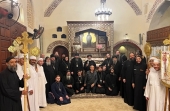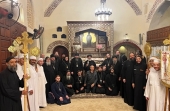
On May 30 — June 1, 2024 a delegation of abbots and monastics of the Russian Orthodox Church headed by Metropolitan Isidore of Smolensk and Dorogobuzh, who is on a patriarchy.ru/db/text/6132867.html">pilgrimage in Egypt, visited the monasteries of the Nitria Desert (Wadi al-Natrun), where Christian monasticism originated in the early 4th century.
At the beginning of the 4th century.
The first stop for the pilgrims was the Monastery of St. Macarius the Great, founded in 360 by this saint revered throughout the Christian world and the site of the earthly exploits and blessed death of one of the founders of monasticism described in the Egyptian Paterik. Metropolitan Isidore and members of the delegation worshipped in the temples of the monastery the relics of the Monk Makarius the Great, two other holy elders who ascended here later and also bore the name Makarius in angelic form, as well as the incorrupt remains of the Monks Paphnutius the Great, Pimen the Great, St. John the Baptist, the Prophet Elisha, John Kolov and other great ascetics, including 51 martyrs who lived in the 5th century; 49 of them were brethren of the monastery, who together with their abbot voluntarily refused to flee from the barbarians who attacked the monastery and chose to die for Christ. Two laymen also suffered with them. They were pilgrims from Constantinople who were then nearby; a nobleman of the imperial court and his nine-year-old son named Zeus. According to the legend, the boy miraculously saw angels descending from heaven and laying shining crowns on the martyrs, after which he desired the same feat and induced his father to enter the monastery and share the fate of the sufferers. The brethren of the monastery are witnesses of cases of healings of the sick and other miracles which still occur at the prayers of these saints. Russian pilgrims also prayed before the icon of the Mother of God «Hodegetria-Smolenskaya», presented to the monastery at the end of the XIX century by the Holy Royal Passion-Bearer Emperor Nicholas II.
The delegation visited the monastery library — the repository of ancient manuscripts of monks of the Nitria Desert.
The pilgrims then visited the Nitria Desert Lavra — the Monastery of St. Paisios the Great (Anba Bishoy), founded by this saint around 357. The delegation worshipped the relics of many ascetics of the ancient Church, first of all Paisios the Great himself, and visited the tomb of His Holiness Patriarch Shenouda III of Coptic (1971-2012), buried here, whose personality is associated with an important epoch in the development of the Coptic Church. The pilgrims were welcomed by Bishop Agapii and his brethren, abbot of the Monastery of St. Paisius. A long communion took place, during which they discussed the issues of monastic life in Russian and Coptic monasteries.
In the monastery of the Syrians (as-Suriani), founded at the end of the IV century by disciples of the Monk Paisios the Great, pilgrims visited his cell, in which he asceticized for many years, including carrying the feat of unsleeping prayer. Closely connected with this ancient monastery is the name of St. Ephrem the Syrian, who once came here to meet with St. Paisios the Great. On the territory of the monastery even today one can see a tree bearing fruit for over one and a half thousand years, which grew from the staff of St. Ephrem stuck in the ground, a living testimony of the meeting of the two ascetics.
Then representatives of Russian monasticism visited the monastery of the Romans (al-Baramus), founded around 335 by St. Macarius the Great and is the first male monastery in the Christian world. It received its name in memory of the sons of the Roman Emperor Valentinian, Maximus and Domitia, who asceticized here at the end of the fourth century under the leadership of this saint. The members of the delegation worshiped the relics of St. Paphnutius the Great, St. Moses Murin, St. Isidore of Egypt and other desert fathers who once lived in the monastery and prayed at the place of St. Arsenius the Great's exploits, a preserved column in the narthex of the main church, behind which he humbly prayed for many years, taking a vow of silence. The guests from Russia toured the IV century refectory, where the first Christian monks at the end of the Liturgy made agape and common meals before going to their desert cells. A stone table and benches for sitting, as well as a stone analogue from which the hegumen read the Holy Scriptures and the Lausaic to the brethren during the meal, have been preserved in this room. Among the buildings on the monastery grounds, the most notable is the citadel, typical of ancient Egyptian monasteries, which served the monks as a defense against numerous attacks by nomadic robbers.
At the end of their stay in the Nitria Desert, the delegation of the Russian Orthodox Church visited the monastery of St. Thomas, an Egyptian ascetic of the 5th century, where the guests were welcomed by the abbot of the monastery, Bishop Severius, and his brethren.
While visiting the Nitria Desert, the pilgrims stayed at the Patriarchal and Synodal Center «Logos» — one of the administrative complexes of the Coptic Patriarchate, where many events of historical importance took place, including meetings of the Joint Commission for Theological Dialogue between the Orthodox Church and the Ancient Eastern Churches, as well as regular meetings of the Holy Synod of the Coptic Church.
The pilgrims' journey will continue to the shrines of Central Egypt and the Red Sea Desert.
The delegation also includes: Bishop Anthony of Volgodonsk and Salsky; Archimandrite Philip (Ponamarchuk), vicar of the Nikolo-Shartomsky monastery in Shuyskaya Yevgeny.html">Shuisky Diocese; Hieromonk Stephan (Igumnov), Secretary of the Department for External Church Relations for Inter-Christian Relations; Hegumen Dionisy (Shlenov), Vicar of the Andreevsky Stavropegial Monastery in Moscow; Hegumen Sergius (Shlenov), Vicar of the Andreevsky Stavropegial Monastery in Moscow; Hegumen Sergius (Sergius), Vicar of the Stavropegial Monastery in Moscow. Moscow; hegumen Sergius (Kuksov), abbot of the David's Desert of the Podolsk Eparchy; hegumen Daniel (Tsupikov), abbot of the Gorno-Nikolsky Monastery of Bryansk Eparchy; hegumen Nikolai (Zolotov), vicar of the Spaso-Preobrazhensky Abrahamiev Monastery Smolensk Eparchy; hieromonk Melchizedek (Skripkin), abbot of the St. John the Theologian Monastery Ryazanskaya Eparchy; hieromonk Melchizedek (Skripkin), abbot of the St. John the Evangelist Monastery Ryazan Eparchy Diocese; Hieromonk Mark (Akhmatkhanov), an employee of the Department for External Church Relations; Priest Lev Garin, assistant to Metropolitan Isidor of Smolensk and Dorogobuzh; Hegumenia Agnia (Sudarikova), abbess of Holy Trinity Belopesotsky Monastery of the Podolsk Diocese. The delegation was accompanied by Bishop Severius, abbot of St. Thomas Monastery and St. Victor Monastery in Hatatba; Hieromonk Daoud el-Anthony, representative of the Coptic Church in Russia; A. Milad, advisor to the Coptic Patriarch; Hieromonk Zeus, abbot of the Monastery of St. Macarius the Great; and Hieromonk Pimen, abbot of the Monastery of St. Paul of Thebes.
EVCS Communication Service/Patriarchy.ru