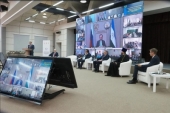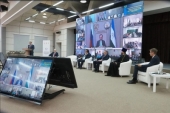
On September 12, 2024 in the city of Saransk took place the Interregional scientific and practical penitentiary forum «Probation in Russia. Experience and prospects», the purpose of which was to discuss the implementation of the provisions of the Federal Law of February 6, 2023 N 10-FZ «On Probation in the Russian Federation».
.
The forum was attended by the Plenipotentiary Representative of the President of the Russian Federation in the Volga Federal District Igor Komarov (via videoconference), Minister of Justice of the Russian Federation Konstantin Chuichenko, Chairman of the State Duma Committee of the Federal Assembly of the Russian Federation on Security and Anti-Corruption Vasily Piskarev, Director of the Federal Penitentiary Service of Russia, General of the Internal Service of the Russian Federation Arkady Gostev, Head of the Republic of Mordovia Artem Zdunov, acting.Acting Chairman of the Synodal Department for Prison Ministry Priest Kirill Markovsky, law enforcement officials, public organizations, and representatives of major enterprises.
Metropolitan Zinovy of Saransk and Mordovia Metropolitan Zinovy of Saransk and Mordovia and representatives of the Spiritual Administration of Muslims of the Republic of Mordovia were among the guests of honor at the forum.
The participants of the meeting considered the following issues issues related to the creation and development of the probation institution in the country; — a set of support measures applied to convicted persons or persons released from prison.
The event was opened by Artem Zdunov, head of the Republic of Mordovia, who welcomed the participants and spoke about the innovations applied in the region for the resocialization of former convicts. The head of the republic noted that currently in Mordovia a register of released prisoners and those who want to be trained or employed has been created; a service for preparation and placement of a convicted person's resume nine months before release on the portal «Work of Russia» a case of audio fairs has been developed and tested. So far, 25 such events have taken place, and every third released person has been employed. In addition, inmates undergo training in educational institutions of the Federal Penitentiary Service of Russia, and upon its completion they confirm their knowledge and skills at the examination center in front of the commission and representatives of potential employers.
In his speech, Minister of Justice of the Russian Federation Konstantin Chuichenko reported on the development of the institute of probation in Russia, including through the expansion of the network of correctional centers, which allows for more frequent application of punishment that is not related to imprisonment. The Minister also touched upon the creation of probation centers, the work of which is aimed at socializing those who leave prison.
The main burden in the implementation of the Federal Law &lquo;On Probation in the Russian Federation» falls on the staff of the Federal Penitentiary Service of Russia. Currently, the department is training specialists for this sphere, and specialized faculties have been created in educational organizations of the Federal Penitentiary Service of Russia. Arkady Gostev, Director of the Federal Penitentiary Service of Russia, spoke about the systematic work being carried out with convicts serving their sentences in places of deprivation of liberty in order to receive education, impart work skills, subsequent employment, overcome alcohol or drug addiction, and maintain and restore social ties.
The probation system involves a wide range of not only state structures, but also civil society institutions and religious organizations. And, of course, the Russian Orthodox Church plays a special role here. The active work of clergymen in places of detention, the performance of divine services, the participation of prisoners in the sacraments of the Church, spiritual conversations, and familiarization with spiritual literature have a positive impact on the inner state of persons in prison. isolation. Priest Kirill Markovsky, acting chairman of the Synodal Department for Prison Ministry, spoke about the role of religious organizations in the prison probation system.
«All the activities of clergy in places of detention are aimed at achieving the goals of probation, which are outlined in the Federal Law. This has always been the case, long before the adoption of the law on probation in the Russian Federation. At present, more than 1,000 Orthodox clergymen in Russia provide spiritual care for suspects, accused and convicted persons in penitentiary institutions, Father Kirill said. — One of the main tasks of their work is, on the one hand, to help a person who has broken the law to deeply realize his criminal actions, which are always destructive for him personally and his loved ones. On the other — to understand the unchangeable validity of the spiritual law, according to which there is only one way to fullness of life and human happiness — to live in accordance with the Divine and human decrees. At the same time, the Church does not only familiarize man with the spiritual laws of existence. In the divine services and Sacraments of the Church man really draws strength for a new life, in which his abilities are revealed and his vocation in life is realized.
Priest Kirill noted that, unfortunately, the potential of religious organizations at present is not yet fully used. One of the main tasks to be solved in the near future in cooperation with the Federal Service for the Execution of Sentences is to ensure that inmates receive quality spiritual education: higher, secondary or primary education in spiritual educational organizations of the Russian Orthodox Church. Convicts have a desire to study. It is difficult to overestimate the importance of spiritual education in the process of human correction and establishment in a new life.
According to the head of the Synodal Department for Prison Ministry, another important area that needs to be developed is the participation of religious organizations in post-penitentiary probation. This participation is possible, first, as the direct creation by religious organizations of resocialization centers, where people released from prison would come (it is crucial that a person goes to this center immediately after release, since this period is very important in terms of his preparation for life at large). The Church has experience in creating such centers. But, unfortunately, they are still very rare. Perhaps, probation centers, which, according to the Federal The clergyman noted that the probation system can be created by religious organizations, among others, and is an option that should be seriously considered.
The interregional forum was a discussion platform that allowed for a deeper study of the development of the probation system in our country.
The interregional forum has become a discussion platform that allows to study the development of the probation system in our country in more depth, to exchange experience, to outline further directions for the development of this social institution. Next, participants of the plenary session of the forum visited an exhibition of achievements of the production sector of the penal system of the Republic of Mordovia. The outdoor exposition presented goods for the defense-industrial complex, garden and park furniture, landscape compositions made of wood, arts and crafts and many other things that are produced in the penitentiary institutions of the region.