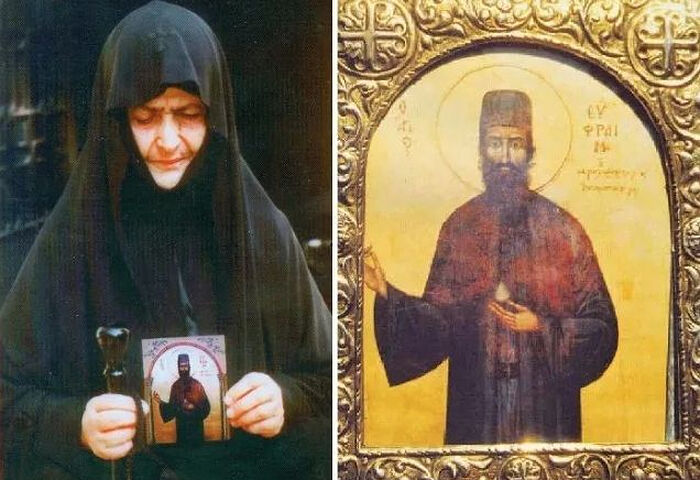
Nea Makri (Attica, Greece), June 7, 2024.

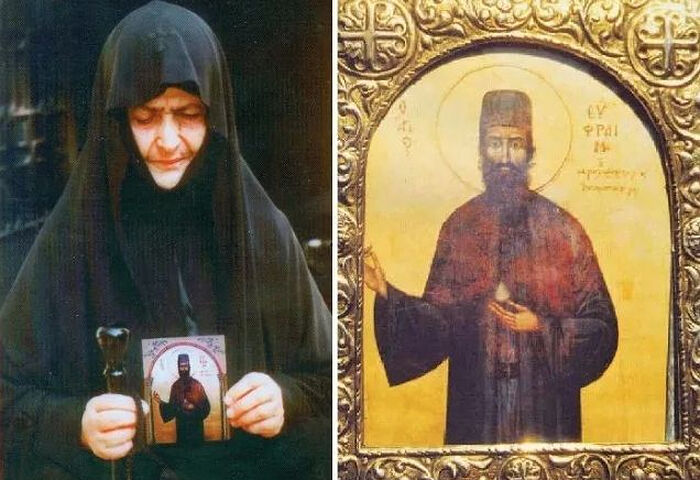
Eldress Makaria (Desipri), who served as abbess of the Holy Annunciation Monastery in Nea Makri (Attica, Greece), who in 1950 was able to discover the relics of the Monk Martyr Ephraim the New, the Wonderworker of Nea Makri (+ c. c. 1426; Comm. 3/16 Jan. 1426; Comm. 3/16 January and 5/18 May) may soon be glorified as a saint.
Metropolitan Cyril (Misyakoulis) of Kifissi, Amarousia and Orop, who served at the monastery at the end of May, announced the happy news. The hierarch has already submitted the relevant documents to the Holy Synod of the Hellenic Church, which will then pass them to the Patriarchate of Constantinople with a request for canonization, Orthodoxia News Agency reported.
Theodosia, an old woman (gerontissa) who ran the monastery after the St. Macaria was also characterized by a holy life. When she departed to the Lord on the feast of the Nativity of the Blessed Virgin Mary in 2022 at the age of 103, the whole monastery was filled with a bright ethereal light.

The future old woman Makaria was born on March 12, 1911 on the island of Tinos. At the age of 19 she decided that she wanted to become a nun. During the occupation, she lovingly cared for the children of prisoners. In 1945 Makaria visited the then men's monastery on Mount Amomon near the town of Nea Makri, where she lived for several years in harsh conditions. During this time her health was severely tested. She slept among the ruins of the monastery, without windows or a roof over her head, enduring all the hardships.
Moved by divine inspiration, she set up a small cell there and began to clear the ruins of the old church to rebuild it. She often reflected on the fact that monks had lived here for centuries and prayed to meet or receive a revelation from one of them. An inner voice (weak at first, but growing stronger with time) commanded her: "Dig and you will find what you wish to find." Then a place in the monastery yard was revealed to her where she should dig.
On January 3, 1950, Macaria instructed a worker to dig at the very spot the voice had indicated to her. Despite the worker's initial reluctance to do so, he was persuaded by her pleas and prayers. A dilapidated fireplace, a wall and ruins were discovered, indicating that it had once been a monk's cell. The first find was the head of the saint - and immediately the whole place was filled with fragrance!
"I reverently knelt down and kissed the relics of the saint, deeply feeling the extent of his torment [recall that on the feast of the Exaltation of the Holy Cross, when he was 42 years old, St. Ephrem was taken captive by Muslim pirates, They tortured him for 8 months, unsuccessfully trying to make him deny Christ, and then hung him upside down from a tree in the courtyard of the monastery, hammered huge nails into his hands and feet, and pierced his body with a red-hot sharp iron rod. note]. My soul was filled with joy - I had found a great treasure. Carefully removing another layer of earth, I saw the rest of his relics, which, despite the fact that they had lain in the ground for many centuries, had not decayed," wrote Matushka Makaria, describing the events that made a deep impression on her.
Carefully Abbess Makaria removed all the relics from the ground and placed them in a niche above the grave. It was obvious that the relics belonged to a clergyman, as his cassock was preserved imperishable.
That same evening, while reading the monastic rule, Matushka Makaria heard footsteps coming from the grave to the door of the church. There she saw him for the first time: it was a tall man with small round eyes, a long black beard up to his neck, dressed in monastic garb. In one hand he held a fire and with the other he was blessing. The monk asked that his body be removed from the niche where he was then placed. The next day, the abbess brought the remains to a proper state and placed them in a niche in the altar of the temple.
That same night the saint appeared to Macaria in a dream, thanked her and revealed his name: Ephrem. Since then, the relics of St. Ephrem have been kept here, and hundreds of believers flock here daily to ask for his blessing and help. By the grace of God, the saint performed thousands of miracles. In the monastery yard of Nea Makri there is still a mulberry tree (mulberry), on which the martyr Ephrem almost 600 years ago took his last breath.
Without any financial means, the old woman Makaria until 1980 miraculously maintained an orphanage, which housed about 70 children of school age, providing them with shelter, food, clothing and primary education. Those who excelled in their studies received higher education, and today they testify to this.
Without a university education, Abbess Makaria published holy theological works, "Words of asceticism" by St. Basil the Great, composed a prayer canon and akathist to her favorite saint Ephrem, recorded and gradually published his miracles in 16 volumes for the consolation and strengthening of the faithful.
The Lord of Glory gave Mother Macaria in her old age to bear the great cross. She bore it with patience and silence, perceiving her trial as a blessing of God. Her end, which she had predicted more than 20 years before her death, was peaceful and righteous.
The Holy Soul of the Elderess Macaria, undoubtedly guided by the holy Monk-martyr Ephraim, after receiving the Holy Mysteries of Christ, she ascended to Heaven on April 23 [the Hellenic Church adheres to the New Julian calendar - note], 1999, at the age of 88.
Today her long-suffering body rests in a remote grave in the monastery cemetery, dug by the old woman Makaria herself many years ago. By the grace of God, she was able to become a revivalist and for half a century to serve as abbess of this monastery, to hear the chants and to be a witness to the glorious and marvelous favors that St. Ephrem does for those who come to his holy monastery in faith.