Today our Church celebrates the Feast of the Epiphany, i.e. the completion of the great Feast of Lights. Through the baptism of Christ the Savior in the Jordan River, all nature is sanctified and man is illuminated by the true light, which is the God-Man Himself.
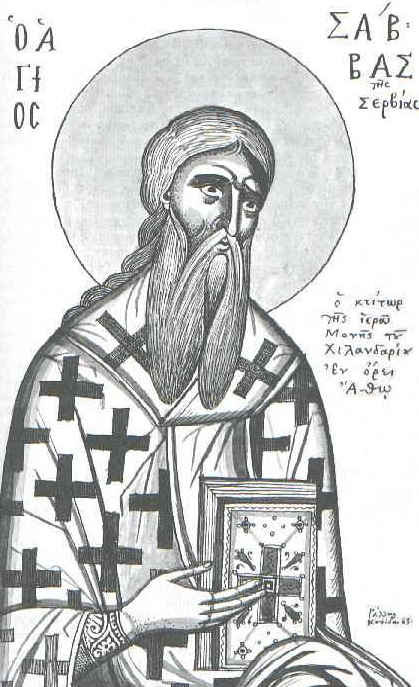
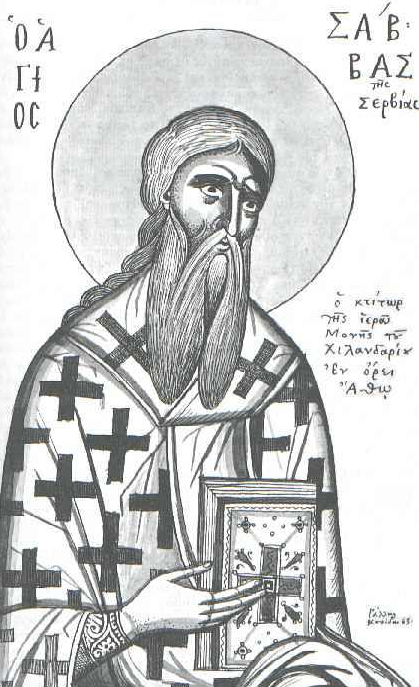
We also honor the memory of the seventy-one holy fathers abolished at Sinai and Raifos, St. Theodulus and St. Stephen and St. Agnes, as well as St. Sava, the first Archbishop of Serbia and founder of the monastery of Hilandari on Mount Athos.
St. Sava lived at the end of the 12th - beginning of the 13th century AD. He was the second son of the ruler of Serbia Stefan I Neman and Princess Anna. From early childhood he strove for morality and virtue and showed great love for the Christian life. Under these conditions he went to Athos at the age of 17, where, with the consent of his royal father, he became a monk in Athos and was renamed Savva, taking the name of the Great Monk of the Desert.
Later, his royal father also arrived on Mount Athos. The royal example was followed by other Serbian private individuals. Thus, around 1195, on the initiative of St. Sava, the Serbian monastery of Hilandari was built.
The Saint, being merciful, helped the poor. Later he left Mount Athos and went on a pilgrimage to the Holy Land, from where, spiritually armed, he returned to Serbia to support the the faith of his fellow Orthodox Christians. He was then appointed archbishop. Having worked for God, he slept peacefully in Tarnovo in 1236.
It took the Serbian Orthodox Christians 40 years to build the Perikal Church of St. Sava in the center of Belgrade. It is one of the largest churches in the Balkans and remains a landmark for our devout Serbian Christian brothers.
We also honor the memory of the seventy-one holy fathers abolished at Sinai and Raifos, St. Theodulus and St. Stephen and St. Agnes, as well as St. Sava, the first Archbishop of Serbia and founder of the monastery of Hilandari on Mount Athos.
St. Sava lived at the end of the 12th - beginning of the 13th century AD. He was the second son of the ruler of Serbia Stefan I Neman and Princess Anna. From early childhood he strove for morality and virtue and showed great love for the Christian life. Under these conditions he went to Athos at the age of 17, where, with the consent of his royal father, he became a monk in Athos and was renamed Savva, taking the name of the Great Monk of the Desert.
Later, his royal father also arrived on Mount Athos. The royal example was followed by other Serbian private individuals. Thus, around 1195, on the initiative of St. Sava, the Serbian monastery of Hilandari was built.
The Saint, being merciful, helped the poor. Later he left Mount Athos and went on a pilgrimage to the Holy Land, from where, spiritually armed, he returned to Serbia to support the the faith of his fellow Orthodox Christians. He was then appointed archbishop. Having worked for God, he slept peacefully in Tarnovo in 1236.
It took the Serbian Orthodox Christians 40 years to build the Perikal Church of St. Sava in the center of Belgrade. It is one of the largest churches in the Balkans and remains a landmark for our devout Serbian Christian brothers.
Share: