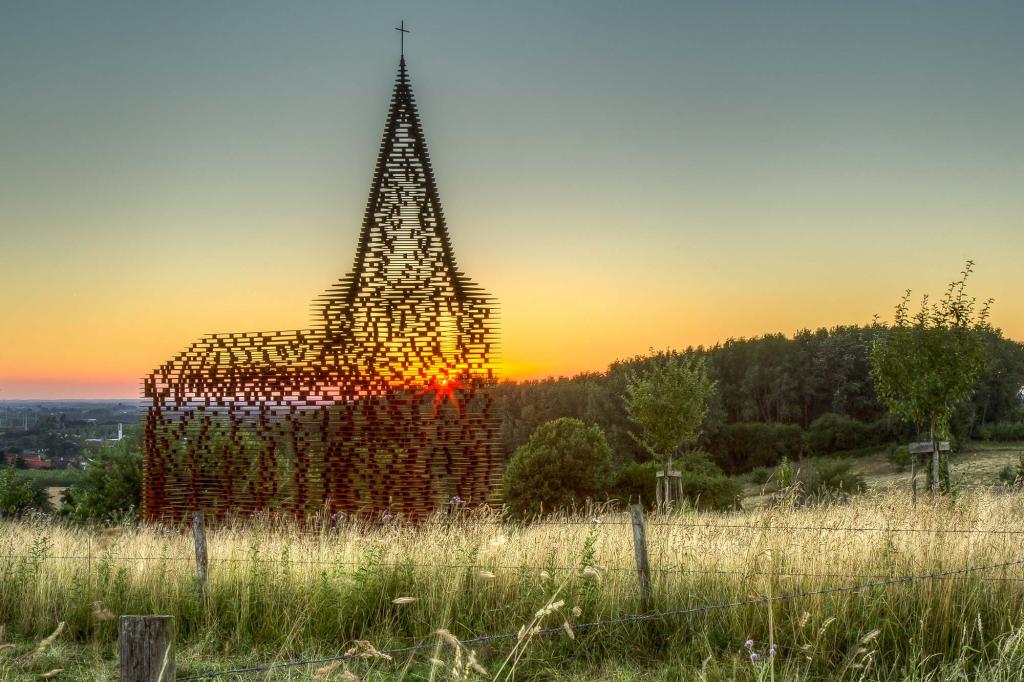
Aerial Church in Limburg (Belgium)

Воздушная церковь в Лимбурге (Бельгия)

It is impossible to attribute this temple to any of the Christian confessions - after all, services are not held there. At the same time, this unusual church in the Belgian Limburg carries a deep symbolic message, formulated and honed over the centuries of development of Christian thought in Europe.
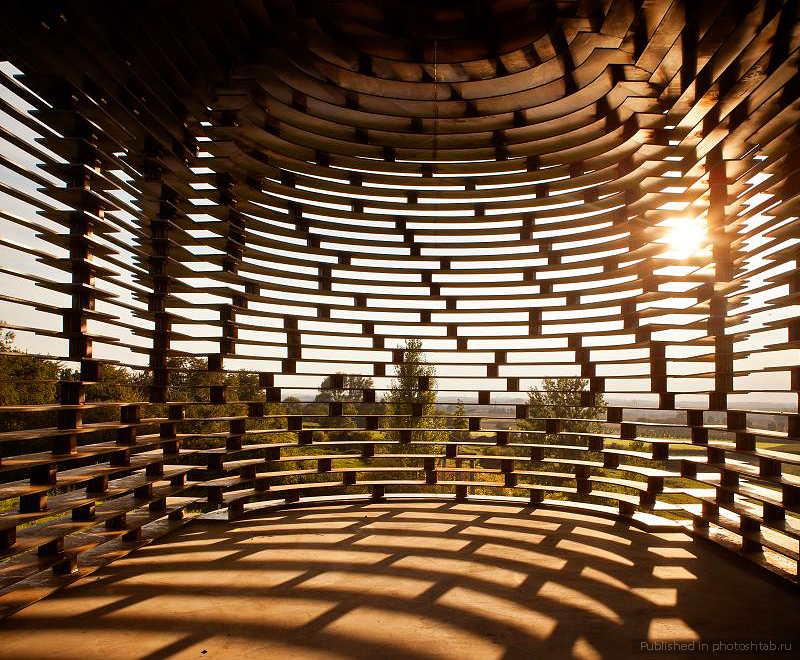
Вид изнутри
Вид изнутри

Belgium, a country known to the whole world for ancient Flemish painting, masterpieces of sculpture and architecture, never ceases to amaze with the works of art created today. Undoubtedly one of the most famous of these is the Hespengau Temple, Borglon Heath, Limburg Province. It is composed of a hundred layers of steel plates - and at the same time, it seems to float in the air. The unusual church is not dedicated to either a saint or a holiday - while it is undoubtedly Christian: the spire of the building is crowned with a four-pointed cross. As an architectural structure, it has a name that can be translated into Russian as “Reading between the lines”.

The air temple was built in 2011 according to the project of the creative studio 'Giles & Vayerenberg'. Young architects Peterjan Giles (Pieterjan Gijs) and Arnout Van Vaerenbergh, whose names the studio bears, are the authors of a number of contemporary art works included in public space and united in a project called Z-OUT. The Limburg Temple is also part of it.
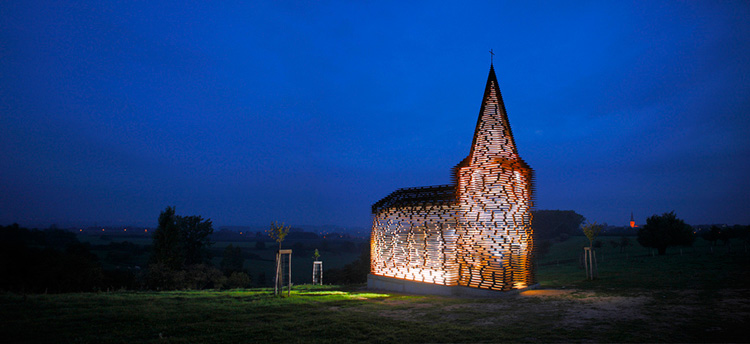
Воздушная церковь вечером
It would seem that the structure of almost thirty tons of steel plates has no functional meaning - in a building open to all winds, you can only hide from the rain. In fact, the intention of the creators of the temple is much deeper. Whether the walls of the temple represent a barrier between a person and the world around him, of which he is a part - this is perhaps the main question that they invite everyone who enters inside to answer on their own ...

The silhouette of the Limburg aerial temple resembles the churches traditional for this area - and at the same time does not repeat exactly any of them. Outside, depending on the point at which the beholder is located, the temple may seem like a heavy monolith of metal - or, conversely, almost dissolve into the surrounding landscape, like a mirage. If you look at the surrounding landscape from the inside of the temple, it develops into a kind of abstract drawing, which gives rise to everyone's own associations.
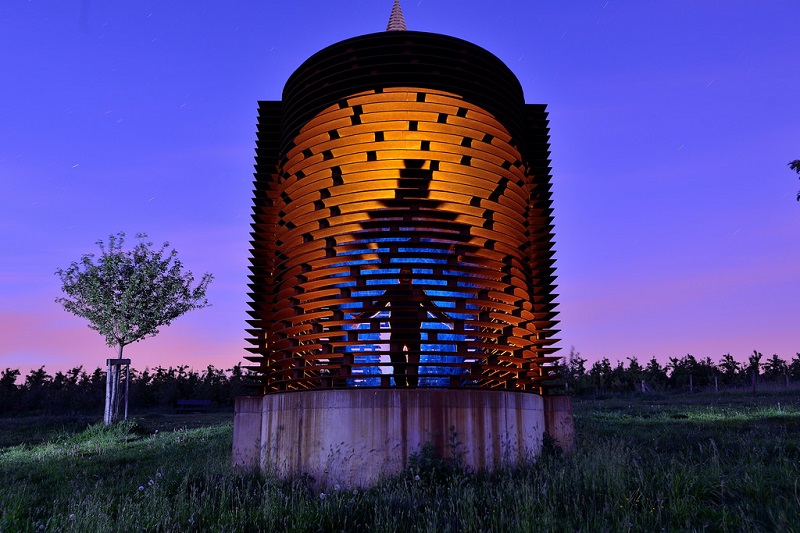
Пронизанная лучами заходящего солнца атмосфера внутри храма создает ощущение возвышенности
The building is about ten meters high. The horizontal elements of the structure are located in such a way that they deprive the one who entered the temple of the feeling of security and a certain closedness that people tend to feel while inside ordinary buildings. But this is exactly how it should be here, because the Divine permeates all creation as a whole, including the crown of His creation - man.

Interestingly, the project that Giles and Van Warenberg was involved in prior to the construction of the air temple was also related to the church. This is the Church of St. Michael in the district of Leuven - a building built in 1671, destroyed during the Second World War and then rebuilt. For him, two young Belgian architects, using steel chains, designed the original inner dome.
V. Sergienko

Share:
Aerial Church in Limburg (Belgium) Aerial Church in Limburg (Belgium) It is impossible to attribute this temple to any of the Christian confessions - after all, services are not held there. At the same time, this unusual church in the Belgian Limburg carries a deep symbolic message, formulated and honed over the centuries of development of Christian thought in Europe. Вид изнутри Belgium, a country known to the whole world for ancient Flemish painting, masterpieces of sculpture and architecture, never ceases to amaze with the works of art created today. Undoubtedly one of the most famous of these is the Hespengau Temple, Borglon Heath, Limburg Province. It is composed of a hundred layers of steel plates - and at the same time, it seems to float in the air. The unusual church is not dedicated to either a saint or a holiday - while it is undoubtedly Christian: the spire of the building is crowned with a four-pointed cross. As an architectural structure, it has a name that can be translated into Russian as “Reading between the lines”. The air temple was built in 2011 according to the project of the creative studio 'Giles & Vayerenberg'. Young architects Peterjan Giles (Pieterjan Gijs) and Arnout Van Vaerenbergh, whose names the studio bears, are the authors of a number of contemporary art works included in public space and united in a project called Z-OUT. The Limburg Temple is also part of it. Воздушная церковь вечером It would seem that the structure of almost thirty tons of steel plates has no functional meaning - in a building open to all winds, you can only hide from the rain. In fact, the intention of the creators of the temple is much deeper. Whether the walls of the temple represent a barrier between a person and the world around him, of which he is a part - this is perhaps the main question that they invite everyone who enters inside to answer on their own ... The silhouette of the Limburg aerial temple resembles the churches traditional for this area - and at the same time does not repeat exactly any of them. Outside, depending on the point at which the beholder is located, the temple may seem like a heavy monolith of metal - or, conversely, almost dissolve into the surrounding landscape, like a mirage. If you look at the surrounding landscape from the inside of the temple, it develops into a kind of abstract drawing, which gives rise to everyone's own associations. Пронизанная лучами заходящего солнца атмосфера внутри храма создает ощущение возвышенности The building is about ten meters high. The horizontal elements of the structure are located in such a way that they deprive the one who entered the temple of the feeling of security and a certain closedness that people tend to feel while inside ordinary buildings. But this is exactly how it should be here, because the Divine permeates all creation as a whole, including the crown of His creation - man. Interestingly, the project that Giles and Van Warenberg was involved in prior to the construction of the air temple was also related to the church. This is the Church of St. Michael in the district of Leuven - a building built in 1671, destroyed during the Second World War and then rebuilt. For him, two young Belgian architects, using steel chains, designed the original inner dome. V. Sergienko
It is impossible to attribute this temple to any of the Christian confessions - after all, services are not held there. At the same time, this unusual church in the Belgian Limburg carries a deep symbolic message, formulated and honed over the centuries of development of Christian thought in Europe. Вид изнутри Belgium, a country known to the whole world for ancient Flemish painting, masterpieces of sculpture and architecture, never ceases to amaze with the works of art created today. Undoubtedly one of the most famous of these is the Hespengau Temple, Borglon Heath, Limburg Province. It is composed of a hundred layers of steel plates - and at the same time, it seems to float in the air. The unusual church is not dedicated to either a saint or a holiday - while it is undoubtedly Christian: the spire of the building is crowned with a four-pointed cross. As an architectural structure, it has a name that can be translated into Russian as “Reading between the lines”. The air temple was built in 2011 according to the project of the creative studio 'Giles & Vayerenberg'. Young architects Peterjan Giles (Pieterjan Gijs) and Arnout Van Vaerenbergh, whose names the studio bears, are the authors of a number of contemporary art works included in public space and united in a project called Z-OUT. The Limburg Temple is also part of it. Воздушная церковь вечером It would seem that the structure of almost thirty tons of steel plates has no functional meaning - in a building open to all winds, you can only hide from the rain. In fact, the intention of the creators of the temple is much deeper. Whether the walls of the temple represent a barrier between a person and the world around him, of which he is a part - this is perhaps the main question that they invite everyone who enters inside to answer on their own ... The silhouette of the Limburg aerial temple resembles the churches traditional for this area - and at the same time does not repeat exactly any of them. Outside, depending on the point at which the beholder is located, the temple may seem like a heavy monolith of metal - or, conversely, almost dissolve into the surrounding landscape, like a mirage. If you look at the surrounding landscape from the inside of the temple, it develops into a kind of abstract drawing, which gives rise to everyone's own associations. Пронизанная лучами заходящего солнца атмосфера внутри храма создает ощущение возвышенности The building is about ten meters high. The horizontal elements of the structure are located in such a way that they deprive the one who entered the temple of the feeling of security and a certain closedness that people tend to feel while inside ordinary buildings. But this is exactly how it should be here, because the Divine permeates all creation as a whole, including the crown of His creation - man. Interestingly, the project that Giles and Van Warenberg was involved in prior to the construction of the air temple was also related to the church. This is the Church of St. Michael in the district of Leuven - a building built in 1671, destroyed during the Second World War and then rebuilt. For him, two young Belgian architects, using steel chains, designed the original inner dome. V. Sergienko