Every year, many thousands of pilgrims who visit the Holy Land flock to the city where the Savior of the world, the Lord Jesus Christ, was born. The Basilica of the Nativity of Christ located here, along with the Jerusalem Church of the Holy Sepulcher and the Church of the Annunciation in Nazareth, are among the most revered Christian shrines. However, on the way to Bethlehem, in this city itself and its environs there are a considerable number of holy places associated with the earthly life of the Savior and the Mother of God, as well as with the living history of Christianity - from the first centuries to the present day. The purpose of this material is to take a closer look at at least the most important of them. Modern Bethlehem is a city in the Palestinian Authority, on the west bank of the Jordan River, and the capital of the province of the same name in historical Judea. The name of the city is translated as 'House of Bread' - and, less often, as 'House of Meat': these two words in the Hebrew language are quite close in sound. It was here, in Bethlehem / Beit Lechem, according to the Holy Scriptures, that the king-psalmist David was anointed for the kingdom - for this reason the place is also called 'the city of David.' However, for Christians all over the world, who come here for the feast of the Nativity of Christ and at any other time of the year, the appearance of the Lord Jesus Christ here is more important. This event, as well as the great shrine associated with it - the Church of the Nativity of Christ in Bethlehem - we will touch on in another, separate article. And today we will tell you about the holy places, which are often completely undeservedly ignored by pilgrims who focus on visiting a single temple, albeit a great one, in a city with three and a half thousand years of history.
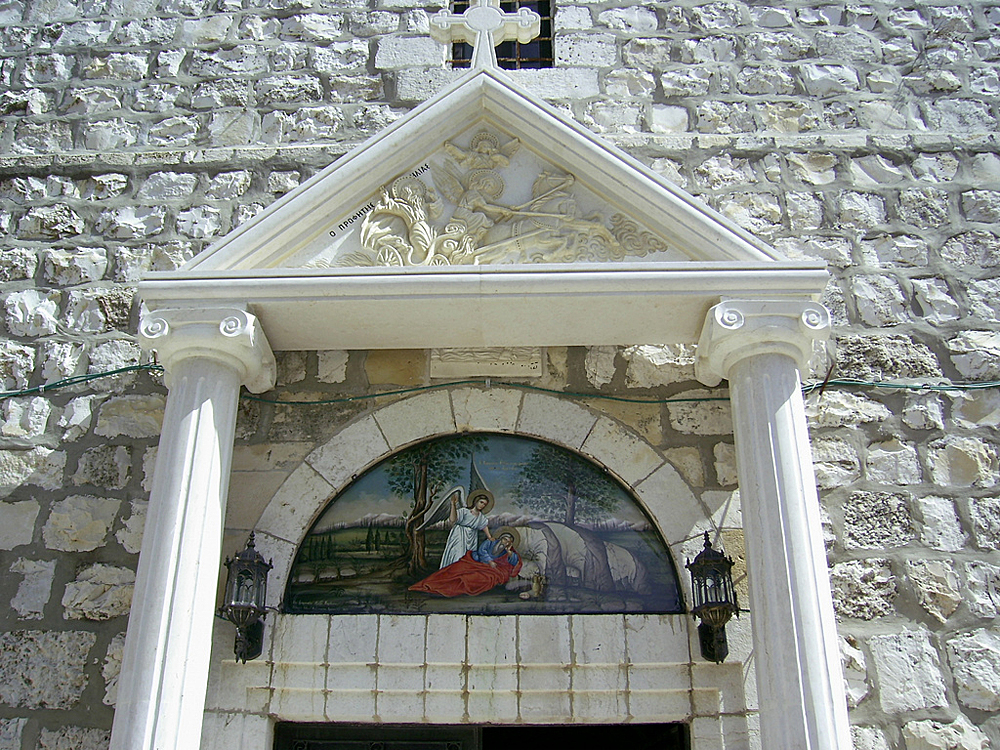
Portico at the entrance to the monastery of Elijah the Prophet So, for most pilgrims and tourists, the road to ancient Bethlehem starts from Jerusalem, from which the city is separated by only ten kilometers. The first place from which the traveler has a view of Bethlehem is the monastery of Elijah the Prophet , one of the most striking figures of the Old Testament, hiding in these places from the treacherous Queen Jezebel. However, the Christian monastery is also connected with two other ascetics who bore the same name: a monk from Egypt, who became the patriarch of Jerusalem, and the Greek bishop Elijah of Bethlehem. During its long history, the beginning of which dates back to the 6th century, the monastery has suffered from earthquakes more than once: its buildings were destroyed in whole or in part - and then rebuilt by the forces of the inhabitants. The last time a major overhaul was done in the monastery was done in 1893 - at the same time a monastery belfry appeared here. At the entrance to the holy monastery, pilgrims are greeted by a portico with a relief - on it the prophet Elijah ascends to heaven on chariot of fire. The portico was built quite recently, in 2010. And of the monks, only one lives here today, who looks after the monastery. Unfortunately, such a small population of the ancient Christian shrines of Palestine in our time is by no means uncommon. Moving from Jerusalem further towards the destination of his journey - Bethlehem - the pilgrim can stop at another shrine - the tomb of Rachel , revered by the followers of Judaism, Christianity and Islam. The biblical foremother, one of the wives of the patriarch Jacob, Rachel died in childbirth, giving birth to her second son, Benjamin, and for centuries became a symbol of female sacrifice. As the prophet Jeremiah testifies, a thousand years later a woman's weeping was heard at this place - it was heard by many when the Jews were taken into Babylonian captivity.
Tomb of the foremother Rachel Rachel's tombstone of eleven stones, repeatedly destroyed and rebuilt anew, revered in ancient times. However, a protective one appeared here only in the seventeenth century, when the Turkish ruler allowed to enclose with a wall four pillars and a dome above them, which enclosed the tomb. Two hundred years later, the building was expanded; a prayer room was attached to it, which in turn are used by adherents of Islam and Judaism. Nowadays, Rachel's tomb is fenced with a strong concrete wall for the safety of the travelers who visit it. In the province of Bethlehem, there is also the town of Beit Jala, whose residents consider St. Nicholas the Wonderworker their heavenly patron and annually organize a colorful festival in his honor, which attracts thousands of Christians from different countries. In Beit Jala, there is the monastery of St. George the Victorious, founded in the third century, and with it - the cave in which Nicholas the Wonderworker prayed. A separate large article is devoted to Beit Jaleh on the Jerusalem Candle website, so here we will not talk in detail about this town - but rather we will go to Bethlehem itself, and then to its surroundings. In the city where the Savior appeared in the world, besides the very place of His birth, marked by the majestic Basilica of the Nativity, there are other Christian shrines. For example, the Milk Cave on the street of the same name Milk Grotto, in which, according to Legend, the Holy Family hid during the beating of infants by King Herod before fleeing to Egypt. The Most Holy Theotokos, who was breastfeeding the Infant, accidentally dropped a few drops of milk, after which the floor and vaults of the cave, which were previously dark, immediately turned white. Note that all houses in the surrounding area is built of brown-beige stone - and the Milk Cave alone is white. Splinters from its walls already in the Middle Ages spread throughout the Christian world as precious relics. And today, fragments of stone from this cave are considered by both Christians and Muslims to give women childbearing and an abundance of breast milk. Today the Catholic Church of the Milk Cave rises above the Milk Cave. Before, an ancient temple stood in its place, the mosaics of which have survived - they can be seen on the terrace of the church.
Milk Cave, Bethlehem
King David's Wells, Bethlehem
It would be strange if not a single place was found in the “city of David” associated with this king and prophet, to whom the Savior's genealogy goes back. And there really is such a place in Bethlehem. It is called the Wells of King David, located in the eastern part of the city - and represents three giant water basins that are located on the territory of the Catholic Social Center. Tradition associates this place with the biblical 'well of Bethlehem, which is at the gate.' When David, fighting the Philistines, wanted to get drunk, several soldiers with they obtained water for him here in battle - but the king refused to drink it, obtained at the risk of his life. It is interesting that in the century before last, to the east of the Wells of King David, as a result of excavations, the remains of a church of the 5th-6th centuries were found, which stood above the ancient necropolis, the entrance to which was marked with the Constantine cross. Perhaps this Bethlehem church bore the name of King David - this is often mentioned by pilgrims of the early Middle Ages; there is even a version that the remains of the Old Testament Tsar-psalmist were in it for a long time. On the outskirts of Bethlehem, near the town of Beit Sahur, there is a place where on the night of Christmas God's angel appeared to the shepherds, commanding them to hurry to the place where the King of Kings was born - they will find him in swaddling clothes, lying in a manger for feeding animals. The shepherds hastened to fulfill what he said - and everything happened in exactly the way described. Olive trees two thousand years old were, perhaps, silent witnesses of those very evangelical events. These trees still grow on the Shepherds' Field.
Near the Cathedral of the Most Holy Theotokos, Field of Shepherds
Church Glory to God in the Highest, Field of Shepherds
According to legend, the shepherds called by an angel to witness the coming into the world of the Savior, completing their earthly path, wished to be buried in these places, which was done. Over time, martyrs for the faith of Christ, who were killed by the Persians in the 7th century, found rest next to them. Already in the Byzantine era, a temple was erected over their graves, which was repeatedly destroyed and then restored. And in the seventies of the last century, after excavations and cardinal reconstruction, next to the Cave of the Shepherds , a temple of the Cathedral of the Most Holy Theotokos was erected on three thrones. However, this temple on the Field of Shepherds is not the only one. In the north-western part of it there is the Catholic Church Gloria in Excelsis Deo or in Arabic Dair-Asir. It was built by the brothers of the Order of St. Francis in the middle of the last century. The temple, the name of which translates as ' Glory to God in the highest ', has the shape of a shepherd's hut - its shape is designed to remind of the events of the Holy Night, when the herding flocks were honored to see the angels of God descending and ascending into heaven. In memory of that miracle, the dome of the temple was made transparent. And his three thrones are consecrated in memory of the events of the night of Christmas: the first - in honor of the appearance of the angels, the second - in memory of the worship of the Divine Infant in Bethlehem cave and, finally, the third reminds of the return of the shepherds to the sheep ... Next to the temple belfry there is a sculptured image of an angel made of bronze. The events associated with the Nativity of the Savior are also correlated with places located at a greater distance from Bethlehem. These include the monastery of Theodosius the Great with the Cave of the Magi - the very first cenobitic monastic cloister in the Holy Land. According to legend, the Gospel Magi stopped here on their way back after worshiping the newborn Christ. Here, in the cave, is the revered image of the Burial of the Monk Theodosius - the very relics of the saint rest in the Church of the Holy Sepulcher in Jerusalem. But the ashes of the holy wives - Eulogia, Theodora, Sophia - and the relics of the martyrs killed by the Persians in 614 are here, in the monastery cave. However, the Persians are not the only non-believers who destroyed the monastery, which during its heyday numbered up to seven hundred monastic brethren. In the sixteenth century, the monastery was destroyed by the Turks. Its restoration began only in 1914 and lasted thirty-eight years. Today this monastery is for women; it is under the jurisdiction of the Jerusalem Patriarchate.
Lavra of Savva the Sanctified Another ancient monastic monastery, which can be visited when traveling from Bethlehem - Mar-Saba, the monastery of Sava the Sanctified in the Judean Desert. This monastery, in contrast to the previous one, is for men, its abbot is the Patriarch of Jerusalem. Unfortunately, women are not allowed to enter the territory of the Lavra according to the local charter. The relics of the founder of the monastery, Saint Sava, rest in the chapel on the territory of the monastery. The fate of the monastery of Sava the Sanctified is similar to the fate of many Christian shrines in Palestine: it was repeatedly destroyed - by Bedouins, Persians, Muslim Arabs, and even once by an earthquake - and each time it was patiently rebuilt by Christian monks anew. The bell tower of the monastery bears the name of Emperor Justinian, who patronized the local inhabitants in ancient times. The latest reconstruction of the Lavra dates back to the century before last. At the same time, the main temple of the monastery - the Catholicon of the Annunciation of the Most Holy Theotokos - dates back to the original construction of the 5th-6th centuries. By the names of the saints, whose relics rest in this monastery, one can study the history of Christianity. Among them is the Monk John Damascene, who was tonsured a monk here and asceticised in the Lavra for about fifty years: his tomb with his relics has survived to our time. Unfortunately, the monastic brethren of the Mar-Saba monastery today not numerous: only one and a half dozen Orthodox Greeks, Romanians and Russians. However, in our journey through the outskirts of Bethlehem, today we have deviated quite far to the east. Next time we will return to the city itself to take a closer look at one of the greatest Christian shrines in the whole world - the place of the Nativity of Christ and the basilica of the same name towering above it. V. Sergienko
Bethlehem - 'House of Bread' and its surroundingsBethlehem - 'House of Bread' and its surroundings Every year, many thousands of pilgrims who visit the Holy Land flock to the city where the Savior of the world, the Lord Jesus Christ, was born. The Basilica of the Nativity of Christ located here, along with the Jerusalem Church of the Holy Sepulcher and the Church of the Annunciation in Nazareth, are among the most revered Christian shrines. However, on the way to Bethlehem, in this city itself and its environs there are a considerable number of holy places associated with the earthly life of the Savior and the Mother of God, as well as with the living history of Christianity - from the first centuries to the present day. The purpose of this material is to take a closer look at at least the most important of them. Modern Bethlehem is a city in the Palestinian Authority, on the west bank of the Jordan River, and the capital of the province of the same name in historical Judea. The name of the city is translated as 'House of Bread' - and, less often, as 'House of Meat': these two words in the Hebrew language are quite close in sound. It was here, in Bethlehem / Beit Lechem, according to the Holy Scriptures, that the king-psalmist David was anointed for the kingdom - for this reason the place is also called 'the city of David.' However, for Christians all over the world, who come here for the feast of the Nativity of Christ and at any other time of the year, the appearance of the Lord Jesus Christ here is more important. This event, as well as the great shrine associated with it - the Church of the Nativity of Christ in Bethlehem - we will touch on in another, separate article. And today we will tell you about the holy places, which are often completely undeservedly ignored by pilgrims who focus on visiting a single temple, albeit a great one, in a city with three and a half thousand years of history. Portico at the entrance to the monastery of Elijah the Prophet So, for most pilgrims and tourists, the road to ancient Bethlehem starts from Jerusalem, from which the city is separated by only ten kilometers. The first place from which the traveler has a view of Bethlehem is the monastery of Elijah the Prophet , one of the most striking figures of the Old Testament, hiding in these places from the treacherous Queen Jezebel. However, the Christian monastery is also connected with two other ascetics who bore the same name: a monk from Egypt, who became the patriarch of Jerusalem, and the Greek bishop Elijah of Bethlehem. During its long history, the beginning of which dates back to the 6th century, the monastery has suffered from earthquakes more than once: its buildings were destroyed in whole or in part - and then rebuilt by the forces of the inhabitants. The last time a major overhaul was done in the monastery was done in 1893 - at the same time a monastery belfry appeared here. At the entrance to the holy monastery, pilgrims are greeted by a portico with a relief - on it the prophet Elijah ascends to heaven on chariot of fire. The portico was built quite recently, in 2010. And of the monks, only one lives here today, who looks after the monastery. Unfortunately, such a small population of the ancient Christian shrines of Palestine in our time is by no means uncommon. Moving from Jerusalem further towards the destination of his journey - Bethlehem - the pilgrim can stop at another shrine - the tomb of Rachel , revered by the followers of Judaism, Christianity and Islam. The biblical foremother, one of the wives of the patriarch Jacob, Rachel died in childbirth, giving birth to her second son, Benjamin, and for centuries became a symbol of female sacrifice. As the prophet Jeremiah testifies, a thousand years later a woman's weeping was heard at this place - it was heard by many when the Jews were taken into Babylonian captivity. Tomb of the foremother Rachel Rachel's tombstone of eleven stones, repeatedly destroyed and rebuilt anew, revered in ancient times. However, a protective one appeared here only in the seventeenth century, when the Turkish ruler allowed to enclose with a wall four pillars and a dome above them, which enclosed the tomb. Two hundred years later, the building was expanded; a prayer room was attached to it, which in turn are used by adherents of Islam and Judaism. Nowadays, Rachel's tomb is fenced with a strong concrete wall for the safety of the travelers who visit it. In the province of Bethlehem, there is also the town of Beit Jala, whose residents consider St. Nicholas the Wonderworker their heavenly patron and annually organize a colorful festival in his honor, which attracts thousands of Christians from different countries. In Beit Jala, there is the monastery of St. George the Victorious, founded in the third century, and with it - the cave in which Nicholas the Wonderworker prayed. A separate large article is devoted to Beit Jaleh on the Jerusalem Candle website, so here we will not talk in detail about this town - but rather we will go to Bethlehem itself, and then to its surroundings. In the city where the Savior appeared in the world, besides the very place of His birth, marked by the majestic Basilica of the Nativity, there are other Christian shrines. For example, the Milk Cave on the street of the same name Milk Grotto, in which, according to Legend, the Holy Family hid during the beating of infants by King Herod before fleeing to Egypt. The Most Holy Theotokos, who was breastfeeding the Infant, accidentally dropped a few drops of milk, after which the floor and vaults of the cave, which were previously dark, immediately turned white. Note that all houses in the surrounding area is built of brown-beige stone - and the Milk Cave alone is white. Splinters from its walls already in the Middle Ages spread throughout the Christian world as precious relics. And today, fragments of stone from this cave are considered by both Christians and Muslims to give women childbearing and an abundance of breast milk. Today the Catholic Church of the Milk Cave rises above the Milk Cave. Before, an ancient temple stood in its place, the mosaics of which have survived - they can be seen on the terrace of the church. Milk Cave, Bethlehem King David's Wells, Bethlehem It would be strange if not a single place was found in the “city of David” associated with this king and prophet, to whom the Savior's genealogy goes back. And there really is such a place in Bethlehem. It is called the Wells of King David, located in the eastern part of the city - and represents three giant water basins that are located on the territory of the Catholic Social Center. Tradition associates this place with the biblical 'well of Bethlehem, which is at the gate.' When David, fighting the Philistines, wanted to get drunk, several soldiers with they obtained water for him here in battle - but the king refused to drink it, obtained at the risk of his life. It is interesting that in the century before last, to the east of the Wells of King David, as a result of excavations, the remains of a church of the 5th-6th centuries were found, which stood above the ancient necropolis, the entrance to which was marked with the Constantine cross. Perhaps this Bethlehem church bore the name of King David - this is often mentioned by pilgrims of the early Middle Ages; there is even a version that the remains of the Old Testament Tsar-psalmist were in it for a long time. On the outskirts of Bethlehem, near the town of Beit Sahur, there is a place where on the night of Christmas God's angel appeared to the shepherds, commanding them to hurry to the place where the King of Kings was born - they will find him in swaddling clothes, lying in a manger for feeding animals. The shepherds hastened to fulfill what he said - and everything happened in exactly the way described. Olive trees two thousand years old were, perhaps, silent witnesses of those very evangelical events. These trees still grow on the Shepherds' Field. Near the Cathedral of the Most Holy Theotokos, Field of Shepherds Church Glory to God in the Highest, Field of Shepherds According to legend, the shepherds called by an angel to witness the coming into the world of the Savior, completing their earthly path, wished to be buried in these places, which was done. Over time, martyrs for the faith of Christ, who were killed by the Persians in the 7th century, found rest next to them. Already in the Byzantine era, a temple was erected over their graves, which was repeatedly destroyed and then restored. And in the seventies of the last century, after excavations and cardinal reconstruction, next to the Cave of the Shepherds , a temple of the Cathedral of the Most Holy Theotokos was erected on three thrones. However, this temple on the Field of Shepherds is not the only one. In the north-western part of it there is the Catholic Church Gloria in Excelsis Deo or in Arabic Dair-Asir. It was built by the brothers of the Order of St. Francis in the middle of the last century. The temple, the name of which translates as ' Glory to God in the highest ', has the shape of a shepherd's hut - its shape is designed to remind of the events of the Holy Night, when the herding flocks were honored to see the angels of God descending and ascending into heaven. In memory of that miracle, the dome of the temple was made transparent. And his three thrones are consecrated in memory of the events of the night of Christmas: the first - in honor of the appearance of the angels, the second - in memory of the worship of the Divine Infant in Bethlehem cave and, finally, the third reminds of the return of the shepherds to the sheep ... Next to the temple belfry there is a sculptured image of an angel made of bronze. The events associated with the Nativity of the Savior are also correlated with places located at a greater distance from Bethlehem. These include the monastery of Theodosius the Great with the Cave of the Magi - the very first cenobitic monastic cloister in the Holy Land. According to legend, the Gospel Magi stopped here on their way back after worshiping the newborn Christ. Here, in the cave, is the revered image of the Burial of the Monk Theodosius - the very relics of the saint rest in the Church of the Holy Sepulcher in Jerusalem. But the ashes of the holy wives - Eulogia, Theodora, Sophia - and the relics of the martyrs killed by the Persians in 614 are here, in the monastery cave. However, the Persians are not the only non-believers who destroyed the monastery, which during its heyday numbered up to seven hundred monastic brethren. In the sixteenth century, the monastery was destroyed by the Turks. Its restoration began only in 1914 and lasted thirty-eight years. Today this monastery is for women; it is under the jurisdiction of the Jerusalem Patriarchate. Lavra of Savva the Sanctified Another ancient monastic monastery, which can be visited when traveling from Bethlehem - Mar-Saba, the monastery of Sava the Sanctified in the Judean Desert. This monastery, in contrast to the previous one, is for men, its abbot is the Patriarch of Jerusalem. Unfortunately, women are not allowed to enter the territory of the Lavra according to the local charter. The relics of the founder of the monastery, Saint Sava, rest in the chapel on the territory of the monastery. The fate of the monastery of Sava the Sanctified is similar to the fate of many Christian shrines in Palestine: it was repeatedly destroyed - by Bedouins, Persians, Muslim Arabs, and even once by an earthquake - and each time it was patiently rebuilt by Christian monks anew. The bell tower of the monastery bears the name of Emperor Justinian, who patronized the local inhabitants in ancient times. The latest reconstruction of the Lavra dates back to the century before last. At the same time, the main temple of the monastery - the Catholicon of the Annunciation of the Most Holy Theotokos - dates back to the original construction of the 5th-6th centuries. By the names of the saints, whose relics rest in this monastery, one can study the history of Christianity. Among them is the Monk John Damascene, who was tonsured a monk here and asceticised in the Lavra for about fifty years: his tomb with his relics has survived to our time. Unfortunately, the monastic brethren of the Mar-Saba monastery today not numerous: only one and a half dozen Orthodox Greeks, Romanians and Russians. However, in our journey through the outskirts of Bethlehem, today we have deviated quite far to the east. Next time we will return to the city itself to take a closer look at one of the greatest Christian shrines in the whole world - the place of the Nativity of Christ and the basilica of the same name towering above it. V. SergienkoСвеча Иерусалима -en
Every year, many thousands of pilgrims who visit the Holy Land flock to the city where the Savior of the world, the Lord Jesus Christ, was born. The Basilica of the Nativity of Christ located here, along with the Jerusalem Church of the Holy Sepulcher and the Church of the Annunciation in Nazareth, are among the most revered Christian shrines. However, on the way to Bethlehem, in this city itself and its environs there are a considerable number of holy places associated with the earthly life of the Savior and the Mother of God, as well as with the living history of Christianity - from the first centuries to the present day. The purpose of this material is to take a closer look at at least the most important of them. Modern Bethlehem is a city in the Palestinian Authority, on the west bank of the Jordan River, and the capital of the province of the same name in historical Judea. The name of the city is translated as 'House of Bread' - and, less often, as 'House of Meat': these two words in the Hebrew language are quite close in sound. It was here, in Bethlehem / Beit Lechem, according to the Holy Scriptures, that the king-psalmist David was anointed for the kingdom - for this reason the place is also called 'the city of David.' However, for Christians all over the world, who come here for the feast of the Nativity of Christ and at any other time of the year, the appearance of the Lord Jesus Christ here is more important. This event, as well as the great shrine associated with it - the Church of the Nativity of Christ in Bethlehem - we will touch on in another, separate article. And today we will tell you about the holy places, which are often completely undeservedly ignored by pilgrims who focus on visiting a single temple, albeit a great one, in a city with three and a half thousand years of history. Portico at the entrance to the monastery of Elijah the Prophet So, for most pilgrims and tourists, the road to ancient Bethlehem starts from Jerusalem, from which the city is separated by only ten kilometers. The first place from which the traveler has a view of Bethlehem is the monastery of Elijah the Prophet , one of the most striking figures of the Old Testament, hiding in these places from the treacherous Queen Jezebel. However, the Christian monastery is also connected with two other ascetics who bore the same name: a monk from Egypt, who became the patriarch of Jerusalem, and the Greek bishop Elijah of Bethlehem. During its long history, the beginning of which dates back to the 6th century, the monastery has suffered from earthquakes more than once: its buildings were destroyed in whole or in part - and then rebuilt by the forces of the inhabitants. The last time a major overhaul was done in the monastery was done in 1893 - at the same time a monastery belfry appeared here. At the entrance to the holy monastery, pilgrims are greeted by a portico with a relief - on it the prophet Elijah ascends to heaven on chariot of fire. The portico was built quite recently, in 2010. And of the monks, only one lives here today, who looks after the monastery. Unfortunately, such a small population of the ancient Christian shrines of Palestine in our time is by no means uncommon. Moving from Jerusalem further towards the destination of his journey - Bethlehem - the pilgrim can stop at another shrine - the tomb of Rachel , revered by the followers of Judaism, Christianity and Islam. The biblical foremother, one of the wives of the patriarch Jacob, Rachel died in childbirth, giving birth to her second son, Benjamin, and for centuries became a symbol of female sacrifice. As the prophet Jeremiah testifies, a thousand years later a woman's weeping was heard at this place - it was heard by many when the Jews were taken into Babylonian captivity. Tomb of the foremother Rachel Rachel's tombstone of eleven stones, repeatedly destroyed and rebuilt anew, revered in ancient times. However, a protective one appeared here only in the seventeenth century, when the Turkish ruler allowed to enclose with a wall four pillars and a dome above them, which enclosed the tomb. Two hundred years later, the building was expanded; a prayer room was attached to it, which in turn are used by adherents of Islam and Judaism. Nowadays, Rachel's tomb is fenced with a strong concrete wall for the safety of the travelers who visit it. In the province of Bethlehem, there is also the town of Beit Jala, whose residents consider St. Nicholas the Wonderworker their heavenly patron and annually organize a colorful festival in his honor, which attracts thousands of Christians from different countries. In Beit Jala, there is the monastery of St. George the Victorious, founded in the third century, and with it - the cave in which Nicholas the Wonderworker prayed. A separate large article is devoted to Beit Jaleh on the Jerusalem Candle website, so here we will not talk in detail about this town - but rather we will go to Bethlehem itself, and then to its surroundings. In the city where the Savior appeared in the world, besides the very place of His birth, marked by the majestic Basilica of the Nativity, there are other Christian shrines. For example, the Milk Cave on the street of the same name Milk Grotto, in which, according to Legend, the Holy Family hid during the beating of infants by King Herod before fleeing to Egypt. The Most Holy Theotokos, who was breastfeeding the Infant, accidentally dropped a few drops of milk, after which the floor and vaults of the cave, which were previously dark, immediately turned white. Note that all houses in the surrounding area is built of brown-beige stone - and the Milk Cave alone is white. Splinters from its walls already in the Middle Ages spread throughout the Christian world as precious relics. And today, fragments of stone from this cave are considered by both Christians and Muslims to give women childbearing and an abundance of breast milk. Today the Catholic Church of the Milk Cave rises above the Milk Cave. Before, an ancient temple stood in its place, the mosaics of which have survived - they can be seen on the terrace of the church. Milk Cave, Bethlehem King David's Wells, Bethlehem It would be strange if not a single place was found in the “city of David” associated with this king and prophet, to whom the Savior's genealogy goes back. And there really is such a place in Bethlehem. It is called the Wells of King David, located in the eastern part of the city - and represents three giant water basins that are located on the territory of the Catholic Social Center. Tradition associates this place with the biblical 'well of Bethlehem, which is at the gate.' When David, fighting the Philistines, wanted to get drunk, several soldiers with they obtained water for him here in battle - but the king refused to drink it, obtained at the risk of his life. It is interesting that in the century before last, to the east of the Wells of King David, as a result of excavations, the remains of a church of the 5th-6th centuries were found, which stood above the ancient necropolis, the entrance to which was marked with the Constantine cross. Perhaps this Bethlehem church bore the name of King David - this is often mentioned by pilgrims of the early Middle Ages; there is even a version that the remains of the Old Testament Tsar-psalmist were in it for a long time. On the outskirts of Bethlehem, near the town of Beit Sahur, there is a place where on the night of Christmas God's angel appeared to the shepherds, commanding them to hurry to the place where the King of Kings was born - they will find him in swaddling clothes, lying in a manger for feeding animals. The shepherds hastened to fulfill what he said - and everything happened in exactly the way described. Olive trees two thousand years old were, perhaps, silent witnesses of those very evangelical events. These trees still grow on the Shepherds' Field. Near the Cathedral of the Most Holy Theotokos, Field of Shepherds Church Glory to God in the Highest, Field of Shepherds According to legend, the shepherds called by an angel to witness the coming into the world of the Savior, completing their earthly path, wished to be buried in these places, which was done. Over time, martyrs for the faith of Christ, who were killed by the Persians in the 7th century, found rest next to them. Already in the Byzantine era, a temple was erected over their graves, which was repeatedly destroyed and then restored. And in the seventies of the last century, after excavations and cardinal reconstruction, next to the Cave of the Shepherds , a temple of the Cathedral of the Most Holy Theotokos was erected on three thrones. However, this temple on the Field of Shepherds is not the only one. In the north-western part of it there is the Catholic Church Gloria in Excelsis Deo or in Arabic Dair-Asir. It was built by the brothers of the Order of St. Francis in the middle of the last century. The temple, the name of which translates as ' Glory to God in the highest ', has the shape of a shepherd's hut - its shape is designed to remind of the events of the Holy Night, when the herding flocks were honored to see the angels of God descending and ascending into heaven. In memory of that miracle, the dome of the temple was made transparent. And his three thrones are consecrated in memory of the events of the night of Christmas: the first - in honor of the appearance of the angels, the second - in memory of the worship of the Divine Infant in Bethlehem cave and, finally, the third reminds of the return of the shepherds to the sheep ... Next to the temple belfry there is a sculptured image of an angel made of bronze. The events associated with the Nativity of the Savior are also correlated with places located at a greater distance from Bethlehem. These include the monastery of Theodosius the Great with the Cave of the Magi - the very first cenobitic monastic cloister in the Holy Land. According to legend, the Gospel Magi stopped here on their way back after worshiping the newborn Christ. Here, in the cave, is the revered image of the Burial of the Monk Theodosius - the very relics of the saint rest in the Church of the Holy Sepulcher in Jerusalem. But the ashes of the holy wives - Eulogia, Theodora, Sophia - and the relics of the martyrs killed by the Persians in 614 are here, in the monastery cave. However, the Persians are not the only non-believers who destroyed the monastery, which during its heyday numbered up to seven hundred monastic brethren. In the sixteenth century, the monastery was destroyed by the Turks. Its restoration began only in 1914 and lasted thirty-eight years. Today this monastery is for women; it is under the jurisdiction of the Jerusalem Patriarchate. Lavra of Savva the Sanctified Another ancient monastic monastery, which can be visited when traveling from Bethlehem - Mar-Saba, the monastery of Sava the Sanctified in the Judean Desert. This monastery, in contrast to the previous one, is for men, its abbot is the Patriarch of Jerusalem. Unfortunately, women are not allowed to enter the territory of the Lavra according to the local charter. The relics of the founder of the monastery, Saint Sava, rest in the chapel on the territory of the monastery. The fate of the monastery of Sava the Sanctified is similar to the fate of many Christian shrines in Palestine: it was repeatedly destroyed - by Bedouins, Persians, Muslim Arabs, and even once by an earthquake - and each time it was patiently rebuilt by Christian monks anew. The bell tower of the monastery bears the name of Emperor Justinian, who patronized the local inhabitants in ancient times. The latest reconstruction of the Lavra dates back to the century before last. At the same time, the main temple of the monastery - the Catholicon of the Annunciation of the Most Holy Theotokos - dates back to the original construction of the 5th-6th centuries. By the names of the saints, whose relics rest in this monastery, one can study the history of Christianity. Among them is the Monk John Damascene, who was tonsured a monk here and asceticised in the Lavra for about fifty years: his tomb with his relics has survived to our time. Unfortunately, the monastic brethren of the Mar-Saba monastery today not numerous: only one and a half dozen Orthodox Greeks, Romanians and Russians. However, in our journey through the outskirts of Bethlehem, today we have deviated quite far to the east. Next time we will return to the city itself to take a closer look at one of the greatest Christian shrines in the whole world - the place of the Nativity of Christ and the basilica of the same name towering above it. V. Sergienko