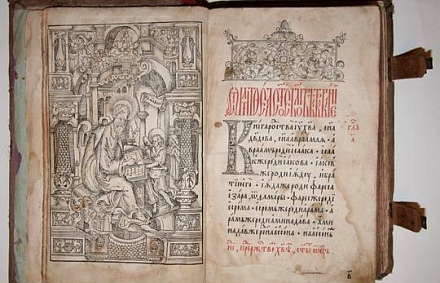
From Mark . 11: 1-11
When they approached Jerusalem, Bethphage and Bethany, and the Mount of Olives, Jesus sent two of His disciples
and he says to them: go to the village that is right in front of you; entering it, you will immediately find a young donkey tied up, on which none of the people sat; untied it, bring it.
And if someone tells you: why are you doing this? - answer that the Lord needs it; and at once will send him here.
They went and found a young donkey tied at the gate in the street and untied him.
And some of those who stood there said to them: What are you doing? Why do you untie the colt?
They answered them as Jesus commanded; and they let them go.
And they brought the colt to Jesus, and threw their clothes on him; Jesus sat on it.
Many spread their clothes on the way; while others cut branches from trees and spread them along the way.
And those who preceded and followed exclaimed: Hosanna! blessed is He who comes in the name of the Lord!
Blessed is the coming kingdom of our father David in the name of the Lord! Hosanna in the highest!
And Jesus went into Jerusalem and into the temple; and having examined everything, as it was already late, he went out to Bethany with twelve.
============
Iannuariy (Ivliev) archimandrite
Interpretation of a group of verses: Mark: 11: 9-9
The cry 'Blessed is he who comes in the name of the Lord!' - quote from 26 Blessed is he who comes in the name of the Lord! We bless you from the house of the Lord. Ps. 117: 26. In connection with these cries, three points should be noted.
1. This greeting is usually greeted by pilgrims when they reach the temple, gathering for a big feast.
2. “Coming One” is another title for the Messiah. When speaking of the Messiah, the Jews always spoke of the Coming One.
3. But the main meaning of these words becomes clear only in connection with the history of the origin of the indicated Psalm 117. In 167 BC. the Syrian throne was taken by a king named Antiochus. He considered it his duty to destroy the Jewish faith. It was then that Judas Maccabee appeared, who expelled in 163 BC. after a series of brilliant victories, Antiochus of Palestine. He purified and rededicated the temple, an event that is celebrated to this day as the Feast of Renewal, or the Feast of Hanuka. And Ps. 117 was written to perpetuate the memory of the great day of the cleansing of the temple and the victory won by Judas Maccabee. This is a conqueror's psalm.
Jesus repeatedly declared His right to be the Messiah, and at the same time tried to show people that they had the wrong impression of the Messiah. But people didn't see it. Their greetings were not intended for the King of love, but for the conqueror who would defeat Israel's enemies.
In verses 9 and 10 the word Hosanna is used. This word is always misunderstood. His quoted and used as if it meant praise, but this Hebrew word means 'Save!' This word occurs several times in the Scripture of the Old Testament 6), where it is used by people seeking help and protection from the king. So in reality the people who shouted Hosanna did not praise Jesus, as we usually understand; it was a call to God to intervene in the course of history and save His people, now that the Messiah has come.
* 6) 'And the woman Thekoitian came in to the king and fell on her face to the ground, and bowed down and said: help, king, [help]!' (4 And the woman Thecoitian came in to the king and fell on her face to the ground, and bowed down and said: Help, king, [help]! 2 Kings 14: 4). “Once the king of Israel was walking along the wall, and a woman with a cry said to him: help, my lord, king” (26 One day the king of Israel was passing along the wall, and a woman with a cry said to him: help, my lord, king. 4 Kings 6:26) ...
A source
Prepared by the rector of St. Nicholas Church Archpriest Roman Romanov.
When they approached Jerusalem, Bethphage and Bethany, and the Mount of Olives, Jesus sent two of His disciples
and he says to them: go to the village that is right in front of you; entering it, you will immediately find a young donkey tied up, on which none of the people sat; untied it, bring it.
And if someone tells you: why are you doing this? - answer that the Lord needs it; and at once will send him here.
They went and found a young donkey tied at the gate in the street and untied him.
And some of those who stood there said to them: What are you doing? Why do you untie the colt?
They answered them as Jesus commanded; and they let them go.
And they brought the colt to Jesus, and threw their clothes on him; Jesus sat on it.
Many spread their clothes on the way; while others cut branches from trees and spread them along the way.
And those who preceded and followed exclaimed: Hosanna! blessed is He who comes in the name of the Lord!
Blessed is the coming kingdom of our father David in the name of the Lord! Hosanna in the highest!
And Jesus went into Jerusalem and into the temple; and having examined everything, as it was already late, he went out to Bethany with twelve.
============
Iannuariy (Ivliev) archimandrite
Interpretation of a group of verses: Mark: 11: 9-9
The cry 'Blessed is he who comes in the name of the Lord!' - quote from 26 Blessed is he who comes in the name of the Lord! We bless you from the house of the Lord. Ps. 117: 26. In connection with these cries, three points should be noted.
1. This greeting is usually greeted by pilgrims when they reach the temple, gathering for a big feast.
2. “Coming One” is another title for the Messiah. When speaking of the Messiah, the Jews always spoke of the Coming One.
3. But the main meaning of these words becomes clear only in connection with the history of the origin of the indicated Psalm 117. In 167 BC. the Syrian throne was taken by a king named Antiochus. He considered it his duty to destroy the Jewish faith. It was then that Judas Maccabee appeared, who expelled in 163 BC. after a series of brilliant victories, Antiochus of Palestine. He purified and rededicated the temple, an event that is celebrated to this day as the Feast of Renewal, or the Feast of Hanuka. And Ps. 117 was written to perpetuate the memory of the great day of the cleansing of the temple and the victory won by Judas Maccabee. This is a conqueror's psalm.
Jesus repeatedly declared His right to be the Messiah, and at the same time tried to show people that they had the wrong impression of the Messiah. But people didn't see it. Their greetings were not intended for the King of love, but for the conqueror who would defeat Israel's enemies.
In verses 9 and 10 the word Hosanna is used. This word is always misunderstood. His quoted and used as if it meant praise, but this Hebrew word means 'Save!' This word occurs several times in the Scripture of the Old Testament 6), where it is used by people seeking help and protection from the king. So in reality the people who shouted Hosanna did not praise Jesus, as we usually understand; it was a call to God to intervene in the course of history and save His people, now that the Messiah has come.
* 6) 'And the woman Thekoitian came in to the king and fell on her face to the ground, and bowed down and said: help, king, [help]!' (4 And the woman Thecoitian came in to the king and fell on her face to the ground, and bowed down and said: Help, king, [help]! 2 Kings 14: 4). “Once the king of Israel was walking along the wall, and a woman with a cry said to him: help, my lord, king” (26 One day the king of Israel was passing along the wall, and a woman with a cry said to him: help, my lord, king. 4 Kings 6:26) ...
A source
Prepared by the rector of St. Nicholas Church Archpriest Roman Romanov.
Share: