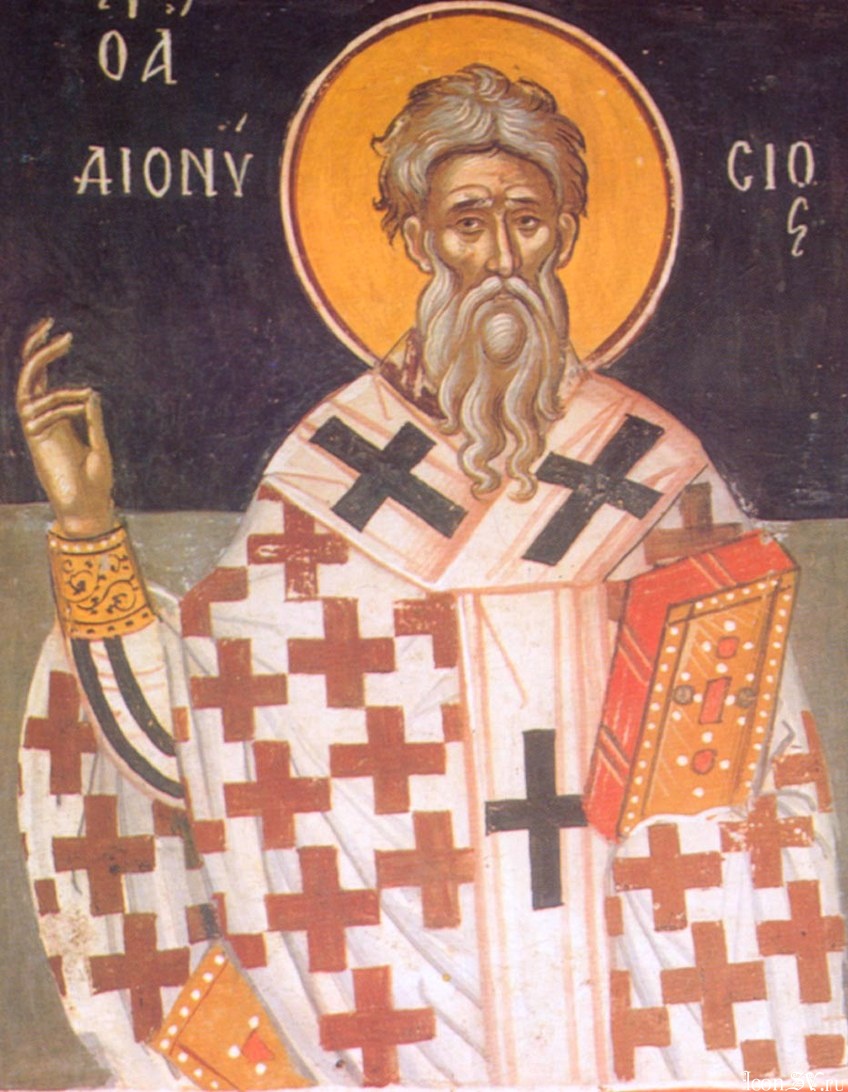
Hieromartyr Dionysius

Священномученик Дионисий
On October 16, Christians remember the Hieromartyr Dionysius, a disciple of the Apostle Paul, who was executed in the 2nd century A.D. Four books have survived to this day: 'On the Heavenly Hierarchy', 'On the Church Hierarchy', 'On the Names of God', 'On Mystical Theology', as well as ten epistles to various persons. Saint Dionysius was originally from Greece and received a classical Hellenic education. In Egypt, he studied astronomy and witnessed a solar eclipse that occurred at the time of the crucifixion of Jesus Christ. Returning to Athens, Dionysius was elected a member of the Supreme Court. When the apostle Paul preached in the Supreme Court, Dionysius became his disciple and followed him for three years. In 57 A.D. he was present at the burial of the Virgin Mary. When his teacher died, Dionysius decided to continue his work and went to preach about Christ in Spain, Germany and Rome. There, thanks to his preaching, many were converted to Christianity. In Gaul, during the persecution of Christians by the pagan authorities, he and his two companions were captured and thrown into prison. There Dionysius was constantly in prayer, and at night he conducted the divine liturgy. The next morning the martyrs were beheaded. Saint Dionysius took his head, marched with her to the church, and only there fell dead. The pious woman Catullus buried the remains of the martyr.
Share:
Hieromartyr Dionysius Hieromartyr Dionysius On October 16, Christians remember the Hieromartyr Dionysius, a disciple of the Apostle Paul, who was executed in the 2nd century A.D. Four books have survived to this day: 'On the Heavenly Hierarchy', 'On the Church Hierarchy', 'On the Names of God', 'On Mystical Theology', as well as ten epistles to various persons. Saint Dionysius was originally from Greece and received a classical Hellenic education. In Egypt, he studied astronomy and witnessed a solar eclipse that occurred at the time of the crucifixion of Jesus Christ. Returning to Athens, Dionysius was elected a member of the Supreme Court. When the apostle Paul preached in the Supreme Court, Dionysius became his disciple and followed him for three years. In 57 A.D. he was present at the burial of the Virgin Mary. When his teacher died, Dionysius decided to continue his work and went to preach about Christ in Spain, Germany and Rome. There, thanks to his preaching, many were converted to Christianity. In Gaul, during the persecution of Christians by the pagan authorities, he and his two companions were captured and thrown into prison. There Dionysius was constantly in prayer, and at night he conducted the divine liturgy. The next morning the martyrs were beheaded. Saint Dionysius took his head, marched with her to the church, and only there fell dead. The pious woman Catullus buried the remains of the martyr.
On October 16, Christians remember the Hieromartyr Dionysius, a disciple of the Apostle Paul, who was executed in the 2nd century A.D. Four books have survived to this day: 'On the Heavenly Hierarchy', 'On the Church Hierarchy', 'On the Names of God', 'On Mystical Theology', as well as ten epistles to various persons. Saint Dionysius was originally from Greece and received a classical Hellenic education. In Egypt, he studied astronomy and witnessed a solar eclipse that occurred at the time of the crucifixion of Jesus Christ. Returning to Athens, Dionysius was elected a member of the Supreme Court. When the apostle Paul preached in the Supreme Court, Dionysius became his disciple and followed him for three years. In 57 A.D. he was present at the burial of the Virgin Mary. When his teacher died, Dionysius decided to continue his work and went to preach about Christ in Spain, Germany and Rome. There, thanks to his preaching, many were converted to Christianity. In Gaul, during the persecution of Christians by the pagan authorities, he and his two companions were captured and thrown into prison. There Dionysius was constantly in prayer, and at night he conducted the divine liturgy. The next morning the martyrs were beheaded. Saint Dionysius took his head, marched with her to the church, and only there fell dead. The pious woman Catullus buried the remains of the martyr.