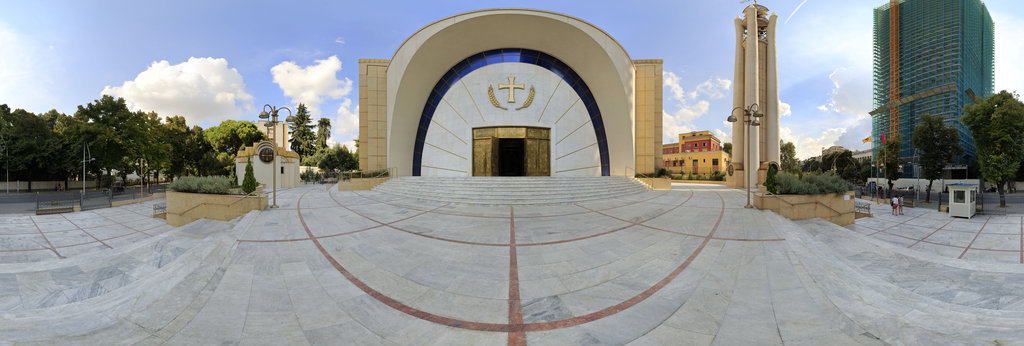
Cathedral of the Resurrection of Christ in Tirana (Albania)

Собор Воскресения Христова в Тиране (Албания)
The country, where every fifth inhabitant professes Orthodoxy, has gone through a long period of the rule of theomachists. Many historical shrines in Albania have been destroyed. In 1967, the cathedral in the capital of the country, Tirana, did not escape this fate. As compensation, the authorities of the new Albania allocated a plot for believing Christians to build a new cathedral in the very center of the city. The new Cathedral of the Resurrection of Christ in Tirana was built from 2004 to 2012. Its consecration and opening were timed to coincide with the twentieth anniversary of the revival of the autocephalous Albanian Orthodox Church and the choice of its head, Archbishop Anastasius. The grand opening of the cathedral took place on June 24, 2012. Both inside and outside the cathedral looks both majestic and, at the same time, somewhat unusual for Orthodox believers from other countries. Apart from the image of the Almighty in the center of the dome, there are icons here only in the iconostasis and on several lecterns. All of them were painted by the monks in the workshops on Mount Athos - especially for the cathedral in Tirana. During the service, believers here pray while sitting, rising only at the most solemn moments of the service, therefore, in the central part of the temple, rows of chairs are installed - or, rather, armchairs decorated with wood carvings. In the middle, on the tiled floor, you can see a two-headed eagle. TO It has nothing to do with Russia (although the Russian Orthodox Church took part in the construction of the cathedral financially): this is the coat of arms of Albania. Before the construction of a new Orthodox cathedral, the main one in the country, an international competition for the best architectural project was announced at the beginning of this century. The winner was Papadatos Partneriteti LLP Architects, a New York-based company owned by Orthodox immigrants of Greek origin. Their project was named the best of all presented - however, during the construction, many changes were made to the original plan. In addition to the cathedral itself, the architectural complex also includes a chapel, a bell tower, the residence of the Holy Synod and a cultural center. Here is how the official press release sent out to the opening of the cathedral describes the main idea of the ensemble: “The architectural concept of the cathedral is based on a cycle that contains an infinite sense of time - and a finite axis, symbolizing the One who connects the earth with heaven. This axis is the center of the huge cross that forms the foundation of the Orthodox Church. ' The roof of the cathedral and the cross crowning its sloping dome are covered with copper-colored gold leaf. The four main columns of the cathedral and the gaps between the dome windows are decorated with biblical bas-reliefs. Facade Cathedral, decorated with marble, made in the form of a giant bow and decorated with blue glass inserts. There is a large four-pointed cross above the main entrance. On the upper tier of the cathedral there is a loggia and two side balconies. At the same time, the pulpit and the iconostasis are visible from any point in the upper and lower tiers. The original chandelier consists of many brass circles; besides him, one hundred and twenty lamps located along the perimeter are responsible for lighting the interior space. In the northwestern part of the ensemble, a square chapel was erected, with an unusual roof, stylized as many domes and covered with copper. But perhaps the most unusual of all the buildings here is the 46-meter bell tower, which consists of four columns symbolizing the Evangelists. The columns are interconnected by a central axis, inside which there is a spiral staircase leading to a two-tiered belfry with sixteen bells. The administrative building on the territory of the cathedral houses the headquarters of the Holy Synod, the residence of the blessed archbishop, a library and two small chapels. The architectural complex of the cathedral also includes two underground tiers with a meeting hall for eight hundred places for church meetings and various cultural events. In addition to them, there are also refectory, museum and exhibition hall. Also on the territory of the cathedral complex there is a library and a Sunday school; there is a space for youth communication and a green area for recreation in summer. The Cathedral of the Resurrection of Christ harmoniously blended into the historical center of Tirana. Located next to the Historical Museum and Skanderbeg Square, it has become not only a spiritual center for all Orthodox Christians in Albania, but also plays an important role in the cause of interfaith understanding in the country. V. Sergienko
Share:
Cathedral of the Resurrection of Christ in Tirana (Albania) Cathedral of the Resurrection of Christ in Tirana (Albania) The country, where every fifth inhabitant professes Orthodoxy, has gone through a long period of the rule of theomachists. Many historical shrines in Albania have been destroyed. In 1967, the cathedral in the capital of the country, Tirana, did not escape this fate. As compensation, the authorities of the new Albania allocated a plot for believing Christians to build a new cathedral in the very center of the city. The new Cathedral of the Resurrection of Christ in Tirana was built from 2004 to 2012. Its consecration and opening were timed to coincide with the twentieth anniversary of the revival of the autocephalous Albanian Orthodox Church and the choice of its head, Archbishop Anastasius. The grand opening of the cathedral took place on June 24, 2012. Both inside and outside the cathedral looks both majestic and, at the same time, somewhat unusual for Orthodox believers from other countries. Apart from the image of the Almighty in the center of the dome, there are icons here only in the iconostasis and on several lecterns. All of them were painted by the monks in the workshops on Mount Athos - especially for the cathedral in Tirana. During the service, believers here pray while sitting, rising only at the most solemn moments of the service, therefore, in the central part of the temple, rows of chairs are installed - or, rather, armchairs decorated with wood carvings. In the middle, on the tiled floor, you can see a two-headed eagle. TO It has nothing to do with Russia (although the Russian Orthodox Church took part in the construction of the cathedral financially): this is the coat of arms of Albania. Before the construction of a new Orthodox cathedral, the main one in the country, an international competition for the best architectural project was announced at the beginning of this century. The winner was Papadatos Partneriteti LLP Architects, a New York-based company owned by Orthodox immigrants of Greek origin. Their project was named the best of all presented - however, during the construction, many changes were made to the original plan. In addition to the cathedral itself, the architectural complex also includes a chapel, a bell tower, the residence of the Holy Synod and a cultural center. Here is how the official press release sent out to the opening of the cathedral describes the main idea of the ensemble: “The architectural concept of the cathedral is based on a cycle that contains an infinite sense of time - and a finite axis, symbolizing the One who connects the earth with heaven. This axis is the center of the huge cross that forms the foundation of the Orthodox Church. ' The roof of the cathedral and the cross crowning its sloping dome are covered with copper-colored gold leaf. The four main columns of the cathedral and the gaps between the dome windows are decorated with biblical bas-reliefs. Facade Cathedral, decorated with marble, made in the form of a giant bow and decorated with blue glass inserts. There is a large four-pointed cross above the main entrance. On the upper tier of the cathedral there is a loggia and two side balconies. At the same time, the pulpit and the iconostasis are visible from any point in the upper and lower tiers. The original chandelier consists of many brass circles; besides him, one hundred and twenty lamps located along the perimeter are responsible for lighting the interior space. In the northwestern part of the ensemble, a square chapel was erected, with an unusual roof, stylized as many domes and covered with copper. But perhaps the most unusual of all the buildings here is the 46-meter bell tower, which consists of four columns symbolizing the Evangelists. The columns are interconnected by a central axis, inside which there is a spiral staircase leading to a two-tiered belfry with sixteen bells. The administrative building on the territory of the cathedral houses the headquarters of the Holy Synod, the residence of the blessed archbishop, a library and two small chapels. The architectural complex of the cathedral also includes two underground tiers with a meeting hall for eight hundred places for church meetings and various cultural events. In addition to them, there are also refectory, museum and exhibition hall. Also on the territory of the cathedral complex there is a library and a Sunday school; there is a space for youth communication and a green area for recreation in summer. The Cathedral of the Resurrection of Christ harmoniously blended into the historical center of Tirana. Located next to the Historical Museum and Skanderbeg Square, it has become not only a spiritual center for all Orthodox Christians in Albania, but also plays an important role in the cause of interfaith understanding in the country. V. Sergienko
The country, where every fifth inhabitant professes Orthodoxy, has gone through a long period of the rule of theomachists. Many historical shrines in Albania have been destroyed. In 1967, the cathedral in the capital of the country, Tirana, did not escape this fate. As compensation, the authorities of the new Albania allocated a plot for believing Christians to build a new cathedral in the very center of the city. The new Cathedral of the Resurrection of Christ in Tirana was built from 2004 to 2012. Its consecration and opening were timed to coincide with the twentieth anniversary of the revival of the autocephalous Albanian Orthodox Church and the choice of its head, Archbishop Anastasius. The grand opening of the cathedral took place on June 24, 2012. Both inside and outside the cathedral looks both majestic and, at the same time, somewhat unusual for Orthodox believers from other countries. Apart from the image of the Almighty in the center of the dome, there are icons here only in the iconostasis and on several lecterns. All of them were painted by the monks in the workshops on Mount Athos - especially for the cathedral in Tirana. During the service, believers here pray while sitting, rising only at the most solemn moments of the service, therefore, in the central part of the temple, rows of chairs are installed - or, rather, armchairs decorated with wood carvings. In the middle, on the tiled floor, you can see a two-headed eagle. TO It has nothing to do with Russia (although the Russian Orthodox Church took part in the construction of the cathedral financially): this is the coat of arms of Albania. Before the construction of a new Orthodox cathedral, the main one in the country, an international competition for the best architectural project was announced at the beginning of this century. The winner was Papadatos Partneriteti LLP Architects, a New York-based company owned by Orthodox immigrants of Greek origin. Their project was named the best of all presented - however, during the construction, many changes were made to the original plan. In addition to the cathedral itself, the architectural complex also includes a chapel, a bell tower, the residence of the Holy Synod and a cultural center. Here is how the official press release sent out to the opening of the cathedral describes the main idea of the ensemble: “The architectural concept of the cathedral is based on a cycle that contains an infinite sense of time - and a finite axis, symbolizing the One who connects the earth with heaven. This axis is the center of the huge cross that forms the foundation of the Orthodox Church. ' The roof of the cathedral and the cross crowning its sloping dome are covered with copper-colored gold leaf. The four main columns of the cathedral and the gaps between the dome windows are decorated with biblical bas-reliefs. Facade Cathedral, decorated with marble, made in the form of a giant bow and decorated with blue glass inserts. There is a large four-pointed cross above the main entrance. On the upper tier of the cathedral there is a loggia and two side balconies. At the same time, the pulpit and the iconostasis are visible from any point in the upper and lower tiers. The original chandelier consists of many brass circles; besides him, one hundred and twenty lamps located along the perimeter are responsible for lighting the interior space. In the northwestern part of the ensemble, a square chapel was erected, with an unusual roof, stylized as many domes and covered with copper. But perhaps the most unusual of all the buildings here is the 46-meter bell tower, which consists of four columns symbolizing the Evangelists. The columns are interconnected by a central axis, inside which there is a spiral staircase leading to a two-tiered belfry with sixteen bells. The administrative building on the territory of the cathedral houses the headquarters of the Holy Synod, the residence of the blessed archbishop, a library and two small chapels. The architectural complex of the cathedral also includes two underground tiers with a meeting hall for eight hundred places for church meetings and various cultural events. In addition to them, there are also refectory, museum and exhibition hall. Also on the territory of the cathedral complex there is a library and a Sunday school; there is a space for youth communication and a green area for recreation in summer. The Cathedral of the Resurrection of Christ harmoniously blended into the historical center of Tirana. Located next to the Historical Museum and Skanderbeg Square, it has become not only a spiritual center for all Orthodox Christians in Albania, but also plays an important role in the cause of interfaith understanding in the country. V. Sergienko