Rare icons: 'Spiritual Labyrinth' of the 18th century
22 December 2020
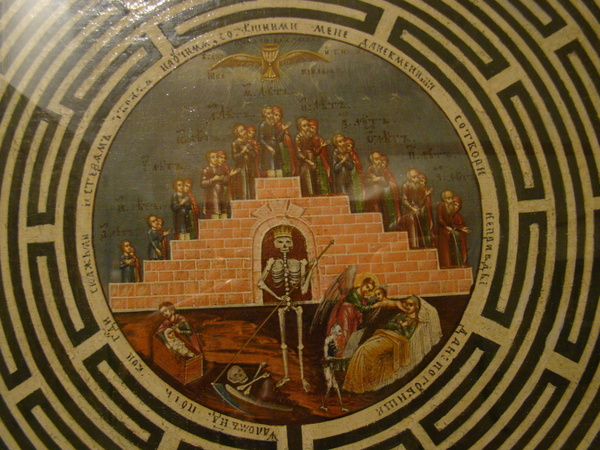
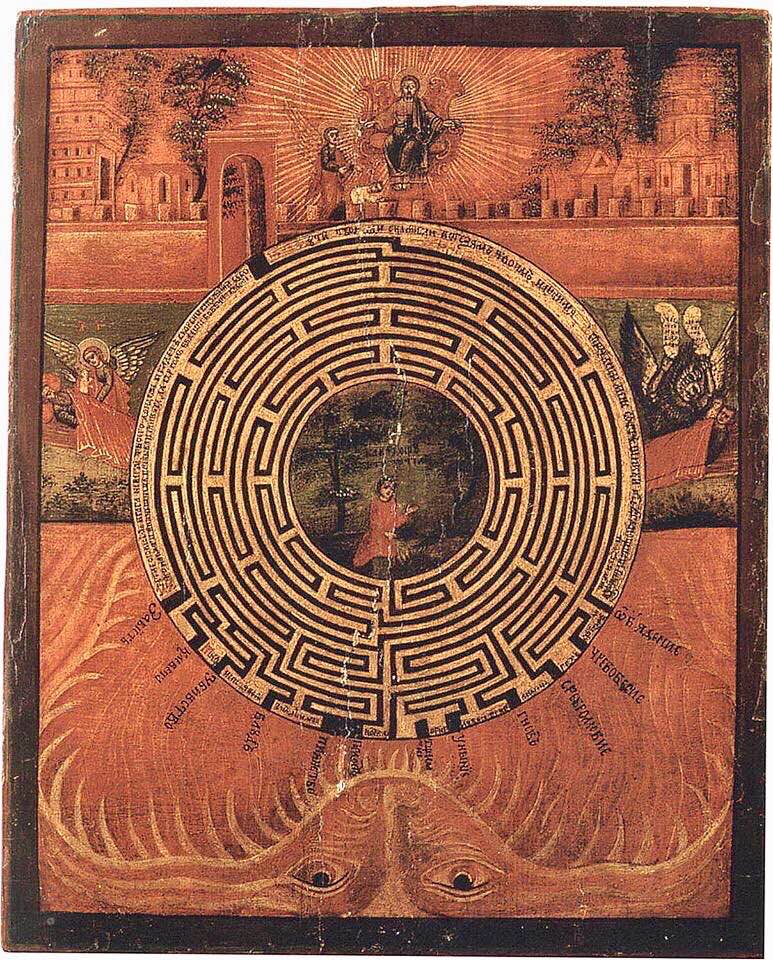
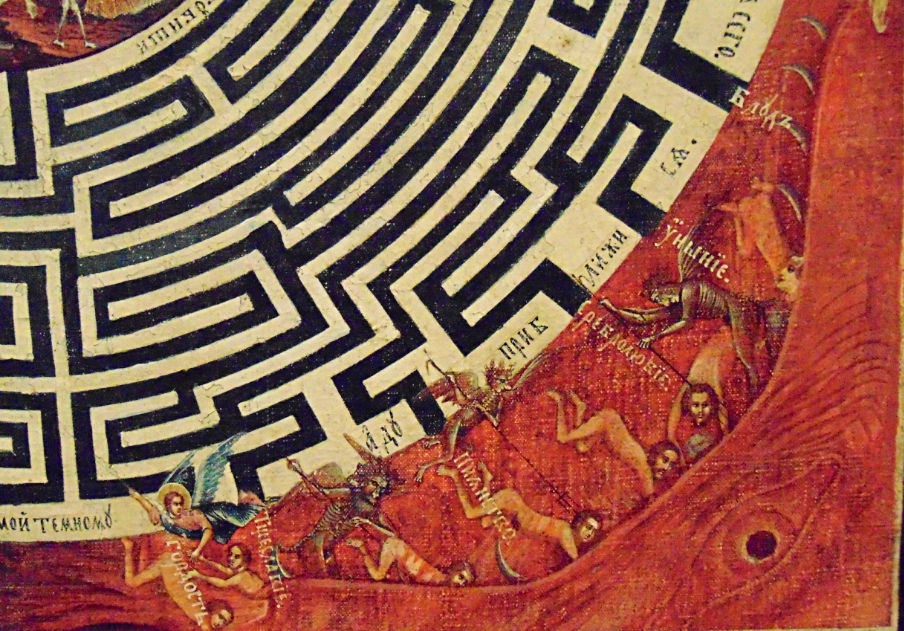
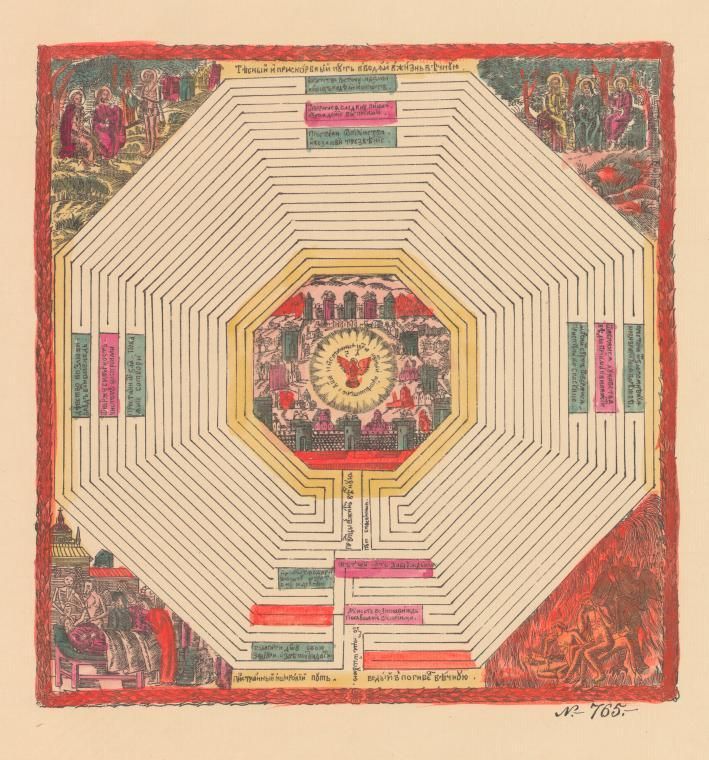
The allegory of the labyrinth as a symbol of the passage of life's path, where it is necessary to constantly make a choice, has been known since ancient times. From antiquity, she stepped into the Middle Ages: mosaic images of labyrinths, simple and rather complex, adorn the floors of grandiose houses of prayer - Gothic cathedrals in Chartres, Reims, Amiens ... '. Икона Лабиринт духовный But how did this structure, consisting of intricate paths leading to an exit or, on the contrary, to a dead end, transferred into the Russian spiritual tradition? One of the probable paths is the book of the Czech philosopher and teacher Jan Amos Komensky 'The Labyrinth of the World and the Heaven of the Heart', known to the Russian reader. In the seventeenth faith, it was not translated and even provided with a poetic preface in Russian. With a high degree of probability, a century later, this text inspired Russian icon painters to create an image called 'Spiritual Labyrinth', atypical for the Russian artistic tradition. At the same time, the meaning that the Russian masters put into this image is based on the Holy Scriptures and the writings of the Church Fathers. Moscow 'src =' / upload / medialibrary / 7d0 / 7d01fc3f519a1f6da2962fcbc4ef6937.jpg 'height =' 615 'title =' A similar icon from the New Jerusalem Monastery near Moscow '> One of the surviving images of this type is in the State Museum of the History of Religion in the St. Petersburg. It was painted by an unknown artist in the 18th century on a wooden sonova measuring 54 x 43.9 and 3.1 centimeters. The labyrinth occupying most of the space of the icon consists of twelve concentric circles, dotted with passages, and has twelve exits. The Kingdom of Heaven, where the King of Glory - the Lord Jesus Christ sits. Eleven other exits lead to fiery Gehenna, opposite each of them there is an inscription corresponding to one of the sins: 'Fornication', 'Despondency', 'Love of money', 'Pianism', 'Vanity ',' Pride ',' Murder ',' Anger ',' Unmerciful ',' Envy ',' Slander ',' Gluttony '. It may seem almost unbelievable, but over the course of several centuries, many people have noted that, trying to follow their gaze from the center of the labyrinth outward, they ended up at the exit with the mark of exactly the sin that really was inherent in them. Even some contemporary art critics, rather far from Christianity, spoke about this. The second of the famous icons of this type is located in the New Jerusalem Monastery, which in the city of Istra near Moscow. It was written somewhat earlier and has a number of individual features. For example, there are fourteen exits: two - up, and twelve - down. Ангел спасает от погибели душу грешника Inside the labyrinth, in a circle, there is a staircase, but by which a man and a woman ascend and then descend: on the first of the steps they are still children, on the last - already very old people. The staircase has a chronological gradation: its first step corresponds to 1 year, the last one - 90 years. Under the stairs is depicted a Reaper with a scythe and in a crown, and on both sides of it - images of the birth and death of a person, whose soul is accompanied by a guardian angel, and next to it there is a devil with a list of sins. Above, along the outer edge of the labyrinth, there is a rhymed text calling to follow Christ, who calls everyone to Himself 'and diligently opens the gates of heaven.' Nearby - the fourth verse of the 24th psalm: 'Your ways, O Lord, tell me, and teach me your paths.' Народная картинка с лабиринтом из собрания Ровинского The quote at the bottom of the labyrinth is also a quote from the Psalter, but completely other content: 'For my soul be filled with evil, and my belly draw near to hell' (Psalm 87: 4). Below it, opposite each of the exits, are the already familiar designations of sins, and below is the image of the underworld into which sinners are thrown. However, at two of the twelve exits one can see the figures of angels saving sinful souls from destruction at the last moment - through the prayers of the Church, earthly and heavenly, as well as relatives and friends of the deceased. The demons in the underworld are depicted by the icon painter armed: at their disposal are bows, guns and even cannons, symbolizing the destructive effect of the passions that demons command. In the upper part of the icon 'Spiritual Labyrinth' is depicted Heavenly Jerusalem from chapter 21 of the book of Revelation of John the Theologian. Carried by the angels, two righteous souls in the form of young men approach the walls encircling the city from different sides. At the very top, over the New Jerusalem, is Christ the Lord Himself, and on either side of him is the Most Holy Theotokos and the Forerunner John the Baptist, praying to the Son of God for the salvation of mankind. Just below the group of three figures - the Holy Spirit in the form of a dove, surrounded by radiance. The icon that is in the St. Petersburg museum, with which we started, has a number of differences. In the center of the labyrinth, it depicts a young man, next to whom the inscription: 'How I want to go the way'. On the left of labyrinth - a scene of the departure of a righteous man to the Lord God, whose soul is perceived by an angel in the form of a child. On the right - the image of the death of a sinner: an ugly demon is ready to take his soul to hell. At the bottom of the icon, instead of demons, Satan himself is depicted. The image of Heavenly Jerusalem in the upper part of the holy image is also noticeably different. Concluding the conversation about the Spiritual Labyrinth icon, it will not be superfluous to note that this image in the 18th-19th centuries served as the basis for the creation of folk pictures dedicated to the same theme. One of these is in the collection of D.A. Rovinsky and is accompanied by an edifying inscription: 'A narrow and unfortunate path, enter into eternal life.' The canonical versions of the Spiritual Labyrinth are gaining popularity in our time: they can often be found in Orthodox shops and icon stores.
Rare icons: 'Spiritual Labyrinth' of the 18th centuryRare icons: 'Spiritual Labyrinth' of the 18th century The allegory of the labyrinth as a symbol of the passage of life's path, where it is necessary to constantly make a choice, has been known since ancient times. From antiquity, she stepped into the Middle Ages: mosaic images of labyrinths, simple and rather complex, adorn the floors of grandiose houses of prayer - Gothic cathedrals in Chartres, Reims, Amiens ... '. Икона Лабиринт духовный But how did this structure, consisting of intricate paths leading to an exit or, on the contrary, to a dead end, transferred into the Russian spiritual tradition? One of the probable paths is the book of the Czech philosopher and teacher Jan Amos Komensky 'The Labyrinth of the World and the Heaven of the Heart', known to the Russian reader. In the seventeenth faith, it was not translated and even provided with a poetic preface in Russian. With a high degree of probability, a century later, this text inspired Russian icon painters to create an image called 'Spiritual Labyrinth', atypical for the Russian artistic tradition. At the same time, the meaning that the Russian masters put into this image is based on the Holy Scriptures and the writings of the Church Fathers. Moscow 'src =' / upload / medialibrary / 7d0 / 7d01fc3f519a1f6da2962fcbc4ef6937.jpg 'height =' 615 'title =' A similar icon from the New Jerusalem Monastery near Moscow '> One of the surviving images of this type is in the State Museum of the History of Religion in the St. Petersburg. It was painted by an unknown artist in the 18th century on a wooden sonova measuring 54 x 43.9 and 3.1 centimeters. The labyrinth occupying most of the space of the icon consists of twelve concentric circles, dotted with passages, and has twelve exits. The Kingdom of Heaven, where the King of Glory - the Lord Jesus Christ sits. Eleven other exits lead to fiery Gehenna, opposite each of them there is an inscription corresponding to one of the sins: 'Fornication', 'Despondency', 'Love of money', 'Pianism', 'Vanity ',' Pride ',' Murder ',' Anger ',' Unmerciful ',' Envy ',' Slander ',' Gluttony '. It may seem almost unbelievable, but over the course of several centuries, many people have noted that, trying to follow their gaze from the center of the labyrinth outward, they ended up at the exit with the mark of exactly the sin that really was inherent in them. Even some contemporary art critics, rather far from Christianity, spoke about this. The second of the famous icons of this type is located in the New Jerusalem Monastery, which in the city of Istra near Moscow. It was written somewhat earlier and has a number of individual features. For example, there are fourteen exits: two - up, and twelve - down. Ангел спасает от погибели душу грешника Inside the labyrinth, in a circle, there is a staircase, but by which a man and a woman ascend and then descend: on the first of the steps they are still children, on the last - already very old people. The staircase has a chronological gradation: its first step corresponds to 1 year, the last one - 90 years. Under the stairs is depicted a Reaper with a scythe and in a crown, and on both sides of it - images of the birth and death of a person, whose soul is accompanied by a guardian angel, and next to it there is a devil with a list of sins. Above, along the outer edge of the labyrinth, there is a rhymed text calling to follow Christ, who calls everyone to Himself 'and diligently opens the gates of heaven.' Nearby - the fourth verse of the 24th psalm: 'Your ways, O Lord, tell me, and teach me your paths.' Народная картинка с лабиринтом из собрания Ровинского The quote at the bottom of the labyrinth is also a quote from the Psalter, but completely other content: 'For my soul be filled with evil, and my belly draw near to hell' (Psalm 87: 4). Below it, opposite each of the exits, are the already familiar designations of sins, and below is the image of the underworld into which sinners are thrown. However, at two of the twelve exits one can see the figures of angels saving sinful souls from destruction at the last moment - through the prayers of the Church, earthly and heavenly, as well as relatives and friends of the deceased. The demons in the underworld are depicted by the icon painter armed: at their disposal are bows, guns and even cannons, symbolizing the destructive effect of the passions that demons command. In the upper part of the icon 'Spiritual Labyrinth' is depicted Heavenly Jerusalem from chapter 21 of the book of Revelation of John the Theologian. Carried by the angels, two righteous souls in the form of young men approach the walls encircling the city from different sides. At the very top, over the New Jerusalem, is Christ the Lord Himself, and on either side of him is the Most Holy Theotokos and the Forerunner John the Baptist, praying to the Son of God for the salvation of mankind. Just below the group of three figures - the Holy Spirit in the form of a dove, surrounded by radiance. The icon that is in the St. Petersburg museum, with which we started, has a number of differences. In the center of the labyrinth, it depicts a young man, next to whom the inscription: 'How I want to go the way'. On the left of labyrinth - a scene of the departure of a righteous man to the Lord God, whose soul is perceived by an angel in the form of a child. On the right - the image of the death of a sinner: an ugly demon is ready to take his soul to hell. At the bottom of the icon, instead of demons, Satan himself is depicted. The image of Heavenly Jerusalem in the upper part of the holy image is also noticeably different. Concluding the conversation about the Spiritual Labyrinth icon, it will not be superfluous to note that this image in the 18th-19th centuries served as the basis for the creation of folk pictures dedicated to the same theme. One of these is in the collection of D.A. Rovinsky and is accompanied by an edifying inscription: 'A narrow and unfortunate path, enter into eternal life.' The canonical versions of the Spiritual Labyrinth are gaining popularity in our time: they can often be found in Orthodox shops and icon stores.Свеча Иерусалима -en
The allegory of the labyrinth as a symbol of the passage of life's path, where it is necessary to constantly make a choice, has been known since ancient times. From antiquity, she stepped into the Middle Ages: mosaic images of labyrinths, simple and rather complex, adorn the floors of grandiose houses of prayer - Gothic cathedrals in Chartres, Reims, Amiens ... '. Икона Лабиринт духовный But how did this structure, consisting of intricate paths leading to an exit or, on the contrary, to a dead end, transferred into the Russian spiritual tradition? One of the probable paths is the book of the Czech philosopher and teacher Jan Amos Komensky 'The Labyrinth of the World and the Heaven of the Heart', known to the Russian reader. In the seventeenth faith, it was not translated and even provided with a poetic preface in Russian. With a high degree of probability, a century later, this text inspired Russian icon painters to create an image called 'Spiritual Labyrinth', atypical for the Russian artistic tradition. At the same time, the meaning that the Russian masters put into this image is based on the Holy Scriptures and the writings of the Church Fathers. Moscow 'src =' / upload / medialibrary / 7d0 / 7d01fc3f519a1f6da2962fcbc4ef6937.jpg 'height =' 615 'title =' A similar icon from the New Jerusalem Monastery near Moscow '> One of the surviving images of this type is in the State Museum of the History of Religion in the St. Petersburg. It was painted by an unknown artist in the 18th century on a wooden sonova measuring 54 x 43.9 and 3.1 centimeters. The labyrinth occupying most of the space of the icon consists of twelve concentric circles, dotted with passages, and has twelve exits. The Kingdom of Heaven, where the King of Glory - the Lord Jesus Christ sits. Eleven other exits lead to fiery Gehenna, opposite each of them there is an inscription corresponding to one of the sins: 'Fornication', 'Despondency', 'Love of money', 'Pianism', 'Vanity ',' Pride ',' Murder ',' Anger ',' Unmerciful ',' Envy ',' Slander ',' Gluttony '. It may seem almost unbelievable, but over the course of several centuries, many people have noted that, trying to follow their gaze from the center of the labyrinth outward, they ended up at the exit with the mark of exactly the sin that really was inherent in them. Even some contemporary art critics, rather far from Christianity, spoke about this. The second of the famous icons of this type is located in the New Jerusalem Monastery, which in the city of Istra near Moscow. It was written somewhat earlier and has a number of individual features. For example, there are fourteen exits: two - up, and twelve - down. Ангел спасает от погибели душу грешника Inside the labyrinth, in a circle, there is a staircase, but by which a man and a woman ascend and then descend: on the first of the steps they are still children, on the last - already very old people. The staircase has a chronological gradation: its first step corresponds to 1 year, the last one - 90 years. Under the stairs is depicted a Reaper with a scythe and in a crown, and on both sides of it - images of the birth and death of a person, whose soul is accompanied by a guardian angel, and next to it there is a devil with a list of sins. Above, along the outer edge of the labyrinth, there is a rhymed text calling to follow Christ, who calls everyone to Himself 'and diligently opens the gates of heaven.' Nearby - the fourth verse of the 24th psalm: 'Your ways, O Lord, tell me, and teach me your paths.' Народная картинка с лабиринтом из собрания Ровинского The quote at the bottom of the labyrinth is also a quote from the Psalter, but completely other content: 'For my soul be filled with evil, and my belly draw near to hell' (Psalm 87: 4). Below it, opposite each of the exits, are the already familiar designations of sins, and below is the image of the underworld into which sinners are thrown. However, at two of the twelve exits one can see the figures of angels saving sinful souls from destruction at the last moment - through the prayers of the Church, earthly and heavenly, as well as relatives and friends of the deceased. The demons in the underworld are depicted by the icon painter armed: at their disposal are bows, guns and even cannons, symbolizing the destructive effect of the passions that demons command. In the upper part of the icon 'Spiritual Labyrinth' is depicted Heavenly Jerusalem from chapter 21 of the book of Revelation of John the Theologian. Carried by the angels, two righteous souls in the form of young men approach the walls encircling the city from different sides. At the very top, over the New Jerusalem, is Christ the Lord Himself, and on either side of him is the Most Holy Theotokos and the Forerunner John the Baptist, praying to the Son of God for the salvation of mankind. Just below the group of three figures - the Holy Spirit in the form of a dove, surrounded by radiance. The icon that is in the St. Petersburg museum, with which we started, has a number of differences. In the center of the labyrinth, it depicts a young man, next to whom the inscription: 'How I want to go the way'. On the left of labyrinth - a scene of the departure of a righteous man to the Lord God, whose soul is perceived by an angel in the form of a child. On the right - the image of the death of a sinner: an ugly demon is ready to take his soul to hell. At the bottom of the icon, instead of demons, Satan himself is depicted. The image of Heavenly Jerusalem in the upper part of the holy image is also noticeably different. Concluding the conversation about the Spiritual Labyrinth icon, it will not be superfluous to note that this image in the 18th-19th centuries served as the basis for the creation of folk pictures dedicated to the same theme. One of these is in the collection of D.A. Rovinsky and is accompanied by an edifying inscription: 'A narrow and unfortunate path, enter into eternal life.' The canonical versions of the Spiritual Labyrinth are gaining popularity in our time: they can often be found in Orthodox shops and icon stores.