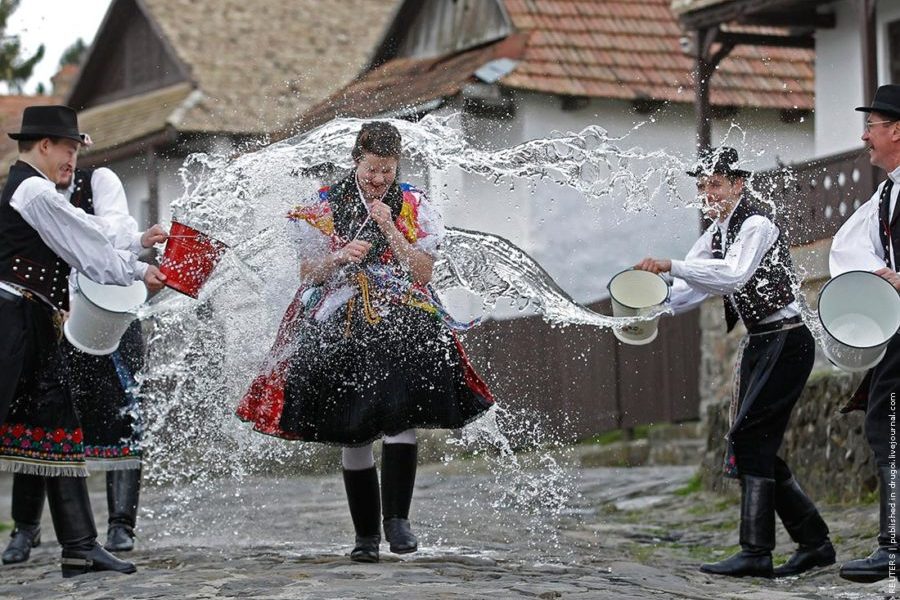
Many folk traditions, which were not originally Christian, over time began to be celebrated in connection with holidays in the church calendar. Just one of these is Watering Monday, which is celebrated in Eastern Europe on the first day after the Bright Resurrection of Christ. No one will say for sure that before the arrival of Christianity this tradition carried in itself - to pour water on each other. Most likely, this is how people expressed their joy from the renewal of nature, which visibly occurs in the spring. Gradually, this custom merged with Christian beliefs and was tied to the first day after the Lord's Passover.
It is not entirely correct to speak of this tradition as a purely European one: in Russia in the old days (and the Old Believers still have) the so-called Voloshebniki, which they walked after Easter not one, but three whole days! The first of them, Monday, was called Volochechny or Douche. On this day, women, girls and even household utensils were poured with water - especially especially valuable ones, for example, everything made of silver. This promised prosperity in the house, and for people - health and prosperity. However, there was one condition: to ask to be doused, and even a hint of it was impossible: it was believed that it should happen spontaneously. However, the matter was not limited to pouring alone these days. Young people went to the homes of their fellow villagers, sang songs like carols - and received food or money as a token of gratitude. Many who were unlucky enough to be doused went to water sources: it was believed that ablution on these days helps men and women cleanse both body and soul, and girls get married sooner. But all the same, it is better if the girl is doused by a man at this time.
In Belarus, on wet Monday, young people went to the river, where the boys poured water on the girls - and as a token of gratitude they received a colored egg from them. And the next day, Tuesday, the girls were watering the guys. And, finally, on Wednesday - who wants whom, there were no restrictions. In Romania, Watering Monday is called Ulyvanka. In this country, the tradition is strictly ordered: the ceremony takes place in the courtyard of the house where the girl lives, and only running water is used for pouring. Each of the men who came must take turns pouring water on the girl, and each does this three times. After the job is done, everyone is invited to the table. But in Hungary, water is used for dousing both from springs and from wells; on Monday, the boys water the girls, and on Tuesday, vice versa. In Poland, on the contrary, improvisation is valued. Guy on At dawn, he tries to get into the house where the girl lives and pour it on her right in bed. Such a 'sign of attention' should demonstrate to her that the young man is not indifferent to her. It is clear that it is somewhat more difficult to do this in a modern city than in a village. In the Czech Republic, Watering Monday is also called Red, thus emphasizing its connection with Easter. Here, more girls try to douse the guys - and then run away from them. However, not very quickly: after all, it is believed that the one who will catch up will receive not only good health, but also beauty. And in order for it to be so, the guys lashed the caught girls with willow twigs - pamazki. Of course, it doesn't hurt - and to stop them, the girls offer the guys a ransom in the form of traditional homemade sweets. In all of the listed countries and in some others, on Watering Monday, they are trying to build a weather forecast, both short-term and for a longer period of time. Calmness, a sky without clouds - to an imminent rain. If you can't hear the singing of migratory birds, expect frost. Sunny weather on this day promises a hot summer, and rain in the morning - for a rainy summer. It is a mistake to think of folk culture as something that is receding into the past. The tradition of Watering Monday is alive in both rural and urban areas - wherever people keep the customs of their land with love. Today, April 29, hundreds of people gathered on Rynok Square in Lviv with a variety of containers filled with water - buckets, bottles, even water pistols. Pouring water over each other near the City Hall this year, 2019, has turned into a real show - as, indeed, a year, and five, and ten years ago. With each new Watering Monday, more people gather here. The authorities approve of such activity of citizens: water for pouring can be collected right in the town hall - and very close by there are hair dryers and special booths where, after participating in an impromptu water show, you can change into dry clothes. Residents of Lviv say that they have never heard that after Watering Monday at least one person caught a cold: Easter, after all, all nature rejoices, you can recover these days, but you cannot get sick. Nobody, of course, checked whether it really is, but I really want to believe it! Daria Pobedintseva
Watering mondayWatering monday Many folk traditions, which were not originally Christian, over time began to be celebrated in connection with holidays in the church calendar. Just one of these is Watering Monday, which is celebrated in Eastern Europe on the first day after the Bright Resurrection of Christ. No one will say for sure that before the arrival of Christianity this tradition carried in itself - to pour water on each other. Most likely, this is how people expressed their joy from the renewal of nature, which visibly occurs in the spring. Gradually, this custom merged with Christian beliefs and was tied to the first day after the Lord's Passover. It is not entirely correct to speak of this tradition as a purely European one: in Russia in the old days (and the Old Believers still have) the so-called Voloshebniki, which they walked after Easter not one, but three whole days! The first of them, Monday, was called Volochechny or Douche. On this day, women, girls and even household utensils were poured with water - especially especially valuable ones, for example, everything made of silver. This promised prosperity in the house, and for people - health and prosperity. However, there was one condition: to ask to be doused, and even a hint of it was impossible: it was believed that it should happen spontaneously. However, the matter was not limited to pouring alone these days. Young people went to the homes of their fellow villagers, sang songs like carols - and received food or money as a token of gratitude. Many who were unlucky enough to be doused went to water sources: it was believed that ablution on these days helps men and women cleanse both body and soul, and girls get married sooner. But all the same, it is better if the girl is doused by a man at this time. In Belarus, on wet Monday, young people went to the river, where the boys poured water on the girls - and as a token of gratitude they received a colored egg from them. And the next day, Tuesday, the girls were watering the guys. And, finally, on Wednesday - who wants whom, there were no restrictions. In Romania, Watering Monday is called Ulyvanka. In this country, the tradition is strictly ordered: the ceremony takes place in the courtyard of the house where the girl lives, and only running water is used for pouring. Each of the men who came must take turns pouring water on the girl, and each does this three times. After the job is done, everyone is invited to the table. But in Hungary, water is used for dousing both from springs and from wells; on Monday, the boys water the girls, and on Tuesday, vice versa. In Poland, on the contrary, improvisation is valued. Guy on At dawn, he tries to get into the house where the girl lives and pour it on her right in bed. Such a 'sign of attention' should demonstrate to her that the young man is not indifferent to her. It is clear that it is somewhat more difficult to do this in a modern city than in a village. In the Czech Republic, Watering Monday is also called Red, thus emphasizing its connection with Easter. Here, more girls try to douse the guys - and then run away from them. However, not very quickly: after all, it is believed that the one who will catch up will receive not only good health, but also beauty. And in order for it to be so, the guys lashed the caught girls with willow twigs - pamazki. Of course, it doesn't hurt - and to stop them, the girls offer the guys a ransom in the form of traditional homemade sweets. In all of the listed countries and in some others, on Watering Monday, they are trying to build a weather forecast, both short-term and for a longer period of time. Calmness, a sky without clouds - to an imminent rain. If you can't hear the singing of migratory birds, expect frost. Sunny weather on this day promises a hot summer, and rain in the morning - for a rainy summer. It is a mistake to think of folk culture as something that is receding into the past. The tradition of Watering Monday is alive in both rural and urban areas - wherever people keep the customs of their land with love. Today, April 29, hundreds of people gathered on Rynok Square in Lviv with a variety of containers filled with water - buckets, bottles, even water pistols. Pouring water over each other near the City Hall this year, 2019, has turned into a real show - as, indeed, a year, and five, and ten years ago. With each new Watering Monday, more people gather here. The authorities approve of such activity of citizens: water for pouring can be collected right in the town hall - and very close by there are hair dryers and special booths where, after participating in an impromptu water show, you can change into dry clothes. Residents of Lviv say that they have never heard that after Watering Monday at least one person caught a cold: Easter, after all, all nature rejoices, you can recover these days, but you cannot get sick. Nobody, of course, checked whether it really is, but I really want to believe it! Daria PobedintsevaСвеча Иерусалима -en
Many folk traditions, which were not originally Christian, over time began to be celebrated in connection with holidays in the church calendar. Just one of these is Watering Monday, which is celebrated in Eastern Europe on the first day after the Bright Resurrection of Christ. No one will say for sure that before the arrival of Christianity this tradition carried in itself - to pour water on each other. Most likely, this is how people expressed their joy from the renewal of nature, which visibly occurs in the spring. Gradually, this custom merged with Christian beliefs and was tied to the first day after the Lord's Passover. It is not entirely correct to speak of this tradition as a purely European one: in Russia in the old days (and the Old Believers still have) the so-called Voloshebniki, which they walked after Easter not one, but three whole days! The first of them, Monday, was called Volochechny or Douche. On this day, women, girls and even household utensils were poured with water - especially especially valuable ones, for example, everything made of silver. This promised prosperity in the house, and for people - health and prosperity. However, there was one condition: to ask to be doused, and even a hint of it was impossible: it was believed that it should happen spontaneously. However, the matter was not limited to pouring alone these days. Young people went to the homes of their fellow villagers, sang songs like carols - and received food or money as a token of gratitude. Many who were unlucky enough to be doused went to water sources: it was believed that ablution on these days helps men and women cleanse both body and soul, and girls get married sooner. But all the same, it is better if the girl is doused by a man at this time. In Belarus, on wet Monday, young people went to the river, where the boys poured water on the girls - and as a token of gratitude they received a colored egg from them. And the next day, Tuesday, the girls were watering the guys. And, finally, on Wednesday - who wants whom, there were no restrictions. In Romania, Watering Monday is called Ulyvanka. In this country, the tradition is strictly ordered: the ceremony takes place in the courtyard of the house where the girl lives, and only running water is used for pouring. Each of the men who came must take turns pouring water on the girl, and each does this three times. After the job is done, everyone is invited to the table. But in Hungary, water is used for dousing both from springs and from wells; on Monday, the boys water the girls, and on Tuesday, vice versa. In Poland, on the contrary, improvisation is valued. Guy on At dawn, he tries to get into the house where the girl lives and pour it on her right in bed. Such a 'sign of attention' should demonstrate to her that the young man is not indifferent to her. It is clear that it is somewhat more difficult to do this in a modern city than in a village. In the Czech Republic, Watering Monday is also called Red, thus emphasizing its connection with Easter. Here, more girls try to douse the guys - and then run away from them. However, not very quickly: after all, it is believed that the one who will catch up will receive not only good health, but also beauty. And in order for it to be so, the guys lashed the caught girls with willow twigs - pamazki. Of course, it doesn't hurt - and to stop them, the girls offer the guys a ransom in the form of traditional homemade sweets. In all of the listed countries and in some others, on Watering Monday, they are trying to build a weather forecast, both short-term and for a longer period of time. Calmness, a sky without clouds - to an imminent rain. If you can't hear the singing of migratory birds, expect frost. Sunny weather on this day promises a hot summer, and rain in the morning - for a rainy summer. It is a mistake to think of folk culture as something that is receding into the past. The tradition of Watering Monday is alive in both rural and urban areas - wherever people keep the customs of their land with love. Today, April 29, hundreds of people gathered on Rynok Square in Lviv with a variety of containers filled with water - buckets, bottles, even water pistols. Pouring water over each other near the City Hall this year, 2019, has turned into a real show - as, indeed, a year, and five, and ten years ago. With each new Watering Monday, more people gather here. The authorities approve of such activity of citizens: water for pouring can be collected right in the town hall - and very close by there are hair dryers and special booths where, after participating in an impromptu water show, you can change into dry clothes. Residents of Lviv say that they have never heard that after Watering Monday at least one person caught a cold: Easter, after all, all nature rejoices, you can recover these days, but you cannot get sick. Nobody, of course, checked whether it really is, but I really want to believe it! Daria Pobedintseva