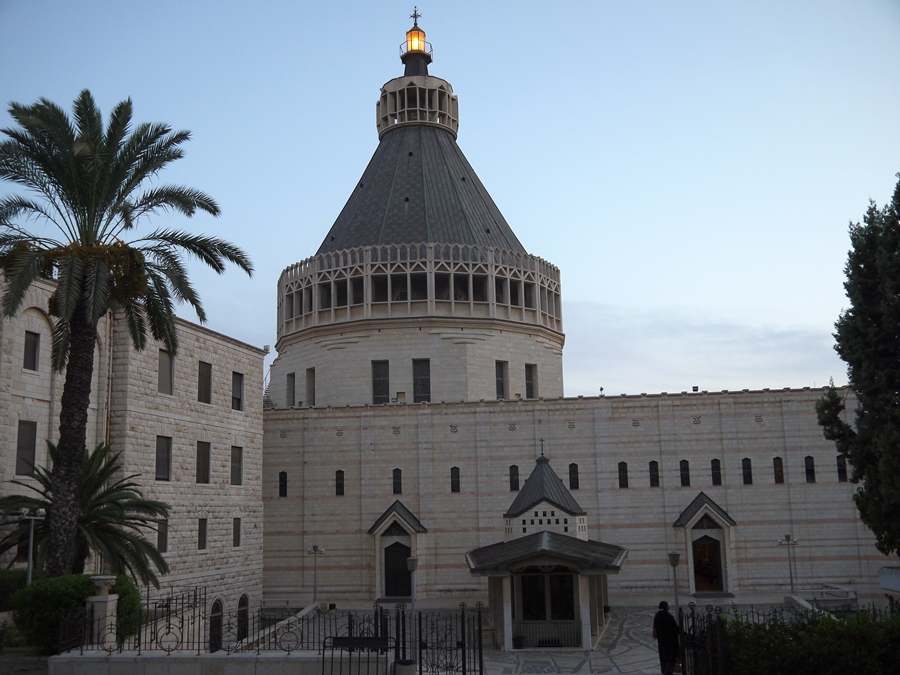
Together with Jerusalem and Bethlehem, the small city of Nazareth in the northern part of Israel (historical Galilee) is one of the three main places of pilgrimage for Christians in the Holy Land. Nazareth is the hometown of the Most Holy Theotokos and the place where miraculous events known as the Annunciation took place. About where exactly they took place, Orthodox and Catholics have two different opinions. According to Eastern and Western Christians, these places are marked by the Church of the Annunciation above the source of the Most Holy Theotokos (aka the temple of the Archangel Gabriel) - and the Basilica of the Annunciation. They are the first to be visited by pilgrims who come from all over the world to Nazareth.
The most Christian city in Israel and the only one in the country where Sunday is declared an official day off, Nazareth is known throughout the world as the place of the Annunciation of the Most Holy Theotokos and the city where the childhood and youth of the Lord Jesus Christ passed. But this is now - and two thousand years ago and a little earlier Nazareth was a very small village in Galilee - provinces lived by Jews, pagans and Hellenes, and which among orthodox Jews from Jerusalem enjoyed a rather dubious reputation ('A prophet does not come from Galilee', John 7, 52).
Nevertheless, it was here that the young Virgin from an ancient but impoverished family was promised by the Archangel of God that She would give birth Savior of the world. Of the four Evangelists, only the Apostle Luke reports on how the Archangel Gabriel, appearing to the Virgin Mary, said: “Rejoice, Graceful One! The Lord is with You; blessed are You between wives. ' - And seeing Her embarrassment, he added: “Do not be afraid, Mary, for You have found grace with God; and behold, you will conceive in your womb, and you will bear a Son, and you will call His name: Jesus. He will be great and will be called the Son of the Most High, and the Lord God will give Him the throne of His father David; and he will reign over the house of Jacob for ever, and his kingdom will have no end. ' (Luke 1, 28-33).
To the canonical Gospel of Luke, the ancient Christian apocryphal add a story about the so-called 'Pre-Annunciation': on the same day, but earlier, the Virgin Mary went to fetch water, and at the well she heard an angelic voice for the first time, saying: 'Hail, Blessed One! The Lord is with You; blessed are You between wives ”- but, not seeing anyone nearby, she was frightened and quickly returned home, where the angel, already visibly, visited Her for the second time, repeating the words of the Gospel. To which the Virgin Mary, who at that time was only fourteen years old, humbly and without a shadow of doubt replied: “Behold, the Servant of the Lord; let it be to me according to your word ”- the last words are literally repeated in the canonical Gospel of Luke (Luke 1, 28-38).
The events that took place that day in little Nazareth are now annually celebrated by Christians as the Great Feast of the Annunciation of the Most Holy Theotokos. And to see exactly where this happened, Christians from all over the world come to Nazareth. And they discover that the Orthodox and Catholics have a slightly different vision of where exactly the Annunciation took place. Catholics believe that this happened in the Grotto, which was one of the rooms in the house of the Sagrada Familia - it was a custom of that era to build underground rooms into houses, fleeing the sweltering heat. Today, the majestic Catholic Basilica of the Annunciation rises here.
The first church on this site was built by the mother of Emperor Constantine the Great, Elena. The invasions of the Persians, and then the Muslim Arabs, did not spare the buildings: the crusaders, who arrived here at the beginning of the twelfth century, found only ruins on the site of the once majestic temple. During the times of the Kingdom of Jerusalem, the temple was rebuilt anew, already in the Romanesque style - but soon after the crusaders left the Holy Land, it was destroyed again, and the Franciscan monks who served in it were expelled. After this, the Christian presence in Nazareth ceases for three centuries. Only in 1620 did the Franciscan monks manage to acquire a plot of land above the Grotto from the Turks - and they seek to build a church on this place 110 years later. However, they built here in 1730, the modest church, of course, did not correspond to the significance of the event that took place on this site. Therefore, in 1955 it was demolished, and in its place in less than a decade and a half, a grandiose basilica was erected by the architect Giovanni Muzio, which is visible from afar at the entrance to Nazareth and is today the main attraction of the city.
Entering the gates of the Basilica of the Annunciation, the pilgrim finds himself in the courtyard in front of the main, western facade - above it there is a sculptural image of the Savior of the world, blessing those who enter - and, just below - the scene of the Annunciation of the Most Holy Theotokos, in whose honor this majestic temple was consecrated in 1969 ... On the right and left of the facade are the words of the Old Testament prophecies about the Incarnation, and in its center are the figures of the four Evangelists and the inscription: 'Here the Word became flesh and lived among us.' The huge entrance doors, which are opened only on especially solemn occasions, are covered with bas-reliefs on the theme of the earthly life of the Lord Jesus Christ.
The main shrine of the basilica - the Grotto Church - can be accessed through one of the side doors. Inside this church, on the left side, a special place is highlighted where the words of the Annunciation sounded - here are the remains of former churches: fragments of walls, columns, Byzantine mosaics ... an old altar - and the exact place where the Virgin Mary stood listening to the Archangel Gabriel is marked on the floor by a marble circle with a cross. The atmosphere in the Church of the Grotto is very ascetic - but it is it that allows you to more clearly feel the Divine presence, as many pilgrims who have visited here say.
A spiral staircase leads from the Grotto Church to the upper church. The situation here is completely different. In the center of the eastern wall is a grandiose mosaic panel with a quote from the Creed at the top. In the center of the panel is the figure of the Savior with outstretched hands, and above it is the All-Seeing Eye of God the Father and the Holy Spirit in the form of a dove. A little behind on a throne, as if floating on a cloud, sits the Blessed Virgin Mary, crowned with a crown. Next to Christ, looking at him, the Apostle Peter stands with a key in his hands - and a little to the side is a group of other apostles, and around - saints, martyrs, ordinary believers heading to Christ.
On the sides of the monumental panel there are two chapels, one of which belongs to the Franciscan order (in it you can see scenes from the life of St. Francis), and the other to the Kingdom of Spain (here there are symbolic images of the struggle between light and darkness, as well as a picture of the meeting of Pope Paul VI with Patriarch Athenagoras of Constantinople in Jerusalem in 1964, when she was an attempt was made to bring the Western and Eastern Churches closer together).
From the upper church, the path leads to the courtyard of the basilica, where the baptistery is located - a baptismal donated to the temple by Germany. A covered gallery is attached to the wall that separates the territory of the basilica from the outside world, in which there are many mosaic, ceramic and other paintings donated to the basilica by different countries - all of them in one way or another relate to the Theotokos theme. It is interesting to note that Greece handed over to the gallery a mosaic copy of the Russian icon of the Virgin of Vladimir.
The Basilica of the Annunciation in Nazareth is the central building of a large Catholic complex - with a school, college, hospital, and buildings for pilgrims. The complex also includes the Church of St. Joseph, which, according to Tradition, stands on the site of the workshop where Joseph the Betrothed, a former carpenter, worked. In the crypt of this church, niches of two thousand years ago have been preserved, as well as vessels for water and grain - the same age as the Gospel events. Since the times of the Jerusalem Kingdom of the Crusaders, the crypt of this church has remained practically unchanged - while the above-ground part of the temple was destroyed by Muslims and lay in ruins for almost half a millennium, until the Franciscans bought out a piece of land here and began to restore the temple. TO Unfortunately, it is impossible to enter the crypt of the church of St. Joseph in our time - but, thanks to the illumination of the entrance, you can see it from the outside. In the upper part of the church there are frescoes 'The Holy Family', 'Joseph's Dream' and 'Joseph's Death' by an Italian icon painter of the middle of the last century.
The voice of the Archangel, which the Blessed Virgin heard at the well, where she came to fetch water, belonged to Gabriel, the messenger of God, whose name the Orthodox Church bears with a double name. The Church of the Annunciation over the source of the Most Holy Theotokos, which belongs to the Nazareth Metropolis of the Jerusalem Orthodox Church, is otherwise called the Church of the Archangel Gabriel. Her parish is run by the local Arab Orthodox Council, and services are held here in both Greek and Arabic. This building, albeit not as grandiose as the Basilica of the Annunciation, nevertheless integrated many ancient and medieval artifacts, including the main shrine - an underground source where the Most Pure Virgin drew water. Above the source, located in a separate vestibule in the crypt of the church, there is an altar with the miraculous image of the 'Annunciation at the Well' placed above it. The source gushes from the ground today - just like it did more than two thousand years ago, when it was the only one in Nazareth.
Originally built during the Byzantine era and later destroyed, this church was rebuilt in the era of the Crusaders - and later, in the seventeenth century, rebuilt again, however, as already mentioned, it retained many elements left over from previous buildings - for example, the vaults of the lower room, dating back to the Byzantine era.
By the way, in the everyday name among the local Arab population, it has remained 'kyanisat-ar-Rum', that is, the Roman (Byzantine) church. It is she who is mentioned in their writings by many historians and travelers who visited Nazareth over the previous centuries. The first to report about it is the Franciscan Arkulf, who made a pilgrimage to the Holy Land in 670. “A wonderful well, deep, with cold water. A round church of the Archangel Gabriel was built over this well, ”- this is the testimony of the Russian abbot Daniel, who traveled to Palestine in 1106-1108, during the times of the Crusader kingdom. The Greek monk John Foka (1185) and the Dominican from the German lands, known as the Burchard of Mount Zion (1283), left their descriptions of the temple for posterity - the latter indicates that, according to local legend, the boy Jesus Himself collected water from the local spring.
In the late Middle Ages, the church was for some time under the control of the Franciscans, however, in the middle of the eighteenth century, the Orthodox community of Nazareth received a firman, which returned control of the temple to it. In 1750, the church was rebuilt by the city's Arab Christian community. In 1767, a wooden baroque iconostasis was installed in it and donated to the church by a Greek businessman.
In the crypt of the church, 10 meters long, 3.3 meters wide and 3.5 meters high, there are seven ancient stone steps. The far part of the crypt is decorated with ancient Armenian tiles. It is there, under the altar with a semicircular asp, that the source is located. Taking advantage of the mug that is always here, anyone who comes can drink water from it.
Note that some of the interior elements of the Orthodox Church of the Annunciation above the spring may seem rather unusual to pilgrims from Russia. These include the parish pews in the temple - as well as a special balcony for women and children where they pray during services.
At the end of our small excursion around the church, we note that the source spilling in its crypt was called the source of Gabriel until the 17th century - and today its image is adorned with the coat of arms of the city of Nazareth.
This is how, for centuries, in a city known to the whole world thanks to the Gospel, two churches coexist - the Catholic and Orthodox - consecrated in memory of the same event. If we take into account the testimonies captured in the Christian apocrypha, which we cited at the very beginning, the existence of these two temples here at the same time does not contradict the truth, but only complements the picture of the events that took place on one spring day in Galilee more than two thousand years ago. By the way, there are many other Christian shrines and ancient artifacts in Nazareth and its environs. We will definitely turn to the most important of them in one of the following articles.
The most Christian city in Israel and the only one in the country where Sunday is declared an official day off, Nazareth is known throughout the world as the place of the Annunciation of the Most Holy Theotokos and the city where the childhood and youth of the Lord Jesus Christ passed. But this is now - and two thousand years ago and a little earlier Nazareth was a very small village in Galilee - provinces lived by Jews, pagans and Hellenes, and which among orthodox Jews from Jerusalem enjoyed a rather dubious reputation ('A prophet does not come from Galilee', John 7, 52).
Nevertheless, it was here that the young Virgin from an ancient but impoverished family was promised by the Archangel of God that She would give birth Savior of the world. Of the four Evangelists, only the Apostle Luke reports on how the Archangel Gabriel, appearing to the Virgin Mary, said: “Rejoice, Graceful One! The Lord is with You; blessed are You between wives. ' - And seeing Her embarrassment, he added: “Do not be afraid, Mary, for You have found grace with God; and behold, you will conceive in your womb, and you will bear a Son, and you will call His name: Jesus. He will be great and will be called the Son of the Most High, and the Lord God will give Him the throne of His father David; and he will reign over the house of Jacob for ever, and his kingdom will have no end. ' (Luke 1, 28-33).
To the canonical Gospel of Luke, the ancient Christian apocryphal add a story about the so-called 'Pre-Annunciation': on the same day, but earlier, the Virgin Mary went to fetch water, and at the well she heard an angelic voice for the first time, saying: 'Hail, Blessed One! The Lord is with You; blessed are You between wives ”- but, not seeing anyone nearby, she was frightened and quickly returned home, where the angel, already visibly, visited Her for the second time, repeating the words of the Gospel. To which the Virgin Mary, who at that time was only fourteen years old, humbly and without a shadow of doubt replied: “Behold, the Servant of the Lord; let it be to me according to your word ”- the last words are literally repeated in the canonical Gospel of Luke (Luke 1, 28-38).
The events that took place that day in little Nazareth are now annually celebrated by Christians as the Great Feast of the Annunciation of the Most Holy Theotokos. And to see exactly where this happened, Christians from all over the world come to Nazareth. And they discover that the Orthodox and Catholics have a slightly different vision of where exactly the Annunciation took place. Catholics believe that this happened in the Grotto, which was one of the rooms in the house of the Sagrada Familia - it was a custom of that era to build underground rooms into houses, fleeing the sweltering heat. Today, the majestic Catholic Basilica of the Annunciation rises here.
The first church on this site was built by the mother of Emperor Constantine the Great, Elena. The invasions of the Persians, and then the Muslim Arabs, did not spare the buildings: the crusaders, who arrived here at the beginning of the twelfth century, found only ruins on the site of the once majestic temple. During the times of the Kingdom of Jerusalem, the temple was rebuilt anew, already in the Romanesque style - but soon after the crusaders left the Holy Land, it was destroyed again, and the Franciscan monks who served in it were expelled. After this, the Christian presence in Nazareth ceases for three centuries. Only in 1620 did the Franciscan monks manage to acquire a plot of land above the Grotto from the Turks - and they seek to build a church on this place 110 years later. However, they built here in 1730, the modest church, of course, did not correspond to the significance of the event that took place on this site. Therefore, in 1955 it was demolished, and in its place in less than a decade and a half, a grandiose basilica was erected by the architect Giovanni Muzio, which is visible from afar at the entrance to Nazareth and is today the main attraction of the city.
Entering the gates of the Basilica of the Annunciation, the pilgrim finds himself in the courtyard in front of the main, western facade - above it there is a sculptural image of the Savior of the world, blessing those who enter - and, just below - the scene of the Annunciation of the Most Holy Theotokos, in whose honor this majestic temple was consecrated in 1969 ... On the right and left of the facade are the words of the Old Testament prophecies about the Incarnation, and in its center are the figures of the four Evangelists and the inscription: 'Here the Word became flesh and lived among us.' The huge entrance doors, which are opened only on especially solemn occasions, are covered with bas-reliefs on the theme of the earthly life of the Lord Jesus Christ.
The main shrine of the basilica - the Grotto Church - can be accessed through one of the side doors. Inside this church, on the left side, a special place is highlighted where the words of the Annunciation sounded - here are the remains of former churches: fragments of walls, columns, Byzantine mosaics ... an old altar - and the exact place where the Virgin Mary stood listening to the Archangel Gabriel is marked on the floor by a marble circle with a cross. The atmosphere in the Church of the Grotto is very ascetic - but it is it that allows you to more clearly feel the Divine presence, as many pilgrims who have visited here say.
A spiral staircase leads from the Grotto Church to the upper church. The situation here is completely different. In the center of the eastern wall is a grandiose mosaic panel with a quote from the Creed at the top. In the center of the panel is the figure of the Savior with outstretched hands, and above it is the All-Seeing Eye of God the Father and the Holy Spirit in the form of a dove. A little behind on a throne, as if floating on a cloud, sits the Blessed Virgin Mary, crowned with a crown. Next to Christ, looking at him, the Apostle Peter stands with a key in his hands - and a little to the side is a group of other apostles, and around - saints, martyrs, ordinary believers heading to Christ.
On the sides of the monumental panel there are two chapels, one of which belongs to the Franciscan order (in it you can see scenes from the life of St. Francis), and the other to the Kingdom of Spain (here there are symbolic images of the struggle between light and darkness, as well as a picture of the meeting of Pope Paul VI with Patriarch Athenagoras of Constantinople in Jerusalem in 1964, when she was an attempt was made to bring the Western and Eastern Churches closer together).
From the upper church, the path leads to the courtyard of the basilica, where the baptistery is located - a baptismal donated to the temple by Germany. A covered gallery is attached to the wall that separates the territory of the basilica from the outside world, in which there are many mosaic, ceramic and other paintings donated to the basilica by different countries - all of them in one way or another relate to the Theotokos theme. It is interesting to note that Greece handed over to the gallery a mosaic copy of the Russian icon of the Virgin of Vladimir.
The Basilica of the Annunciation in Nazareth is the central building of a large Catholic complex - with a school, college, hospital, and buildings for pilgrims. The complex also includes the Church of St. Joseph, which, according to Tradition, stands on the site of the workshop where Joseph the Betrothed, a former carpenter, worked. In the crypt of this church, niches of two thousand years ago have been preserved, as well as vessels for water and grain - the same age as the Gospel events. Since the times of the Jerusalem Kingdom of the Crusaders, the crypt of this church has remained practically unchanged - while the above-ground part of the temple was destroyed by Muslims and lay in ruins for almost half a millennium, until the Franciscans bought out a piece of land here and began to restore the temple. TO Unfortunately, it is impossible to enter the crypt of the church of St. Joseph in our time - but, thanks to the illumination of the entrance, you can see it from the outside. In the upper part of the church there are frescoes 'The Holy Family', 'Joseph's Dream' and 'Joseph's Death' by an Italian icon painter of the middle of the last century.
The voice of the Archangel, which the Blessed Virgin heard at the well, where she came to fetch water, belonged to Gabriel, the messenger of God, whose name the Orthodox Church bears with a double name. The Church of the Annunciation over the source of the Most Holy Theotokos, which belongs to the Nazareth Metropolis of the Jerusalem Orthodox Church, is otherwise called the Church of the Archangel Gabriel. Her parish is run by the local Arab Orthodox Council, and services are held here in both Greek and Arabic. This building, albeit not as grandiose as the Basilica of the Annunciation, nevertheless integrated many ancient and medieval artifacts, including the main shrine - an underground source where the Most Pure Virgin drew water. Above the source, located in a separate vestibule in the crypt of the church, there is an altar with the miraculous image of the 'Annunciation at the Well' placed above it. The source gushes from the ground today - just like it did more than two thousand years ago, when it was the only one in Nazareth.
Originally built during the Byzantine era and later destroyed, this church was rebuilt in the era of the Crusaders - and later, in the seventeenth century, rebuilt again, however, as already mentioned, it retained many elements left over from previous buildings - for example, the vaults of the lower room, dating back to the Byzantine era.
By the way, in the everyday name among the local Arab population, it has remained 'kyanisat-ar-Rum', that is, the Roman (Byzantine) church. It is she who is mentioned in their writings by many historians and travelers who visited Nazareth over the previous centuries. The first to report about it is the Franciscan Arkulf, who made a pilgrimage to the Holy Land in 670. “A wonderful well, deep, with cold water. A round church of the Archangel Gabriel was built over this well, ”- this is the testimony of the Russian abbot Daniel, who traveled to Palestine in 1106-1108, during the times of the Crusader kingdom. The Greek monk John Foka (1185) and the Dominican from the German lands, known as the Burchard of Mount Zion (1283), left their descriptions of the temple for posterity - the latter indicates that, according to local legend, the boy Jesus Himself collected water from the local spring.
In the late Middle Ages, the church was for some time under the control of the Franciscans, however, in the middle of the eighteenth century, the Orthodox community of Nazareth received a firman, which returned control of the temple to it. In 1750, the church was rebuilt by the city's Arab Christian community. In 1767, a wooden baroque iconostasis was installed in it and donated to the church by a Greek businessman.
In the crypt of the church, 10 meters long, 3.3 meters wide and 3.5 meters high, there are seven ancient stone steps. The far part of the crypt is decorated with ancient Armenian tiles. It is there, under the altar with a semicircular asp, that the source is located. Taking advantage of the mug that is always here, anyone who comes can drink water from it.
Note that some of the interior elements of the Orthodox Church of the Annunciation above the spring may seem rather unusual to pilgrims from Russia. These include the parish pews in the temple - as well as a special balcony for women and children where they pray during services.
At the end of our small excursion around the church, we note that the source spilling in its crypt was called the source of Gabriel until the 17th century - and today its image is adorned with the coat of arms of the city of Nazareth.
This is how, for centuries, in a city known to the whole world thanks to the Gospel, two churches coexist - the Catholic and Orthodox - consecrated in memory of the same event. If we take into account the testimonies captured in the Christian apocrypha, which we cited at the very beginning, the existence of these two temples here at the same time does not contradict the truth, but only complements the picture of the events that took place on one spring day in Galilee more than two thousand years ago. By the way, there are many other Christian shrines and ancient artifacts in Nazareth and its environs. We will definitely turn to the most important of them in one of the following articles.
Share: