Traces of one of the oldest Christian churches in Russia were found on Taman

На Тамани обнаружили следы одного из древнейших христианских храмов на территории России
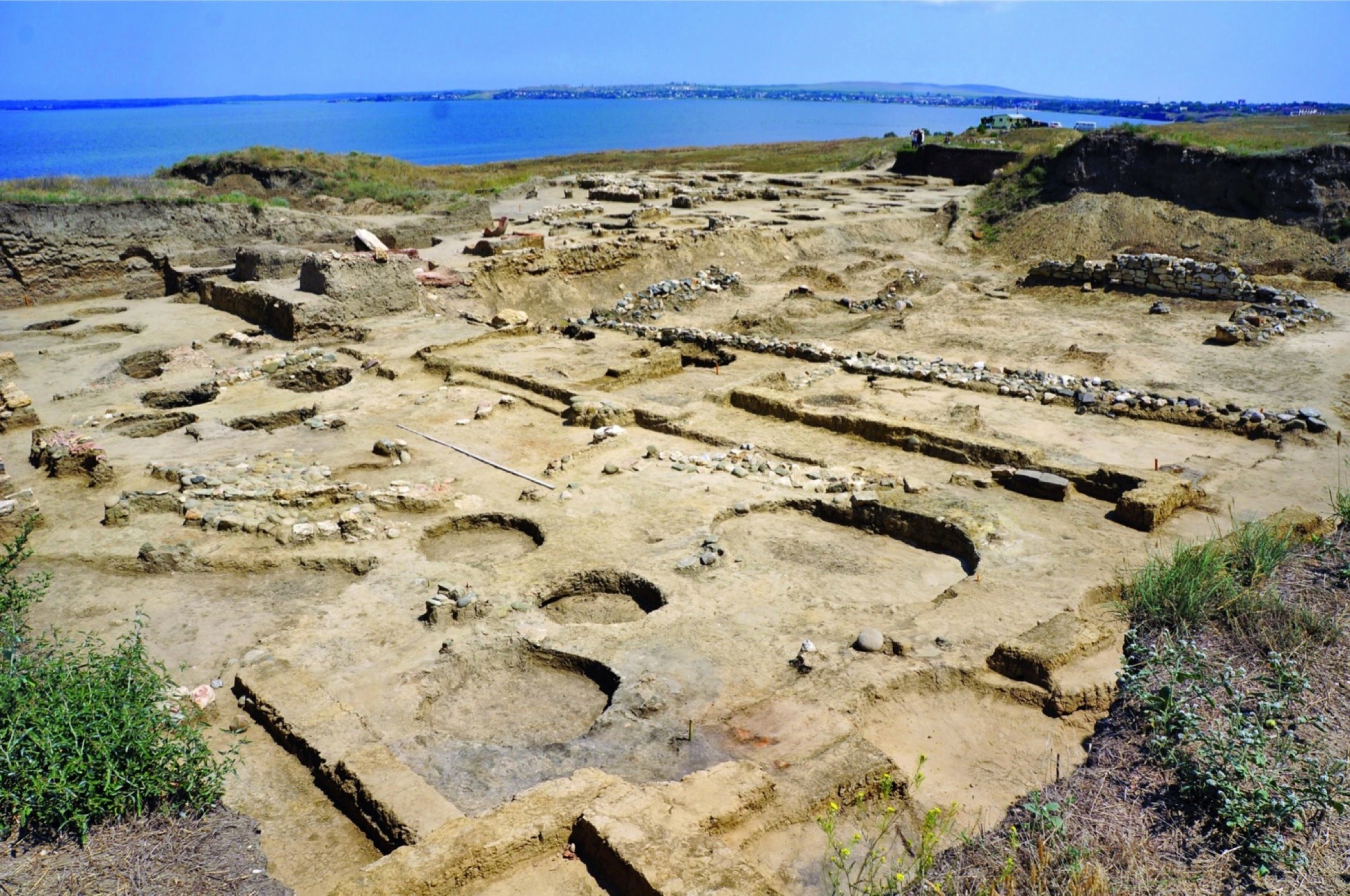
In the course of excavations on the Taman Peninsula of Krasnodar Territory, a part of a baptismal font (baptistery) and a fragment of a marble countertop in the form of the Greek letter 'sigma', which were used in the altars of early Byzantine churches in the 5th-6th centuries, were discovered. The news portal Kuban 24 reported about the finds made on the territory of ancient Phanagoria. Semicircular marble tabletops with arched cutouts were used by Christians of the first centuries during the liturgy, as well as for preparing memorial meals. Their surviving intact specimens were previously found in Corinth and the Syrian Alamea. Fragments of such countertops found in Athens and Rome are as close as possible to the Phanagorian find. The discovered part of the baptistery makes it possible to form an impression of the size of the entire object - not only children, but also adults could be baptized in it. The Phanagorian specimen represents the bottom, side and back walls; the front part of the font, on which, as a rule, there was an image of a cross, has not been preserved. Discovered temple utensils confirm that in the middle of the first millennium AD, there were already active Christian churches in Phanagoria. Until now, during the excavations, which are ongoing here, it was possible to find only parts of earthenware with images of a cross and limestone tombstones with epitaphs of Christian content, as well as marble slabs with texts of prayers for travelers on the sea.
Share:
Traces of one of the oldest Christian churches in Russia were found on Taman Traces of one of the oldest Christian churches in Russia were found on Taman In the course of excavations on the Taman Peninsula of Krasnodar Territory, a part of a baptismal font (baptistery) and a fragment of a marble countertop in the form of the Greek letter 'sigma', which were used in the altars of early Byzantine churches in the 5th-6th centuries, were discovered. The news portal Kuban 24 reported about the finds made on the territory of ancient Phanagoria. Semicircular marble tabletops with arched cutouts were used by Christians of the first centuries during the liturgy, as well as for preparing memorial meals. Their surviving intact specimens were previously found in Corinth and the Syrian Alamea. Fragments of such countertops found in Athens and Rome are as close as possible to the Phanagorian find. The discovered part of the baptistery makes it possible to form an impression of the size of the entire object - not only children, but also adults could be baptized in it. The Phanagorian specimen represents the bottom, side and back walls; the front part of the font, on which, as a rule, there was an image of a cross, has not been preserved. Discovered temple utensils confirm that in the middle of the first millennium AD, there were already active Christian churches in Phanagoria. Until now, during the excavations, which are ongoing here, it was possible to find only parts of earthenware with images of a cross and limestone tombstones with epitaphs of Christian content, as well as marble slabs with texts of prayers for travelers on the sea.
In the course of excavations on the Taman Peninsula of Krasnodar Territory, a part of a baptismal font (baptistery) and a fragment of a marble countertop in the form of the Greek letter 'sigma', which were used in the altars of early Byzantine churches in the 5th-6th centuries, were discovered. The news portal Kuban 24 reported about the finds made on the territory of ancient Phanagoria. Semicircular marble tabletops with arched cutouts were used by Christians of the first centuries during the liturgy, as well as for preparing memorial meals. Their surviving intact specimens were previously found in Corinth and the Syrian Alamea. Fragments of such countertops found in Athens and Rome are as close as possible to the Phanagorian find. The discovered part of the baptistery makes it possible to form an impression of the size of the entire object - not only children, but also adults could be baptized in it. The Phanagorian specimen represents the bottom, side and back walls; the front part of the font, on which, as a rule, there was an image of a cross, has not been preserved. Discovered temple utensils confirm that in the middle of the first millennium AD, there were already active Christian churches in Phanagoria. Until now, during the excavations, which are ongoing here, it was possible to find only parts of earthenware with images of a cross and limestone tombstones with epitaphs of Christian content, as well as marble slabs with texts of prayers for travelers on the sea.