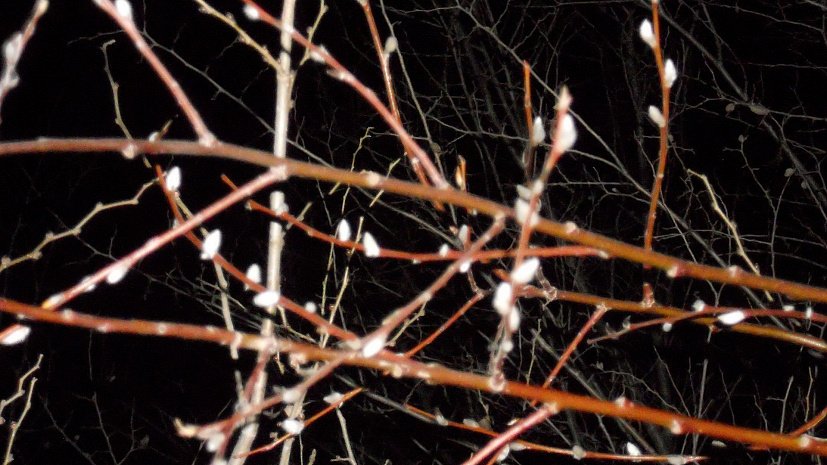
On the feast of the Entry into the Temple of the Most Holy Theotokos, a pussy willow is blooming
30 June 2019
The Christian miracles that we write about are most often associated with a specific place - be it Mount Tabor, the Church of the Holy Sepulcher in Jerusalem, or something else. But there is one inexplicable phenomenon that can be observed in different countries - while many believers have seen it with their own eyes more than once.
In winter, on the night from December 3rd to 4th according to the new style, when Orthodox believers celebrate the Great Feast of the Entry into the Temple of the Most Holy Theotokos, whatever the weather - frost or pouring rain, willow blossoms briefly bloom. There is no scientific explanation for this fact, there are a lot of hypotheses, none of which can be considered a clue to this phenomenal phenomenon of nature. Everyone can see this miracle of nature with their own eyes. To do this, you need to wait for the approach of midnight and go to the garden, to the park, or just to the street - to any place where these trees grow. Ten or twenty minutes before it strikes twelve, you will witness an extraordinary phenomenon: the willow buds, even covered with a layer of ice, will begin to open rapidly. On a quiet night, near the willows, clicks are heard - these are trees, waking up from winter sleep for a while, throwing ice from the buds. The people about this night they say: 'the willow is cracking.' At this time, you can even see leaves appearing on some branches. Just like in a fairy tale about twelve months - but for real. Unfortunately, this miracle is very fleeting. Shortly after the clock shows twelve at night, the kidneys often begin to close just as quickly. And the sprouts that have thrown off the ice will remain a reminder of what they saw - of course, in the area where frosts already occur at this time of year.
To preserve the memory of what you saw, you can cut off a willow branch with opened buds before midnight - in this case, it will remain exactly in this open form. On the Introduction to the Temple of the Most Holy Theotokos, you can see such branches in the church that believers bring with them as evidence of God's miracle. If you put such a branch in a jar of clean water at home, the willow will continue to bloom - however, at the usual pace set by nature: as a rule, this happens within two weeks, a little more or a little less. The climax of this miraculous phenomenon always falls at around 11:50 pm. At the same time, the time when the willow opens and closes can be different, and this event itself also has a different duration. For example, in 2001, the willow blossomed at the beginning of the eleventh and did not close until the onset of dawn. And two years earlier, blooming began fifteen minutes before midnight and proceeded rapidly: at a quarter past twelve, the buds had already closed. While still unexplained by science, this phenomenon has more than once caught the lenses of television cameras. The most famous video of this kind was filmed in 2000, in almost twenty degrees of frost, in Odintsovo near Moscow - and then shown on one of the federal channels in the Russian House program. But, of course, no TV broadcast can be compared to when a person himself becomes a witness of this miracle. You need a little for this: find a suitable tree nearby in advance, go to it closer to midnight - and wait patiently, with faith. V. Sergienko
On the feast of the Entry into the Temple of the Most Holy Theotokos, a pussy willow is bloomingOn the feast of the Entry into the Temple of the Most Holy Theotokos, a pussy willow is bloomingThe Christian miracles that we write about are most often associated with a specific place - be it Mount Tabor, the Church of the Holy Sepulcher in Jerusalem, or something else. But there is one inexplicable phenomenon that can be observed in different countries - while many believers have seen it with their own eyes more than once. In winter, on the night from December 3rd to 4th according to the new style, when Orthodox believers celebrate the Great Feast of the Entry into the Temple of the Most Holy Theotokos, whatever the weather - frost or pouring rain, willow blossoms briefly bloom. There is no scientific explanation for this fact, there are a lot of hypotheses, none of which can be considered a clue to this phenomenal phenomenon of nature. Everyone can see this miracle of nature with their own eyes. To do this, you need to wait for the approach of midnight and go to the garden, to the park, or just to the street - to any place where these trees grow. Ten or twenty minutes before it strikes twelve, you will witness an extraordinary phenomenon: the willow buds, even covered with a layer of ice, will begin to open rapidly. On a quiet night, near the willows, clicks are heard - these are trees, waking up from winter sleep for a while, throwing ice from the buds. The people about this night they say: 'the willow is cracking.' At this time, you can even see leaves appearing on some branches. Just like in a fairy tale about twelve months - but for real. Unfortunately, this miracle is very fleeting. Shortly after the clock shows twelve at night, the kidneys often begin to close just as quickly. And the sprouts that have thrown off the ice will remain a reminder of what they saw - of course, in the area where frosts already occur at this time of year. To preserve the memory of what you saw, you can cut off a willow branch with opened buds before midnight - in this case, it will remain exactly in this open form. On the Introduction to the Temple of the Most Holy Theotokos, you can see such branches in the church that believers bring with them as evidence of God's miracle. If you put such a branch in a jar of clean water at home, the willow will continue to bloom - however, at the usual pace set by nature: as a rule, this happens within two weeks, a little more or a little less. The climax of this miraculous phenomenon always falls at around 11:50 pm. At the same time, the time when the willow opens and closes can be different, and this event itself also has a different duration. For example, in 2001, the willow blossomed at the beginning of the eleventh and did not close until the onset of dawn. And two years earlier, blooming began fifteen minutes before midnight and proceeded rapidly: at a quarter past twelve, the buds had already closed. While still unexplained by science, this phenomenon has more than once caught the lenses of television cameras. The most famous video of this kind was filmed in 2000, in almost twenty degrees of frost, in Odintsovo near Moscow - and then shown on one of the federal channels in the Russian House program. But, of course, no TV broadcast can be compared to when a person himself becomes a witness of this miracle. You need a little for this: find a suitable tree nearby in advance, go to it closer to midnight - and wait patiently, with faith. V. SergienkoСвеча Иерусалима -en
The Christian miracles that we write about are most often associated with a specific place - be it Mount Tabor, the Church of the Holy Sepulcher in Jerusalem, or something else. But there is one inexplicable phenomenon that can be observed in different countries - while many believers have seen it with their own eyes more than once. In winter, on the night from December 3rd to 4th according to the new style, when Orthodox believers celebrate the Great Feast of the Entry into the Temple of the Most Holy Theotokos, whatever the weather - frost or pouring rain, willow blossoms briefly bloom. There is no scientific explanation for this fact, there are a lot of hypotheses, none of which can be considered a clue to this phenomenal phenomenon of nature. Everyone can see this miracle of nature with their own eyes. To do this, you need to wait for the approach of midnight and go to the garden, to the park, or just to the street - to any place where these trees grow. Ten or twenty minutes before it strikes twelve, you will witness an extraordinary phenomenon: the willow buds, even covered with a layer of ice, will begin to open rapidly. On a quiet night, near the willows, clicks are heard - these are trees, waking up from winter sleep for a while, throwing ice from the buds. The people about this night they say: 'the willow is cracking.' At this time, you can even see leaves appearing on some branches. Just like in a fairy tale about twelve months - but for real. Unfortunately, this miracle is very fleeting. Shortly after the clock shows twelve at night, the kidneys often begin to close just as quickly. And the sprouts that have thrown off the ice will remain a reminder of what they saw - of course, in the area where frosts already occur at this time of year. To preserve the memory of what you saw, you can cut off a willow branch with opened buds before midnight - in this case, it will remain exactly in this open form. On the Introduction to the Temple of the Most Holy Theotokos, you can see such branches in the church that believers bring with them as evidence of God's miracle. If you put such a branch in a jar of clean water at home, the willow will continue to bloom - however, at the usual pace set by nature: as a rule, this happens within two weeks, a little more or a little less. The climax of this miraculous phenomenon always falls at around 11:50 pm. At the same time, the time when the willow opens and closes can be different, and this event itself also has a different duration. For example, in 2001, the willow blossomed at the beginning of the eleventh and did not close until the onset of dawn. And two years earlier, blooming began fifteen minutes before midnight and proceeded rapidly: at a quarter past twelve, the buds had already closed. While still unexplained by science, this phenomenon has more than once caught the lenses of television cameras. The most famous video of this kind was filmed in 2000, in almost twenty degrees of frost, in Odintsovo near Moscow - and then shown on one of the federal channels in the Russian House program. But, of course, no TV broadcast can be compared to when a person himself becomes a witness of this miracle. You need a little for this: find a suitable tree nearby in advance, go to it closer to midnight - and wait patiently, with faith. V. Sergienko