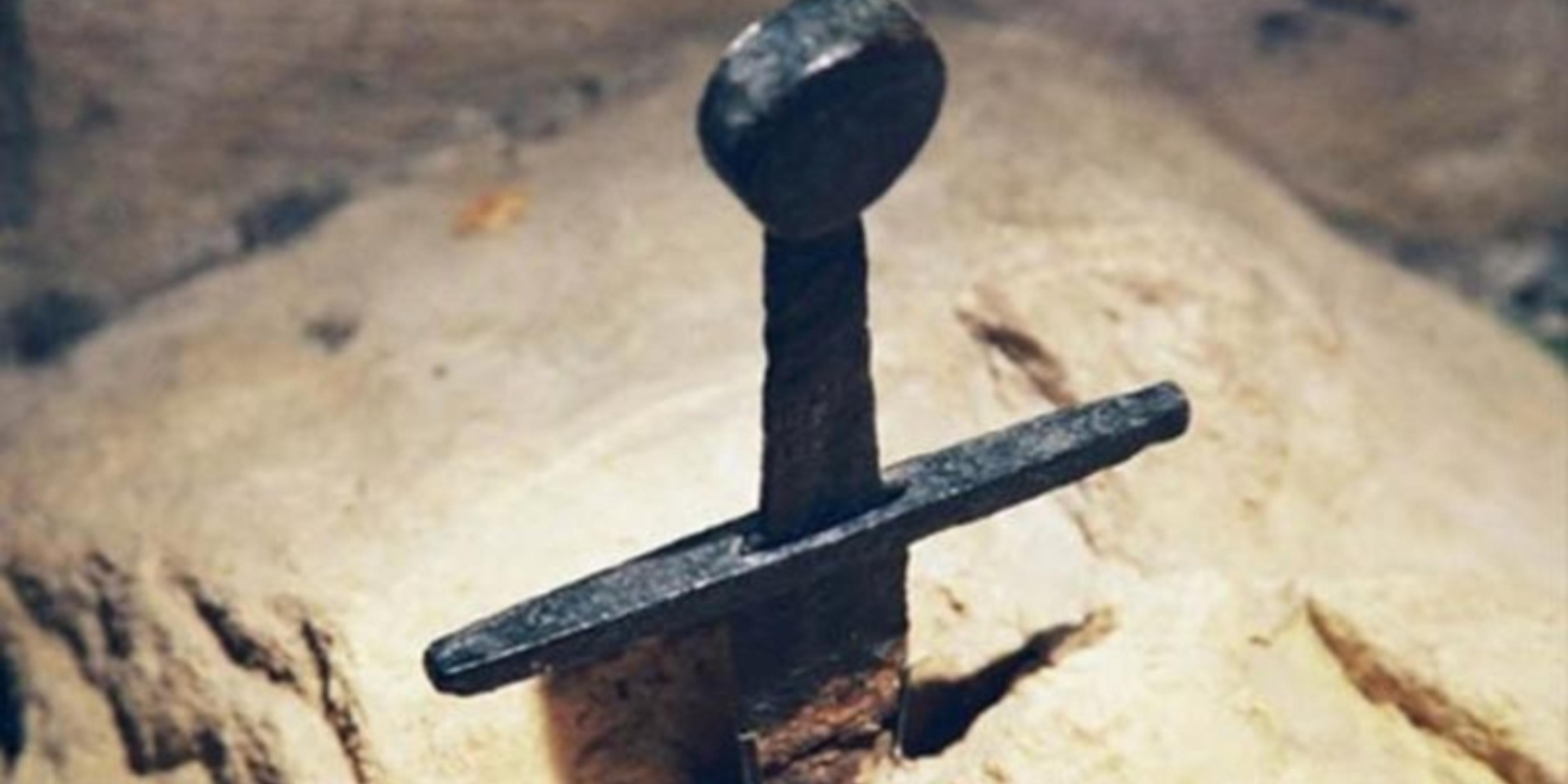
The story of the wizard Merlin, the evil Morgana and the sword that King Arthur had to pull out of the stone is probably known to everyone. This English legend is one of the most popular in the world. However, there is another sword immersed in a stone, which can still be seen with your own eyes in our time - although it is still not worth trying to pull it out. It is located in Italian Tuscany, in the chapel (chapel) of Montesiepi.
Very far from the mythical Avalon, much closer to the Abbey of San Galliano in Chiusdino, only forty kilometers from Siena there is a chapel where under a glass bell are enclosed two parts of one whole - a stone and almost up to the hilt of a sword driven into it. The type of sword makes it almost unmistakable to be attributed to the twelfth century.
The sword belonged to a noble but dissolute man, a nobleman from Ciusdino, who wasted his life in drunkenness and debauchery. This continued until none other than Nicholas the Wonderworker appeared to him. It is not known for certain in what terms the saint demanded that the sinner change his way of life - however, the chroniclers report, very soon he became a hermit, spending time in solitude, simple labors and fervent prayer.
The man's name was Galgano Guidotti. He made his departure from worldly life in a very symbolic way: with a swing driving his own sword deep into the stone. Tradition says that the devil, in order to shake Galgano's faith, split the sword into three pieces - but he prayed fervently, and the weapon in the stone again became one. Moreover, the sword was so deeply embedded in the rock that no one could extract it from there: neither the recognized strongmen, nor the most noble knights.
Soon after Guidotti completed his earthly path as a hermit, and the Church recognized him as a saint in 1385, the believers cut out a part of the rock with a sword and carefully transferred it to a small chapel. Here it is to this day, carefully protected by a glass cover from people's attempts to test their strength and luck (in past centuries there were many of them).
Surrounding the sculptural composition - if, of course, I can put it that way - are frescoes of the fourteenth century, telling the life of the saint, including, of course, the story of the sword.
It must be said that the relic from Tuscany has been repeatedly subjected to metallographic examination and other research methods available to science. However, all of them, to a single one, confirmed that the sword belongs to the era of the Crusades, in which Galgano Guidotti lived and asceticised. Among historians, there is an opinion that the history of this particular sword was the one that served to include a somewhat modified plot with it in the Arthurian cycle, but many of their colleagues disagree with this. Who is right, one or the other, it is impossible to say for sure. However, the fact that one of the Knights of the Round Table was called Galvano, allows us to assume that the Tuscan nobleman who changed his life still has some relation to the legends of King Arthur.
Very far from the mythical Avalon, much closer to the Abbey of San Galliano in Chiusdino, only forty kilometers from Siena there is a chapel where under a glass bell are enclosed two parts of one whole - a stone and almost up to the hilt of a sword driven into it. The type of sword makes it almost unmistakable to be attributed to the twelfth century.
The sword belonged to a noble but dissolute man, a nobleman from Ciusdino, who wasted his life in drunkenness and debauchery. This continued until none other than Nicholas the Wonderworker appeared to him. It is not known for certain in what terms the saint demanded that the sinner change his way of life - however, the chroniclers report, very soon he became a hermit, spending time in solitude, simple labors and fervent prayer.
The man's name was Galgano Guidotti. He made his departure from worldly life in a very symbolic way: with a swing driving his own sword deep into the stone. Tradition says that the devil, in order to shake Galgano's faith, split the sword into three pieces - but he prayed fervently, and the weapon in the stone again became one. Moreover, the sword was so deeply embedded in the rock that no one could extract it from there: neither the recognized strongmen, nor the most noble knights.
Soon after Guidotti completed his earthly path as a hermit, and the Church recognized him as a saint in 1385, the believers cut out a part of the rock with a sword and carefully transferred it to a small chapel. Here it is to this day, carefully protected by a glass cover from people's attempts to test their strength and luck (in past centuries there were many of them).
Surrounding the sculptural composition - if, of course, I can put it that way - are frescoes of the fourteenth century, telling the life of the saint, including, of course, the story of the sword.
It must be said that the relic from Tuscany has been repeatedly subjected to metallographic examination and other research methods available to science. However, all of them, to a single one, confirmed that the sword belongs to the era of the Crusades, in which Galgano Guidotti lived and asceticised. Among historians, there is an opinion that the history of this particular sword was the one that served to include a somewhat modified plot with it in the Arthurian cycle, but many of their colleagues disagree with this. Who is right, one or the other, it is impossible to say for sure. However, the fact that one of the Knights of the Round Table was called Galvano, allows us to assume that the Tuscan nobleman who changed his life still has some relation to the legends of King Arthur.
Share: