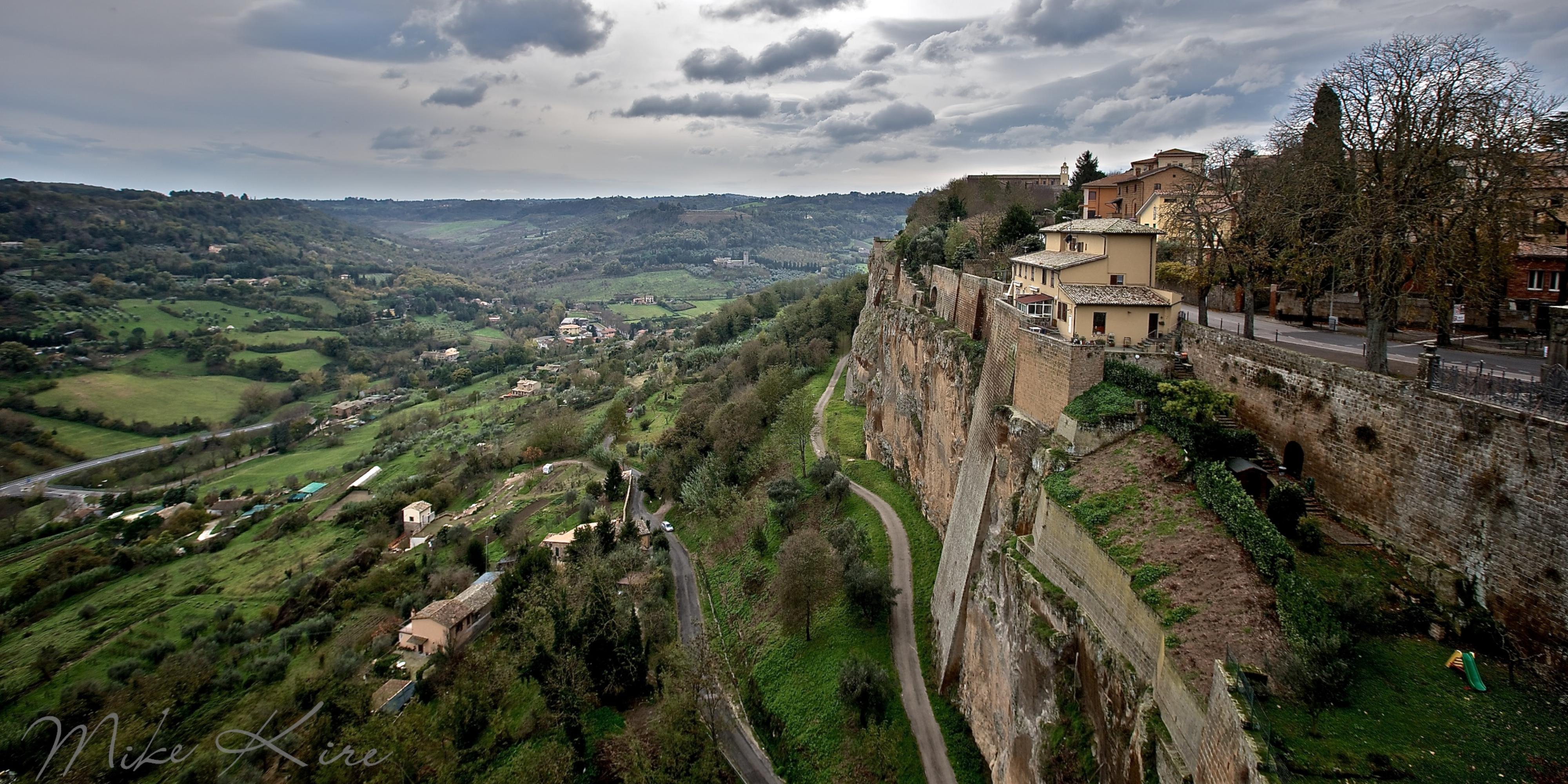
St. Patrick's Well in Orvieto (Italy)

Колодец святого Патрика в Орвието (Италия)

Strictly speaking, the unique well in Italian Orvieto (Umbria) is not a Christian shrine and a place of pilgrimage. At the same time, it is an integral part of the history of the Roman Catholic Church and a monument to the engineering genius of the Renaissance. The inscription in Latin, made on the well, reads: 'What nature has not given can be created by human hands.'

The history of the creation of a grandiose well 62 deep and 13.4 meters wide dates back to the first third of the 16th century. In 1527, the army of the Spanish king Charles V sacked the Eternal City. Pope Clement VII was forced to flee from Rome - and found himself in Orvieto. Here he instructed the talented architect Antonio de Sangallo Jr. to build a well - large enough so that in the event of a siege of the city by the Spaniards or another army, there would be enough water from it for all local residents. Despite the fact that the threat of a military invasion soon passed, it was decided to bring the grandiose project begun by de Sangallo to completion.

Today, half a thousand years later, this engineering structure never ceases to amaze - both by its size and by its thoroughly thought-out design. Two spiral staircases lead inside the well: one serves for the entrance, the other for the exit. They are located in a spiral along the walls of the structure. Non-intersecting staircases are wide enough to carts drawn by horses or mules, driven by drivers, could move along them. Each staircase has 248 steps. So that the ascent and descent did not take place in the dark, Sangallo equipped each of the stairs with 72 arched windows. The drivers went downstairs, filled the barrels with water - and then climbed up another staircase.

The well in Orvieto was named after St. Patrick - by analogy with the cave named after him, which is located in Ireland, on an island in the middle of Loch Derg. According to medieval Irish tradition, this is where the entrance to Purgatory is located.

At the bottom of the well in the Umbrian Orvieto, there is a capacious reservoir of water, over which a small bridge is thrown. Today its bottom is littered with coins - tourists throw them, because the grandiose well is no longer used for its intended purpose.

The well of St. Patrick is located in the upper part of the city of Orvieto at Viale San Gallo, 05018, next to the funicular station, which costs one euro. Actually, a visit to the well will cost five euros, and if you arrive there as part of a group - three and a half. The same is the entrance for children and seniors. The well is open to the public all year round, although visiting times vary from season to season.

V. Sergienko

Orvieto, Terni, Umbria, Italy, Europe 'width =' 960 'height =' 720 'src =' https://www.youtube.com/embed/tFwN8kzmCTA?feature=oembed 'frameborder =' 0 'allow =' accelerometer ; autoplay; encrypted-media; gyroscope; picture-in-picture 'allowfullscreen =' '>

Share:
St. Patrick's Well in Orvieto (Italy) St. Patrick's Well in Orvieto (Italy) Strictly speaking, the unique well in Italian Orvieto (Umbria) is not a Christian shrine and a place of pilgrimage. At the same time, it is an integral part of the history of the Roman Catholic Church and a monument to the engineering genius of the Renaissance. The inscription in Latin, made on the well, reads: 'What nature has not given can be created by human hands.' The history of the creation of a grandiose well 62 deep and 13.4 meters wide dates back to the first third of the 16th century. In 1527, the army of the Spanish king Charles V sacked the Eternal City. Pope Clement VII was forced to flee from Rome - and found himself in Orvieto. Here he instructed the talented architect Antonio de Sangallo Jr. to build a well - large enough so that in the event of a siege of the city by the Spaniards or another army, there would be enough water from it for all local residents. Despite the fact that the threat of a military invasion soon passed, it was decided to bring the grandiose project begun by de Sangallo to completion. Today, half a thousand years later, this engineering structure never ceases to amaze - both by its size and by its thoroughly thought-out design. Two spiral staircases lead inside the well: one serves for the entrance, the other for the exit. They are located in a spiral along the walls of the structure. Non-intersecting staircases are wide enough to carts drawn by horses or mules, driven by drivers, could move along them. Each staircase has 248 steps. So that the ascent and descent did not take place in the dark, Sangallo equipped each of the stairs with 72 arched windows. The drivers went downstairs, filled the barrels with water - and then climbed up another staircase. The well in Orvieto was named after St. Patrick - by analogy with the cave named after him, which is located in Ireland, on an island in the middle of Loch Derg. According to medieval Irish tradition, this is where the entrance to Purgatory is located. At the bottom of the well in the Umbrian Orvieto, there is a capacious reservoir of water, over which a small bridge is thrown. Today its bottom is littered with coins - tourists throw them, because the grandiose well is no longer used for its intended purpose. The well of St. Patrick is located in the upper part of the city of Orvieto at Viale San Gallo, 05018, next to the funicular station, which costs one euro. Actually, a visit to the well will cost five euros, and if you arrive there as part of a group - three and a half. The same is the entrance for children and seniors. The well is open to the public all year round, although visiting times vary from season to season. V. Sergienko Orvieto, Terni, Umbria, Italy, Europe 'width =' 960 'height =' 720 'src =' https://www.youtube.com/embed/tFwN8kzmCTA?feature=oembed 'frameborder =' 0 'allow =' accelerometer ; autoplay; encrypted-media; gyroscope; picture-in-picture 'allowfullscreen =' '>
Strictly speaking, the unique well in Italian Orvieto (Umbria) is not a Christian shrine and a place of pilgrimage. At the same time, it is an integral part of the history of the Roman Catholic Church and a monument to the engineering genius of the Renaissance. The inscription in Latin, made on the well, reads: 'What nature has not given can be created by human hands.' The history of the creation of a grandiose well 62 deep and 13.4 meters wide dates back to the first third of the 16th century. In 1527, the army of the Spanish king Charles V sacked the Eternal City. Pope Clement VII was forced to flee from Rome - and found himself in Orvieto. Here he instructed the talented architect Antonio de Sangallo Jr. to build a well - large enough so that in the event of a siege of the city by the Spaniards or another army, there would be enough water from it for all local residents. Despite the fact that the threat of a military invasion soon passed, it was decided to bring the grandiose project begun by de Sangallo to completion. Today, half a thousand years later, this engineering structure never ceases to amaze - both by its size and by its thoroughly thought-out design. Two spiral staircases lead inside the well: one serves for the entrance, the other for the exit. They are located in a spiral along the walls of the structure. Non-intersecting staircases are wide enough to carts drawn by horses or mules, driven by drivers, could move along them. Each staircase has 248 steps. So that the ascent and descent did not take place in the dark, Sangallo equipped each of the stairs with 72 arched windows. The drivers went downstairs, filled the barrels with water - and then climbed up another staircase. The well in Orvieto was named after St. Patrick - by analogy with the cave named after him, which is located in Ireland, on an island in the middle of Loch Derg. According to medieval Irish tradition, this is where the entrance to Purgatory is located. At the bottom of the well in the Umbrian Orvieto, there is a capacious reservoir of water, over which a small bridge is thrown. Today its bottom is littered with coins - tourists throw them, because the grandiose well is no longer used for its intended purpose. The well of St. Patrick is located in the upper part of the city of Orvieto at Viale San Gallo, 05018, next to the funicular station, which costs one euro. Actually, a visit to the well will cost five euros, and if you arrive there as part of a group - three and a half. The same is the entrance for children and seniors. The well is open to the public all year round, although visiting times vary from season to season. V. Sergienko Orvieto, Terni, Umbria, Italy, Europe 'width =' 960 'height =' 720 'src =' https://www.youtube.com/embed/tFwN8kzmCTA?feature=oembed 'frameborder =' 0 'allow =' accelerometer ; autoplay; encrypted-media; gyroscope; picture-in-picture 'allowfullscreen =' '>