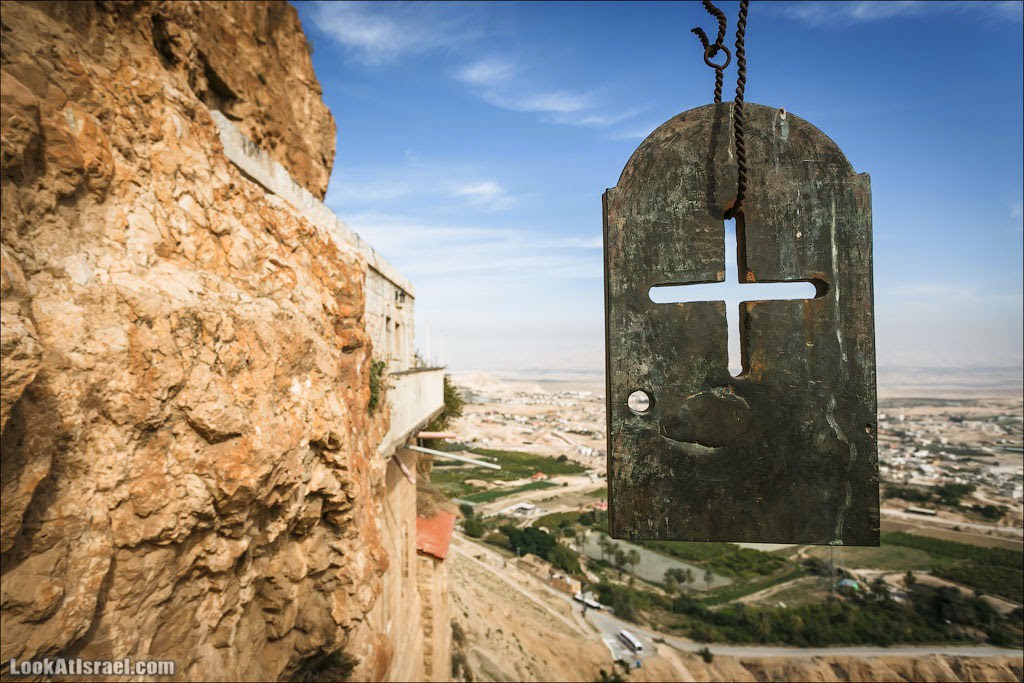
Although monastic life on Mount Karantal began to warm up in the fourth century, the current Greek monastery was built here fifteen hundred years later. Its main shrine is the stone on which, according to Tradition, the Lord Jesus Christ prayed when he was in the wilderness for forty days and was tempted by the devil before leaving for His earthly ministry. And, of course, no less shrine is the cave itself, in which He stayed throughout the entire period of His voluntary withdrawal from the world.
In the Judean Desert, on the northwestern outskirts of ancient Jericho, there is a holy monastery, the name of which, like the name of the mountain into which it literally grew, is associated with the well-known events of the New Testament, which are mentioned at the beginning of chapter 4 of the Gospel of Matthew (verses 1 - 11):
“Then Jesus was led by the Spirit into the wilderness to be tempted by the devil, and after fasting forty days and forty nights, finally he was hungry. And the tempter came to Him and said: If you are the Son of God, command that these stones be made bread. But he answered and said to him: It is written: Man shall not live by bread alone, but by every word that proceeds from the mouth of God. Then the devil takes Him to the holy city and sets Him up on the wing of the temple, and says to Him: if You are the Son of God, throw yourself down, for it is written: He will command His angels about You, and they will carry them in their arms. You, so you do not stumble over a stone with Your foot. Jesus said to him: It is also written: Thou shalt not tempt the Lord thy God. Again the devil takes Him to a very high mountain and shows Him all the kingdoms of the world and their glory, and says to Him: I will give you all this, if you fall down and worship me. Then Jesus says to him: Get away from Me, Satan, for it is written: Worship the Lord thy God and serve Him alone. Then the devil leaves him, and behold, the angels came and served him. '
None of the evangelists consider it necessary to explain why the Savior takes such a step as going into the wilderness, and here is why. At the dawn of Christianity, a long stay away from the world was a habitual action for almost any person who decided to devote himself to the service of God. And not only at dawn. Back in the 19th century, Coptic and Ethiopian monks observed the custom of spending the time of Lent in solitude on the Mount of Temptation. Here is what her contemporary, the Russian Archimandrite Leonid (Kavelin), writes about this tradition: “They leave here from Jerusalem a week after the Feast of the Epiphany and return to the Holy City on the week of Vai, feeding at this time with herbs or dry food and practicing prayer and reading, for which they take books with them. Their clothes consist of a shirt and a cotton blanket, in which they wrap themselves up like a cloak against the cold of the night. '
Today this place is not as deserted as a century and a half ago, and you can get here either by cable car, or on foot, having undertaken not the easiest half-hour climb up the mountain, on which there is a high probability of meeting other pilgrims - of the six holy monasteries of the Judean Desert, the Temptation Monastery is perhaps the most visited in our time.
Mount Karantali or, in Russian, Forty-Day Mountain and the Temptation Monastery on it are located on the territory of the Palestinian Authority - and if it is not easy for an Israeli to get into the monastery, then Orthodox pilgrims who come here almost every day are always open to the way here. Previously, this place was called Mount Dok (short for Dagon - this was the name of the ancient Semitic deity, whose name comes either from the word 'fish', or from the word 'cereal'). The toponym indicates a very, very ancient acquaintance of people with this area. The mountain rises three hundred and eighty meters in the Jericho Valley; from open water sources there is only one large seasonal brook Prat. Considering that Karantal is, in the language of the military, the dominant height, it is quite logical that during the time of the Hasmonean kings a fortress was built on its top, from which control over the Fara gorge (or otherwise - Wadi Kelt) was exercised on the way to Jerusalem from the East. This fortress (or rather, its walls that have survived to this day) can be observed today. As, by the way, and a modern military base on the neighboring hill.
The Christian name of the mountain - Karantal - comes from the Latin quarenta, a numeral meaning 'forty.' Already at the time of Saint Helena, the mother of Emperor Constantine the Great, Church Tradition unequivocally identified this mountain with the events of the temptation of Jesus Christ, therefore the appearance of the holy monastery here was only a matter of time. This, in fact, happened in 349, when the Monk Chariton the Confessor, already known for having founded two other monasteries in the Holy Land, laid the foundation for the Duke Lavra here. Until the beginning of the seventh century, the monastery was a fairly populous and prosperous place - however, first the invasion of the Persians, and then the seizure of the Holy Land by Caliph Umar ibn Khattab caused the monastic residence here for a long time to be interrupted. In the XII century, during the time of the Kingdom of Jerusalem, the crusaders erected two temples on Karantal - one in the cave where the Savior prayed, and the second - at the very top of the mountain. After the departure of the crusaders and the seizure of the Holy Land by the Muslims, the monastery with cells carved into the rock again ceases to function, this time for a long time, even by historical standards.
Only in 1874 Greek Orthodox the church acquires these lands and with the assistance of Russia (financial, diplomatic, etc.), in just two decades it does a colossal amount of construction and finishing work - and restores the ancient monastery. In fact, he is building it anew on the same basis: by 1895, the monastery acquired the features by which it is known to Christian pilgrims all over the world in our time. True, if at the end of the 19th century the ancient monastery was full of inhabitants, today all the brethren of the monastery in the rock, hanging over ancient Jericho, consists of only one hieromonk and his assistant deacon. For this reason, the monastery is guarded: to get inside, you need to convince the gatekeeper of the purity and seriousness of your intentions. Before that, you will have to knock on the monastery gates with a copper ring for quite a long time: maybe the gatekeeper's post is very remote from them, or maybe this has its own special monastic symbolism, who knows.
By the way, even those of the pilgrims who climb to the monastery by cable car, the final part of the path is overcome on foot along a wide ascending path, getting the opportunity to work a little. As for the funicular, it is an attraction in itself. Firstly, it is the longest cable car in the Middle East, with a length of 1,330 meters. Secondly, this is the road located in the lowest place on the planet: its lowest point is located at an elevation of three hundred meters below sea level.
However, back to the monastery. In fact, it is a long narrow gallery that stretches along the eastern slope of the mountain. Passages - with open vaults; on one side - a natural rock texture, on the other - attached walls. Ladders, descents, ascents. Empty cells, quite spacious, obviously for guests - or maybe counting on the future inhabitants of the monastery. Even in the heat over forty Celsius, a refreshing coolness reigns in the Monastery of Temptation.
The main monastery temple is located in a cave - but in order to reach the main local shrines, you need to go further. The end of the path is a small cave temple (it is called the Chapel of Temptation) at the very place where Jesus Christ was during His voluntary forty days of fasting, tempted alternately by glory, wealth and power - and rejected all these temptations. These events in the monastery church are depicted many times, in icons and in paintings. The stone on which the Savior prayed is also here: as a rule, all who come reverently kiss it.
Interestingly, in the wooden carvings of the iconostasis of the temple, one can see not only eagles (that same historical 'Russian trace' in the history of the monastery?), But even dragons. If you're lucky, you can ask the local guardian about the symbolism of these figures - Father Gerasim, who has been serving in the monastery of Temptation for more than thirty years. Or deacon Onuphrius, who helps an honest father in everything he can.
What prayers come to mind for pilgrims at the Chapel of Temptation? The most different, but to all without exception - the main one: 'Our Father', which sounds over the vaults cut in the rock in a variety of languages. After praying, many of those who came serve in this church notes about the health and repose of relatives and friends - by the way, they should be written here only in block letters.
As already mentioned, the holy monastery is actually a two-story gallery attached to the mountain, which is thoroughly cut through by large and smaller caves. Many visitors have a natural question: what about water at such a height? On the lower floor, in the main hall of the monastery, there is a well, which is supplied with water from the source of Elisha in Jericho. They scoop it from the monastery well with a teapot tied to a rope. However, the monastery is male, and only men have the right to draw water here. Therefore, pilgrims sometimes have to wait until one of the men appears and fills the bottles with them.
If you go out to the long and narrow balcony of the Monastery of Temptation, you can to see the very cells in which the medieval monks lived, and their spiritual descendants overcame the temptation during Great Lent already in modern times. Not everyone has enough spirit to go out onto the balcony, but those who nevertheless decide are fully rewarded with the view that opens up to them. The most stunning photos from Karantal are taken from here.
If the path along the wide path to the gate of the Monastery of Temptation takes about half an hour, then you can go down to the base of the mountain twice as fast. And already here, with pleasure, to reinforce their strength in an institution under the signboard with Russian letters: 'Mountain Cafe'. There are most of the Russian pilgrims here - and, like a hundred-odd years ago, the attitude towards them is the most benevolent.
In the Judean Desert, on the northwestern outskirts of ancient Jericho, there is a holy monastery, the name of which, like the name of the mountain into which it literally grew, is associated with the well-known events of the New Testament, which are mentioned at the beginning of chapter 4 of the Gospel of Matthew (verses 1 - 11):
“Then Jesus was led by the Spirit into the wilderness to be tempted by the devil, and after fasting forty days and forty nights, finally he was hungry. And the tempter came to Him and said: If you are the Son of God, command that these stones be made bread. But he answered and said to him: It is written: Man shall not live by bread alone, but by every word that proceeds from the mouth of God. Then the devil takes Him to the holy city and sets Him up on the wing of the temple, and says to Him: if You are the Son of God, throw yourself down, for it is written: He will command His angels about You, and they will carry them in their arms. You, so you do not stumble over a stone with Your foot. Jesus said to him: It is also written: Thou shalt not tempt the Lord thy God. Again the devil takes Him to a very high mountain and shows Him all the kingdoms of the world and their glory, and says to Him: I will give you all this, if you fall down and worship me. Then Jesus says to him: Get away from Me, Satan, for it is written: Worship the Lord thy God and serve Him alone. Then the devil leaves him, and behold, the angels came and served him. '
None of the evangelists consider it necessary to explain why the Savior takes such a step as going into the wilderness, and here is why. At the dawn of Christianity, a long stay away from the world was a habitual action for almost any person who decided to devote himself to the service of God. And not only at dawn. Back in the 19th century, Coptic and Ethiopian monks observed the custom of spending the time of Lent in solitude on the Mount of Temptation. Here is what her contemporary, the Russian Archimandrite Leonid (Kavelin), writes about this tradition: “They leave here from Jerusalem a week after the Feast of the Epiphany and return to the Holy City on the week of Vai, feeding at this time with herbs or dry food and practicing prayer and reading, for which they take books with them. Their clothes consist of a shirt and a cotton blanket, in which they wrap themselves up like a cloak against the cold of the night. '
Today this place is not as deserted as a century and a half ago, and you can get here either by cable car, or on foot, having undertaken not the easiest half-hour climb up the mountain, on which there is a high probability of meeting other pilgrims - of the six holy monasteries of the Judean Desert, the Temptation Monastery is perhaps the most visited in our time.
Mount Karantali or, in Russian, Forty-Day Mountain and the Temptation Monastery on it are located on the territory of the Palestinian Authority - and if it is not easy for an Israeli to get into the monastery, then Orthodox pilgrims who come here almost every day are always open to the way here. Previously, this place was called Mount Dok (short for Dagon - this was the name of the ancient Semitic deity, whose name comes either from the word 'fish', or from the word 'cereal'). The toponym indicates a very, very ancient acquaintance of people with this area. The mountain rises three hundred and eighty meters in the Jericho Valley; from open water sources there is only one large seasonal brook Prat. Considering that Karantal is, in the language of the military, the dominant height, it is quite logical that during the time of the Hasmonean kings a fortress was built on its top, from which control over the Fara gorge (or otherwise - Wadi Kelt) was exercised on the way to Jerusalem from the East. This fortress (or rather, its walls that have survived to this day) can be observed today. As, by the way, and a modern military base on the neighboring hill.
The Christian name of the mountain - Karantal - comes from the Latin quarenta, a numeral meaning 'forty.' Already at the time of Saint Helena, the mother of Emperor Constantine the Great, Church Tradition unequivocally identified this mountain with the events of the temptation of Jesus Christ, therefore the appearance of the holy monastery here was only a matter of time. This, in fact, happened in 349, when the Monk Chariton the Confessor, already known for having founded two other monasteries in the Holy Land, laid the foundation for the Duke Lavra here. Until the beginning of the seventh century, the monastery was a fairly populous and prosperous place - however, first the invasion of the Persians, and then the seizure of the Holy Land by Caliph Umar ibn Khattab caused the monastic residence here for a long time to be interrupted. In the XII century, during the time of the Kingdom of Jerusalem, the crusaders erected two temples on Karantal - one in the cave where the Savior prayed, and the second - at the very top of the mountain. After the departure of the crusaders and the seizure of the Holy Land by the Muslims, the monastery with cells carved into the rock again ceases to function, this time for a long time, even by historical standards.
Only in 1874 Greek Orthodox the church acquires these lands and with the assistance of Russia (financial, diplomatic, etc.), in just two decades it does a colossal amount of construction and finishing work - and restores the ancient monastery. In fact, he is building it anew on the same basis: by 1895, the monastery acquired the features by which it is known to Christian pilgrims all over the world in our time. True, if at the end of the 19th century the ancient monastery was full of inhabitants, today all the brethren of the monastery in the rock, hanging over ancient Jericho, consists of only one hieromonk and his assistant deacon. For this reason, the monastery is guarded: to get inside, you need to convince the gatekeeper of the purity and seriousness of your intentions. Before that, you will have to knock on the monastery gates with a copper ring for quite a long time: maybe the gatekeeper's post is very remote from them, or maybe this has its own special monastic symbolism, who knows.
By the way, even those of the pilgrims who climb to the monastery by cable car, the final part of the path is overcome on foot along a wide ascending path, getting the opportunity to work a little. As for the funicular, it is an attraction in itself. Firstly, it is the longest cable car in the Middle East, with a length of 1,330 meters. Secondly, this is the road located in the lowest place on the planet: its lowest point is located at an elevation of three hundred meters below sea level.
However, back to the monastery. In fact, it is a long narrow gallery that stretches along the eastern slope of the mountain. Passages - with open vaults; on one side - a natural rock texture, on the other - attached walls. Ladders, descents, ascents. Empty cells, quite spacious, obviously for guests - or maybe counting on the future inhabitants of the monastery. Even in the heat over forty Celsius, a refreshing coolness reigns in the Monastery of Temptation.
The main monastery temple is located in a cave - but in order to reach the main local shrines, you need to go further. The end of the path is a small cave temple (it is called the Chapel of Temptation) at the very place where Jesus Christ was during His voluntary forty days of fasting, tempted alternately by glory, wealth and power - and rejected all these temptations. These events in the monastery church are depicted many times, in icons and in paintings. The stone on which the Savior prayed is also here: as a rule, all who come reverently kiss it.
Interestingly, in the wooden carvings of the iconostasis of the temple, one can see not only eagles (that same historical 'Russian trace' in the history of the monastery?), But even dragons. If you're lucky, you can ask the local guardian about the symbolism of these figures - Father Gerasim, who has been serving in the monastery of Temptation for more than thirty years. Or deacon Onuphrius, who helps an honest father in everything he can.
What prayers come to mind for pilgrims at the Chapel of Temptation? The most different, but to all without exception - the main one: 'Our Father', which sounds over the vaults cut in the rock in a variety of languages. After praying, many of those who came serve in this church notes about the health and repose of relatives and friends - by the way, they should be written here only in block letters.
As already mentioned, the holy monastery is actually a two-story gallery attached to the mountain, which is thoroughly cut through by large and smaller caves. Many visitors have a natural question: what about water at such a height? On the lower floor, in the main hall of the monastery, there is a well, which is supplied with water from the source of Elisha in Jericho. They scoop it from the monastery well with a teapot tied to a rope. However, the monastery is male, and only men have the right to draw water here. Therefore, pilgrims sometimes have to wait until one of the men appears and fills the bottles with them.
If you go out to the long and narrow balcony of the Monastery of Temptation, you can to see the very cells in which the medieval monks lived, and their spiritual descendants overcame the temptation during Great Lent already in modern times. Not everyone has enough spirit to go out onto the balcony, but those who nevertheless decide are fully rewarded with the view that opens up to them. The most stunning photos from Karantal are taken from here.
If the path along the wide path to the gate of the Monastery of Temptation takes about half an hour, then you can go down to the base of the mountain twice as fast. And already here, with pleasure, to reinforce their strength in an institution under the signboard with Russian letters: 'Mountain Cafe'. There are most of the Russian pilgrims here - and, like a hundred-odd years ago, the attitude towards them is the most benevolent.
Share: