Emperor Constantine and Empress Helena - Founders of the First Churches in Holy Places One of the turning points in late antique history was the reign of Emperor Constantine I (the Great), who was especially revered by the Christian Church and canonized after death in the face of Equal to the Apostles. Being a pagan at the beginning of his reign, Constantine in October 312 defeated the army of Maxentius superior in strength with the help of a special sacred sign - the monogram of Christ, shown to him in a prophetic dream on the eve of the battle . After believing in the power of Jesus, Constantine in 313 gave Christianity the status of a state religion, which became dominant in the territory of the Roman Empire by the end of the 4th century. Thanks to Constantine, Christians, for the first time after three hundred years of persecution, were able to openly confess their faith.
The city he founded on the shores of the Bosphorus, located on the site of the former Greek colony, which bore the name Byzantium, later became the capital of the entire Orthodox Christian world, and after the death of its founder received his name - Constantinople. At a time when the Western Roman Empire was falling into decay and shuddering under the crushing blows of barbarian tribes, the city of Constantine - the capital of the Eastern Roman Empire - was experiencing its heyday.
After the establishment of Christianity, Emperor Constantine set out to find the very Life-giving cross on which the Savior was crucified. To this end, he sent his mother, Queen Helena, who was a devout Christian, to the Holy Land.
Saints Constantine (with the banner with the monogram of Christ) and Helena (with the acquired cross). Mosaic in St. Isaac's Cathedral, St. Petersburg According to the Roman historian Eusebius of Caesarea, 'this eldress of extraordinary mind with the speed of a young man hurried eastward' (Elena was already about eighty years old at that time). Having experienced all the difficulties and hardships of a long journey, the queen arrived in Palestine, where she found a very bleak picture: it turned out that most of the places associated with the Gospel events had long been destroyed. The cave of the Holy Sepulcher was covered with garbage, and a pagan temple dedicated to Venus, the Roman goddess of love, was built on the hill poured over it. Helen ordered to destroy all the pagan temples, placed on the holy places for Christians, and instead to build holy temples. Further, the queen was actively engaged in the search for Christian relics, for which she undertook extensive excavations at Calvary and discovered the cave of the Holy Sepulcher, and not far from it - the remains of three crosses. From contact with one of them, a deceased resurrected, who was carried along the street for burial - thus the cross that belonged to Christ was identified. Helen's discovery of the cross in May 326 marked the beginning of the Feast of the Exaltation .
Piero della Francesca. Finding the Life-giving Cross and raising the dead. Fresco of the 15th century. In addition to the crosses, the queen also found four nails and a plaque with the inscription INRI, an abbreviation written at the direction of Pilate. According to historical sources, part of the Life-giving Cross, placed in the silver ark, remained in Jerusalem, and Helen sent the other to Constantinople. Two nails from the cross were also sent there, one of which Constantine ordered to be inlaid in a tiara, and the second - to be placed in a horse bridle. One of the legends also tells that from this pilgrimage trip Helen brought a marble staircase from the palace of Pontius Pilate, along which Jesus ascended to judgment. The so-called “Pilate's staircase” ( Scala Pilati ) , which was transported in due time to Rome, has survived to this day and you can climb it to the personal papal chapel of the Holy of Holies (Sancta Sanctorum). Believers overcome all twenty-eight steps exclusively on their knees, while reading special prayers.
Pilgrims on the Holy Staircase (Pilate's Staircase) in the Lateran Palace in Rome Ancient historians report that Queen Helena designated places associated with the earthly life of Jesus Christ, the foundation of several dozen temples. The earliest sources indicate that there were three such churches: the Church of the Holy Sepulcher at Calvary , the Basilica of the Nativity of Christ in Bethlehem and the church above the place of Christ's ascension on the Mount of Olives . Later in the hagiographic literature (not earlier than the 7th century), there was a mention of the churches erected by her in Gethsemane (at the place where the Savior prayed before being taken into custody, and where the Most Holy Theotokos was later buried), in Hebron, near the oak of Mamre (in that the place where the three angels appeared to Abraham), in Bethany (over the tomb of Lazarus resurrected by Christ), on Mount Tabor (where the miracle of the Transfiguration of the Lord took place), at Lake Tiberias (where the Apostles Peter and Andrew were fishing when they were called by Christ to the apostolic ministry) other.
Basilica of the Nativity in Bethlehem. Incision. The reconstruction of the original view of the Basilica of the Nativity in Bethlehem , which is one of the oldest continuously operating churches in the world, has survived to this day with additions and alterations - a consequence of a fire, what happened in the VI century. Initially, it was a large five-nave temple, in front of which there was an atrium - an open courtyard surrounded by a colonnade, intended for the uninitiated - those who had not yet received the rite of baptism. The eastern part of the temple ended with an apse of a complicated form, which was conceived as a frame for the grotto in which Christ was born. The Cave of the Nativity is still located under the pulpit of the basilica; the birthplace of the Savior located in its eastern part is marked with a silver star.
The Jerusalem complex of the Church of the Holy Sepulcher , built by the decree of Emperor Constantine and consecrated in 335, was destroyed in the 11th century. Muslims and now exists in a rebuilt form. Initially, it was an imposing five-nave basilica, to the altar of which was adjoined a martyrium - a memorial complex erected over the place where Jesus died on the cross for the salvation of mankind. Martyrius was a large courtyard containing two shrines: a part of the rock of Calvary - evidence of the death of Christ, and the Holy Sepulcher - evidence of his resurrection. A round building was erected over the tomb of Christ, within which twelve columns surrounded a stone tombstone. The temple was under construction for about ten years and was consecrated after the death of Elena.
The Chapel of the Ascension on the Mount of Olives in Jerusalem, also founded during the time of Saints Constantine and Helena, in the 7th century. was destroyed by the Persians. The temple that we can see today was restored by the crusaders in the Middle Ages. Its main attraction is a stone at the entrance with a notch in the shape of an imprint of the left human foot; according to legend, it was from this stone that Jesus Christ ascended into Heaven.
For his work in spreading Christianity, for his great services to the Church and for his efforts to acquire the Life-giving Cross, Constantine, together with his mother Helen, was canonized.
Elena died at the age of 80 in 327. In memory of her excavations in Jerusalem, a special side-altar in the Church of the Holy Sepulcher , which today belongs to the Armenian Apostolic Church, is named in her honor. There is a window in the altar of this side-altar, marking the place from where Elena, according to legend, watched the excavation progress and threw coins and jewelry to encourage the workers. From the church of St. Helena you can go down the stairs to the chapel of the acquisition Cross, which is the lowest point of the Church of the Holy Sepulcher.
Emperor Constantine survived his mother by ten years. He died in 337, being baptized on his deathbed. This powerful Roman emperor went down in history under the name of Saint, Great and Equal to the Apostles. Marina Grigoryan
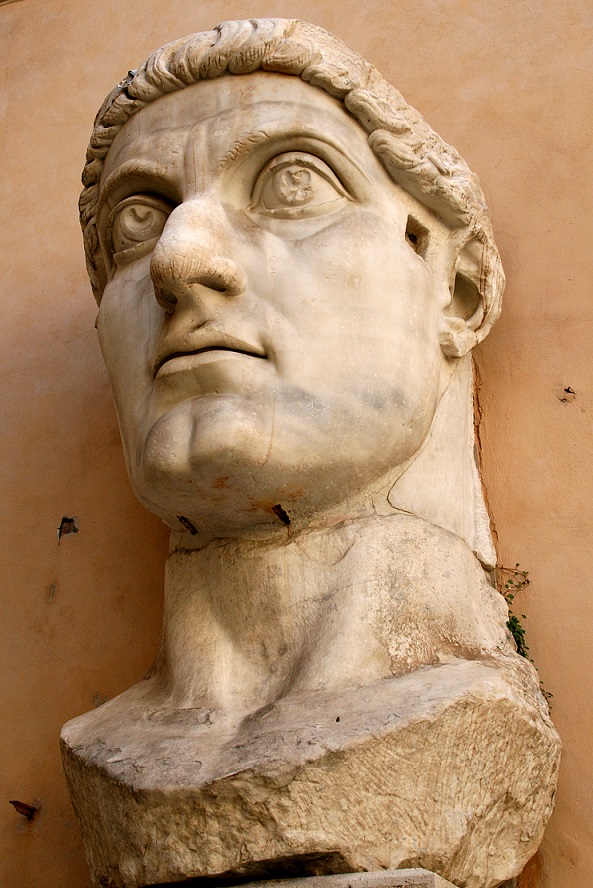
 Constantine the Great. Fragment colossal statue. IV century |  Arch of Constantine in Rome |
The city he founded on the shores of the Bosphorus, located on the site of the former Greek colony, which bore the name Byzantium, later became the capital of the entire Orthodox Christian world, and after the death of its founder received his name - Constantinople. At a time when the Western Roman Empire was falling into decay and shuddering under the crushing blows of barbarian tribes, the city of Constantine - the capital of the Eastern Roman Empire - was experiencing its heyday.
 |  Our Lady of the city model. Fragment of Byzantine mosaics in the church of St. Sofia in Constantinople. X century. |
After the establishment of Christianity, Emperor Constantine set out to find the very Life-giving cross on which the Savior was crucified. To this end, he sent his mother, Queen Helena, who was a devout Christian, to the Holy Land.
 |
Saints Constantine (with the banner with the monogram of Christ) and Helena (with the acquired cross). Mosaic in St. Isaac's Cathedral, St. Petersburg According to the Roman historian Eusebius of Caesarea, 'this eldress of extraordinary mind with the speed of a young man hurried eastward' (Elena was already about eighty years old at that time). Having experienced all the difficulties and hardships of a long journey, the queen arrived in Palestine, where she found a very bleak picture: it turned out that most of the places associated with the Gospel events had long been destroyed. The cave of the Holy Sepulcher was covered with garbage, and a pagan temple dedicated to Venus, the Roman goddess of love, was built on the hill poured over it. Helen ordered to destroy all the pagan temples, placed on the holy places for Christians, and instead to build holy temples. Further, the queen was actively engaged in the search for Christian relics, for which she undertook extensive excavations at Calvary and discovered the cave of the Holy Sepulcher, and not far from it - the remains of three crosses. From contact with one of them, a deceased resurrected, who was carried along the street for burial - thus the cross that belonged to Christ was identified. Helen's discovery of the cross in May 326 marked the beginning of the Feast of the Exaltation .
 |
Piero della Francesca. Finding the Life-giving Cross and raising the dead. Fresco of the 15th century. In addition to the crosses, the queen also found four nails and a plaque with the inscription INRI, an abbreviation written at the direction of Pilate. According to historical sources, part of the Life-giving Cross, placed in the silver ark, remained in Jerusalem, and Helen sent the other to Constantinople. Two nails from the cross were also sent there, one of which Constantine ordered to be inlaid in a tiara, and the second - to be placed in a horse bridle. One of the legends also tells that from this pilgrimage trip Helen brought a marble staircase from the palace of Pontius Pilate, along which Jesus ascended to judgment. The so-called “Pilate's staircase” ( Scala Pilati ) , which was transported in due time to Rome, has survived to this day and you can climb it to the personal papal chapel of the Holy of Holies (Sancta Sanctorum). Believers overcome all twenty-eight steps exclusively on their knees, while reading special prayers.
 |
Pilgrims on the Holy Staircase (Pilate's Staircase) in the Lateran Palace in Rome Ancient historians report that Queen Helena designated places associated with the earthly life of Jesus Christ, the foundation of several dozen temples. The earliest sources indicate that there were three such churches: the Church of the Holy Sepulcher at Calvary , the Basilica of the Nativity of Christ in Bethlehem and the church above the place of Christ's ascension on the Mount of Olives . Later in the hagiographic literature (not earlier than the 7th century), there was a mention of the churches erected by her in Gethsemane (at the place where the Savior prayed before being taken into custody, and where the Most Holy Theotokos was later buried), in Hebron, near the oak of Mamre (in that the place where the three angels appeared to Abraham), in Bethany (over the tomb of Lazarus resurrected by Christ), on Mount Tabor (where the miracle of the Transfiguration of the Lord took place), at Lake Tiberias (where the Apostles Peter and Andrew were fishing when they were called by Christ to the apostolic ministry) other.
 |
Basilica of the Nativity in Bethlehem. Incision. The reconstruction of the original view of the Basilica of the Nativity in Bethlehem , which is one of the oldest continuously operating churches in the world, has survived to this day with additions and alterations - a consequence of a fire, what happened in the VI century. Initially, it was a large five-nave temple, in front of which there was an atrium - an open courtyard surrounded by a colonnade, intended for the uninitiated - those who had not yet received the rite of baptism. The eastern part of the temple ended with an apse of a complicated form, which was conceived as a frame for the grotto in which Christ was born. The Cave of the Nativity is still located under the pulpit of the basilica; the birthplace of the Savior located in its eastern part is marked with a silver star.
 in Bethlehem. Central nave. Modern look |  Star of bethlehem |
The Jerusalem complex of the Church of the Holy Sepulcher , built by the decree of Emperor Constantine and consecrated in 335, was destroyed in the 11th century. Muslims and now exists in a rebuilt form. Initially, it was an imposing five-nave basilica, to the altar of which was adjoined a martyrium - a memorial complex erected over the place where Jesus died on the cross for the salvation of mankind. Martyrius was a large courtyard containing two shrines: a part of the rock of Calvary - evidence of the death of Christ, and the Holy Sepulcher - evidence of his resurrection. A round building was erected over the tomb of Christ, within which twelve columns surrounded a stone tombstone. The temple was under construction for about ten years and was consecrated after the death of Elena.
 in Jerusalem. Reconstruction of the original view |  Modern look |
The Chapel of the Ascension on the Mount of Olives in Jerusalem, also founded during the time of Saints Constantine and Helena, in the 7th century. was destroyed by the Persians. The temple that we can see today was restored by the crusaders in the Middle Ages. Its main attraction is a stone at the entrance with a notch in the shape of an imprint of the left human foot; according to legend, it was from this stone that Jesus Christ ascended into Heaven.
 |  Footprint in the Chapel of the Ascension |
For his work in spreading Christianity, for his great services to the Church and for his efforts to acquire the Life-giving Cross, Constantine, together with his mother Helen, was canonized.
 Saints Equal to the Apostles Constantine and Elena. Byzantine mosaic. VI century. |  St. Constantine and Helena. Old Russian icon. XVII century |
Elena died at the age of 80 in 327. In memory of her excavations in Jerusalem, a special side-altar in the Church of the Holy Sepulcher , which today belongs to the Armenian Apostolic Church, is named in her honor. There is a window in the altar of this side-altar, marking the place from where Elena, according to legend, watched the excavation progress and threw coins and jewelry to encourage the workers. From the church of St. Helena you can go down the stairs to the chapel of the acquisition Cross, which is the lowest point of the Church of the Holy Sepulcher.
 Chapel of the Finding of the Life-giving Cross in the Church of the Holy Sepulcher, Jerusalem |  Marble slab, designating place Finding the Cross |
Emperor Constantine survived his mother by ten years. He died in 337, being baptized on his deathbed. This powerful Roman emperor went down in history under the name of Saint, Great and Equal to the Apostles. Marina Grigoryan
Share: