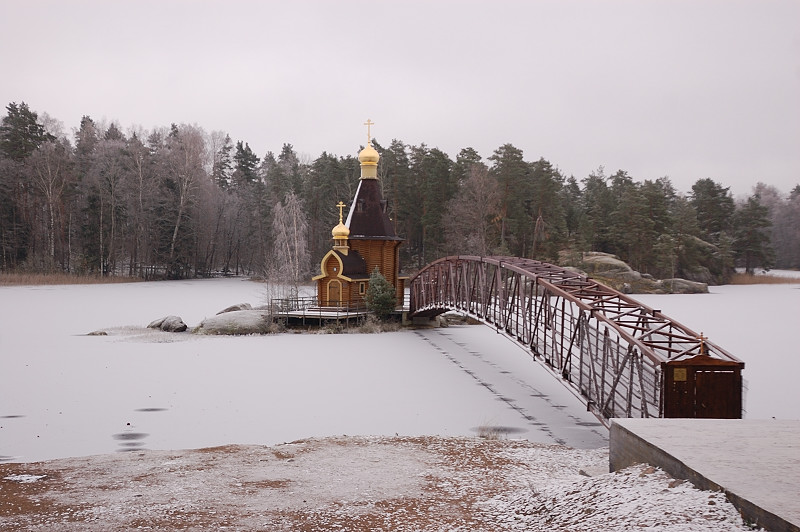
Church of the Holy Apostle Andrew the First-Called on Vuoksa
17 April 2019
This temple, located in the Priozersky district of the Leningrad region, does not yet claim the title of historical: it was built and consecrated in 2000. And yet it is unique. Standing on a rocky island in the middle of the water, this temple is noted even in the Guinness Book of Records. Until recently, it was only possible to get to this tent-roofed church, erected in the traditions of wooden Russian architecture, by water - now a bridge leads to the island. The temple is as if created for a solitary conversation with the Lord. Although services here, of course, are held regularly. Strictly speaking, Vuoksa is not a river, but a whole lake-river system: its former name Uzerva, mentioned in the Novgorod chronicles, is translated from Karelian as “new lake”. These places, once inhabited by only Karelians, have long been the subject of disputes between two states: Sweden and Russia (first in the person of Veliky Novgorod, and, later, the Moscow kingdom). According to the Stolbovsky Peace Treaty, this area at the beginning of the 17th century became part of Sweden, then became part of the Ryisyala Vyborg province of Finland, and after 1939 it became part of Russia. In 1948, the former Karelian Tiuri was renamed Vasilyevo - in honor of the commander of the reconnaissance platoon of the 54th rifle division, junior lieutenant Alexander Makarovich Vasiliev, who fell on the battlefield at the beginning of the Great Patriotic. Back in the late nineties of the last century, less than a hundred people lived in the village - therefore, the temple that was erected here turned out to be miniature, as they say - chamber: initially its creators did not count on the huge interest in the construction from pilgrims and tourists. It is interesting that in Vuoks, where many people go by boat, on a small island they first wanted to equip a shelter for boatmen to rest. However, two enthusiasts - a professor at Herzen University and a summer resident living nearby - had other thoughts on this: they saw a handsome temple on the island, and it was this idea that found support from the Metropolitan of St. Petersburg John (Snychev). On a rock island with an area of one hundred square meters, he blessed the construction of a wooden church. The author of the project is the architect Andrey Rotionov. He and the aforementioned summer resident Andrei Lyamkin saw here a temple in the name of the Holy Apostle Andrew the First-Called, who, according to local legend, once brought the word about the faith of Christ to the banks of the Vuoksa and himself performed the sacrament of baptism over some of the local residents. Whether it is true or not, it is impossible to say for sure - but over the boats that glide on the water of Vuoksa, you can often see the St. Andrew's flag.
The charge of enthusiasm among the two Andreev was great, and already in 2000 a small wooden church in the shape of an eight was completed and consecrated in the name of St. Andrew the Apostle. The creators of the temple were inspired by the Church of the Ascension on the Moskva River in Kolomenskoye, and yet the temple on Vuoksa has its own unique flavor, for which it is loved by pilgrims and tourists who come here mainly in the warm season. For thinking about God, both the secluded temple itself and the local places in general are the best fit: here it is especially easy to abandon the hustle and bustle, routine - and inwardly strive for the lofty, eternal ... and the Church of the Assumption in Slovenia, and the church in Kalyazin on the Volga, and other churches - for example, in Kondopoga and Volgograd. And yet it was the Church of St. Andrew the First-Called in Vuoksa that harmoniously, and perhaps even ideally, blended into the surrounding nature, at the same time merging and towering above it. How it can be - it is better to see with your own eyes. To get here from St. Petersburg, you need to go along the Priozerskoe highway to Losevo, and then after eight kilometers turn off the road to the right towards the village of Vasilyevo. Then pass this settlement - immediately after it you will need to turn right again. Leaving the car in the parking lot it will take two hundred meters on foot for your gaze to open up this amazing, like a forest fairy tale, church, having visited it once, you will surely want to return to it again and again. V. Sergienko
Church of the Holy Apostle Andrew the First-Called on VuoksaChurch of the Holy Apostle Andrew the First-Called on Vuoksa This temple, located in the Priozersky district of the Leningrad region, does not yet claim the title of historical: it was built and consecrated in 2000. And yet it is unique. Standing on a rocky island in the middle of the water, this temple is noted even in the Guinness Book of Records. Until recently, it was only possible to get to this tent-roofed church, erected in the traditions of wooden Russian architecture, by water - now a bridge leads to the island. The temple is as if created for a solitary conversation with the Lord. Although services here, of course, are held regularly. Strictly speaking, Vuoksa is not a river, but a whole lake-river system: its former name Uzerva, mentioned in the Novgorod chronicles, is translated from Karelian as “new lake”. These places, once inhabited by only Karelians, have long been the subject of disputes between two states: Sweden and Russia (first in the person of Veliky Novgorod, and, later, the Moscow kingdom). According to the Stolbovsky Peace Treaty, this area at the beginning of the 17th century became part of Sweden, then became part of the Ryisyala Vyborg province of Finland, and after 1939 it became part of Russia. In 1948, the former Karelian Tiuri was renamed Vasilyevo - in honor of the commander of the reconnaissance platoon of the 54th rifle division, junior lieutenant Alexander Makarovich Vasiliev, who fell on the battlefield at the beginning of the Great Patriotic. Back in the late nineties of the last century, less than a hundred people lived in the village - therefore, the temple that was erected here turned out to be miniature, as they say - chamber: initially its creators did not count on the huge interest in the construction from pilgrims and tourists. It is interesting that in Vuoks, where many people go by boat, on a small island they first wanted to equip a shelter for boatmen to rest. However, two enthusiasts - a professor at Herzen University and a summer resident living nearby - had other thoughts on this: they saw a handsome temple on the island, and it was this idea that found support from the Metropolitan of St. Petersburg John (Snychev). On a rock island with an area of one hundred square meters, he blessed the construction of a wooden church. The author of the project is the architect Andrey Rotionov. He and the aforementioned summer resident Andrei Lyamkin saw here a temple in the name of the Holy Apostle Andrew the First-Called, who, according to local legend, once brought the word about the faith of Christ to the banks of the Vuoksa and himself performed the sacrament of baptism over some of the local residents. Whether it is true or not, it is impossible to say for sure - but over the boats that glide on the water of Vuoksa, you can often see the St. Andrew's flag. The charge of enthusiasm among the two Andreev was great, and already in 2000 a small wooden church in the shape of an eight was completed and consecrated in the name of St. Andrew the Apostle. The creators of the temple were inspired by the Church of the Ascension on the Moskva River in Kolomenskoye, and yet the temple on Vuoksa has its own unique flavor, for which it is loved by pilgrims and tourists who come here mainly in the warm season. For thinking about God, both the secluded temple itself and the local places in general are the best fit: here it is especially easy to abandon the hustle and bustle, routine - and inwardly strive for the lofty, eternal ... and the Church of the Assumption in Slovenia, and the church in Kalyazin on the Volga, and other churches - for example, in Kondopoga and Volgograd. And yet it was the Church of St. Andrew the First-Called in Vuoksa that harmoniously, and perhaps even ideally, blended into the surrounding nature, at the same time merging and towering above it. How it can be - it is better to see with your own eyes. To get here from St. Petersburg, you need to go along the Priozerskoe highway to Losevo, and then after eight kilometers turn off the road to the right towards the village of Vasilyevo. Then pass this settlement - immediately after it you will need to turn right again. Leaving the car in the parking lot it will take two hundred meters on foot for your gaze to open up this amazing, like a forest fairy tale, church, having visited it once, you will surely want to return to it again and again. V. SergienkoСвеча Иерусалима -en
This temple, located in the Priozersky district of the Leningrad region, does not yet claim the title of historical: it was built and consecrated in 2000. And yet it is unique. Standing on a rocky island in the middle of the water, this temple is noted even in the Guinness Book of Records. Until recently, it was only possible to get to this tent-roofed church, erected in the traditions of wooden Russian architecture, by water - now a bridge leads to the island. The temple is as if created for a solitary conversation with the Lord. Although services here, of course, are held regularly. Strictly speaking, Vuoksa is not a river, but a whole lake-river system: its former name Uzerva, mentioned in the Novgorod chronicles, is translated from Karelian as “new lake”. These places, once inhabited by only Karelians, have long been the subject of disputes between two states: Sweden and Russia (first in the person of Veliky Novgorod, and, later, the Moscow kingdom). According to the Stolbovsky Peace Treaty, this area at the beginning of the 17th century became part of Sweden, then became part of the Ryisyala Vyborg province of Finland, and after 1939 it became part of Russia. In 1948, the former Karelian Tiuri was renamed Vasilyevo - in honor of the commander of the reconnaissance platoon of the 54th rifle division, junior lieutenant Alexander Makarovich Vasiliev, who fell on the battlefield at the beginning of the Great Patriotic. Back in the late nineties of the last century, less than a hundred people lived in the village - therefore, the temple that was erected here turned out to be miniature, as they say - chamber: initially its creators did not count on the huge interest in the construction from pilgrims and tourists. It is interesting that in Vuoks, where many people go by boat, on a small island they first wanted to equip a shelter for boatmen to rest. However, two enthusiasts - a professor at Herzen University and a summer resident living nearby - had other thoughts on this: they saw a handsome temple on the island, and it was this idea that found support from the Metropolitan of St. Petersburg John (Snychev). On a rock island with an area of one hundred square meters, he blessed the construction of a wooden church. The author of the project is the architect Andrey Rotionov. He and the aforementioned summer resident Andrei Lyamkin saw here a temple in the name of the Holy Apostle Andrew the First-Called, who, according to local legend, once brought the word about the faith of Christ to the banks of the Vuoksa and himself performed the sacrament of baptism over some of the local residents. Whether it is true or not, it is impossible to say for sure - but over the boats that glide on the water of Vuoksa, you can often see the St. Andrew's flag. The charge of enthusiasm among the two Andreev was great, and already in 2000 a small wooden church in the shape of an eight was completed and consecrated in the name of St. Andrew the Apostle. The creators of the temple were inspired by the Church of the Ascension on the Moskva River in Kolomenskoye, and yet the temple on Vuoksa has its own unique flavor, for which it is loved by pilgrims and tourists who come here mainly in the warm season. For thinking about God, both the secluded temple itself and the local places in general are the best fit: here it is especially easy to abandon the hustle and bustle, routine - and inwardly strive for the lofty, eternal ... and the Church of the Assumption in Slovenia, and the church in Kalyazin on the Volga, and other churches - for example, in Kondopoga and Volgograd. And yet it was the Church of St. Andrew the First-Called in Vuoksa that harmoniously, and perhaps even ideally, blended into the surrounding nature, at the same time merging and towering above it. How it can be - it is better to see with your own eyes. To get here from St. Petersburg, you need to go along the Priozerskoe highway to Losevo, and then after eight kilometers turn off the road to the right towards the village of Vasilyevo. Then pass this settlement - immediately after it you will need to turn right again. Leaving the car in the parking lot it will take two hundred meters on foot for your gaze to open up this amazing, like a forest fairy tale, church, having visited it once, you will surely want to return to it again and again. V. Sergienko