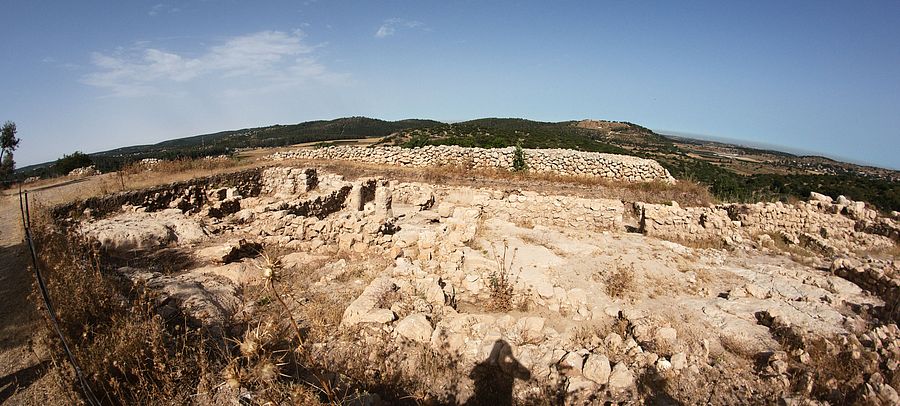
Excavations, begun by scientists thirty kilometers west of Jerusalem in the middle of the last decade and continuing to this day, add an increasing number of supporters to the hypothesis that the Old Testament city of Shaaraim ('Two Gates') was located on the site of the archaeological site of Khirbet Qeyafa - the location of the prophet's residence and The psalmist David, the second king of Israel.
To be precise, Khirbet Qeyafa was identified as an archaeological site back in the sixties of the last century. However, the socio-political situation in the era of Turkish rule was not conducive to excavations - and the few finds made then did not allow to fully appreciate the historical value of the place hiding under the buried land on a large hill. Only in 2007, what was left of an ancient fortification with an area of 2.4 hectares was discovered here - and the next seven years have passed in the mode of continuous archaeological research and attempts to identify the finds. The latter turned out to be much older than the Byzantine fortress, located here in the middle of the first millennium AD. Ancient, neither more nor less, for one and a half thousand years. As scientists have established, the lower tier of the excavation site belonged to the tenth century BC - the era of the reign of the Old Testament king David, which makes this archaeological site is truly unique. “Until now, no traces of such buildings have been found from the beginning of the 10th century BC. Khirbet Qeyafa was probably destroyed in one of the battles fought with the Philistines around 980 BC. The found palace and the ruins of the city fortifications are a significant advance in the study of the history of the Kingdom of Judah, ”- say Yossi Garfinkel and Saar Ganor, professors of archeology at the Hebrew University of Jerusalem.
The town of Beit Shemesh, closest to the excavation site, is thirty-two kilometers away from Jerusalem. It is interesting that the local Bedouins call the ruins only Khirbet Daud, that is, 'David's ruins.' In this, Israeli scholars are in full solidarity with them, who believe that they discovered the Old Testament city of Shaaraim and the residence of King David, which he often visited - and not only dealt with issues of government here, but also devoted time to creativity, spiritual reflection and rest. Of the structures on the site of the ancient city, the two largest are the thirty-meter masonry of the fortress wall, as well as the southern wing of the palace with an area of about one square kilometer. Inside the latter there were many rooms, the finds in which were the most numerous. Hundreds of objects were found here - items made of iron, bronze (swords, ax) and ceramics, a loom, plant remains, as well as Egyptian vessels made of alabaster, which are rare for these places. On the stone pillars to which donkeys were tied, even traces of ropes have been preserved. Another interesting find is the remains of a structure 15 by 6 meters in size, which stood on piles. According to scientists, there was a warehouse to which the inhabitants of the nearest lowland of Shfela brought tax in the form of agricultural products for payment. This version is supported by the many vessels of various sizes and shapes found here, as well as clay seals. The dating of objects is the same - around the 10th century BC.
A wing of a palace with many rooms
The very decision to locate the city and the palace above it in these places betrays the remarkable statesman behind it. The palace is located in the center, at the very top of the hill - from it, not only the whole city was perfectly visible, but also the area from the Mediterranean Sea in the west to the Judean Mountains and Jerusalem in the east. “This fortress is unequivocal proof that the king sought to create fortified administrative centers at strategically important points, ”say Yossi Garfinkel and Saar Ganor. Indeed, a signal fire lit on the roof of a palace that was once located here would have been visible for tens of kilometers in any direction. I agree with his colleagues and the head of the excavations in Khirbet Qeyafa, Professor Abraham Faust, in whose opinion the finds here are an illustration of 'a part of the events in the Bible attributed to the reign of David.' In an interview with Breaking Israel News, Professor Faust said: 'We certainly did not find artifacts directly pointing to King David or King Solomon - but we did find signs of social transformation in the region, indicating the transformation of Canaanite culture into Jewish culture.' ... Professor Abraham Faust especially noted many arrowheads among the finds - they, the scientist believe, testify to the battle that took place at a later time and the result of which was the departure of the Jewish population and the seizure of this place by other peoples, possibly the Philistines.
Jewish and Philistine Pottery One of the most exciting finds made at Khirbet Qeiyafa is a three-thousand-year-old pottery jar on which Israeli scholars succeeded read. Having gathered together many fragments, the researchers established the name of its owner - Ishbaal-bin-Bada, that is, 'Ishbaal is the son of Bada.' The name Ishbaal is mentioned in II Kings. That was the name of the youngest son of King Saul, who was killed in a dream by his own military leaders - they brought his severed head to David ... However, the father of the owner of the vessel was blocked by Bad, and not Saul (Shaul). Whoever he was, the inscription on the vessel speaks unequivocally about the ethnic composition of the population of the ancient city and its environs. And indirectly she also says that during the time of King David, literacy among his subjects was very widespread. And the fact that among the samples of ceramics found here there are a lot of clearly Philistine origin, does not deny the assertion about the predominantly Jewish settlement of these places. That and the other people lived in the neighborhood, entered not only military, but also trade relations - and mixed marriages between them happened: it is worth remembering at least the biblical hero Samson, who was married to a Philistine woman. In general, if we talk about written evidence relating to the time of the biblical king David and somewhat later - X-VIII centuries BC - such inscriptions can be counted literally on the fingers of the hand. Two of them were found here in Khirbet Qeyaf, one in Jerusalem, and one in Beit Shemesh. There is one more inscription - on the so-called Tel Dan stele found in 1994. On it, by order of the Aramaic ruler, a list of his victories was engraved: “... he destroyed seventy kings, who equipped against him thousands of chariots and thousands of horsemen. And ... he killed the king of Israel, Joram, the son of Ahab, and the king from the house of David (bytdwd) Achiziyahu, the son of Joram. '
But back to Khirbet Qeyafu. Another, not named by us earlier, written evidence was found here. It was a clay splinter in the shape of an inverted trapezoid, on which words were inscribed in Canaanite writing with a lettering characteristic of the 10th-9th centuries BC, the coherent meaning of which could not be established. However, at the same time they raise a layer of vocabulary that is well known to us from the books of the Old Testament. One of the researchers, Shmuel Akhitov, offers the following reading of these words: “Don't do it! And to the slave ... Crime (?) Reckoning ... Tsar ... A stranger or exile. ' Familiar phrasing, isn't it? Opponents of scholars defending the Hebrew genesis of the settlement believe that the city discovered in Khirbet Qeyaf could well have been built by the Philistines or other people who were in Palestine in the mentioned era gained a lot. This point of view is shared, for example, by Israel Finkelstein from Tel Aviv University. However, then it is completely incomprehensible why among the garbage found at the site of the excavation were not found the bones of dogs or pigs - animals, the ban on the use of which existed only among Jews. The Philistines, for example, eagerly ate both. But if the city excavated at Khirbet Qeyaf is really the biblical Shaaraim, then where are the very “two gates” to which, in fact, its name indicates? Archaeologists also managed to find them - from the southern and western sides of the ancient city. The facade of the gate is more than ten meters, the width of the passage is almost four; at the entrance to one of them there is a megalithic stone threshold weighing more than ten tons. Interestingly, the entrance to the gate was carried out along an inclined ramp running along the wall, which slowed down the speed of those walking and excluded the possibility of sudden penetration into the city. But, perhaps, the most interesting from the point of view of biblical studies are the cult objects and objects discovered in Khirbet Qeyaf. These include a dais for rites, water basins for washing the feet and the whole body - and a portable basalt altar with stylized images of palm branches and the entrance to the sanctuary - a recessed door in the form of three arches following one after the other. Another model of the sanctuary was found - similar to the first, but made of clay. Its roof is decorated with images of two unknown animals (it is unclear whether it is lions or birds), and its facade is decorated with two stylized columns and a curtain. The proportions known from the Holy Scriptures are also observed here - in particular, the width, which refers to the height as one to two. The fact that these objects relate specifically to the religious practice of Judaism, the researchers were convinced by any absence of images of the deity on them.
Clay model of the sanctuary
Basalt sanctuary model
Among the finds are also other cult objects, the purpose of which is not so clear. For example, a ceramic vessel in the shape of two female breasts, presumably intended for mixing various liquids in it. Ritual bowls have also been found, which are believed to be used for burning incense. It is interesting that the sacred objects in Khirbet Qeyaf were not in a special building, but in special rooms of private houses, which exactly corresponds to the biblical descriptions dating back to the times before the construction of the Temple by the king. Solomon. However, what makes it possible to correlate all the finds made in Khirbet Qeyaf with the time of the reign of King David? The years of his reign are known for certain thanks to the biblical account. A radiometric analysis of the layer to which the finds of organic origin were made (among them, for example, four olive pits) indicate the period from 1020 to 980 BC. Thus, even if we assume that the skeptics are right in the camp of researchers, and David did not found a city on the site of Khirbet Qeyafa, he, at least, captured it, expanding his kingdom and owned it among others. One way or another, Israeli scientists engaged in excavations at this place and interpreting the meaning of the finds made here, whichever of the two opinions they hold, are united by one thing: the desire to preserve this unique monument of biblical archeology, prevent the development of this place with modern infrastructure and preserve Khirbet -Keyafu as a national park, on the territory of which many exciting discoveries will surely await researchers. V. Sergienko
Khirbet Qeyafa: the city of King David?Khirbet Qeyafa: the city of King David? Excavations, begun by scientists thirty kilometers west of Jerusalem in the middle of the last decade and continuing to this day, add an increasing number of supporters to the hypothesis that the Old Testament city of Shaaraim ('Two Gates') was located on the site of the archaeological site of Khirbet Qeyafa - the location of the prophet's residence and The psalmist David, the second king of Israel. To be precise, Khirbet Qeyafa was identified as an archaeological site back in the sixties of the last century. However, the socio-political situation in the era of Turkish rule was not conducive to excavations - and the few finds made then did not allow to fully appreciate the historical value of the place hiding under the buried land on a large hill. Only in 2007, what was left of an ancient fortification with an area of 2.4 hectares was discovered here - and the next seven years have passed in the mode of continuous archaeological research and attempts to identify the finds. The latter turned out to be much older than the Byzantine fortress, located here in the middle of the first millennium AD. Ancient, neither more nor less, for one and a half thousand years. As scientists have established, the lower tier of the excavation site belonged to the tenth century BC - the era of the reign of the Old Testament king David, which makes this archaeological site is truly unique. “Until now, no traces of such buildings have been found from the beginning of the 10th century BC. Khirbet Qeyafa was probably destroyed in one of the battles fought with the Philistines around 980 BC. The found palace and the ruins of the city fortifications are a significant advance in the study of the history of the Kingdom of Judah, ”- say Yossi Garfinkel and Saar Ganor, professors of archeology at the Hebrew University of Jerusalem. The town of Beit Shemesh, closest to the excavation site, is thirty-two kilometers away from Jerusalem. It is interesting that the local Bedouins call the ruins only Khirbet Daud, that is, 'David's ruins.' In this, Israeli scholars are in full solidarity with them, who believe that they discovered the Old Testament city of Shaaraim and the residence of King David, which he often visited - and not only dealt with issues of government here, but also devoted time to creativity, spiritual reflection and rest. Of the structures on the site of the ancient city, the two largest are the thirty-meter masonry of the fortress wall, as well as the southern wing of the palace with an area of about one square kilometer. Inside the latter there were many rooms, the finds in which were the most numerous. Hundreds of objects were found here - items made of iron, bronze (swords, ax) and ceramics, a loom, plant remains, as well as Egyptian vessels made of alabaster, which are rare for these places. On the stone pillars to which donkeys were tied, even traces of ropes have been preserved. Another interesting find is the remains of a structure 15 by 6 meters in size, which stood on piles. According to scientists, there was a warehouse to which the inhabitants of the nearest lowland of Shfela brought tax in the form of agricultural products for payment. This version is supported by the many vessels of various sizes and shapes found here, as well as clay seals. The dating of objects is the same - around the 10th century BC. A wing of a palace with many rooms The very decision to locate the city and the palace above it in these places betrays the remarkable statesman behind it. The palace is located in the center, at the very top of the hill - from it, not only the whole city was perfectly visible, but also the area from the Mediterranean Sea in the west to the Judean Mountains and Jerusalem in the east. “This fortress is unequivocal proof that the king sought to create fortified administrative centers at strategically important points, ”say Yossi Garfinkel and Saar Ganor. Indeed, a signal fire lit on the roof of a palace that was once located here would have been visible for tens of kilometers in any direction. I agree with his colleagues and the head of the excavations in Khirbet Qeyafa, Professor Abraham Faust, in whose opinion the finds here are an illustration of 'a part of the events in the Bible attributed to the reign of David.' In an interview with Breaking Israel News, Professor Faust said: 'We certainly did not find artifacts directly pointing to King David or King Solomon - but we did find signs of social transformation in the region, indicating the transformation of Canaanite culture into Jewish culture.' ... Professor Abraham Faust especially noted many arrowheads among the finds - they, the scientist believe, testify to the battle that took place at a later time and the result of which was the departure of the Jewish population and the seizure of this place by other peoples, possibly the Philistines. Jewish and Philistine Pottery One of the most exciting finds made at Khirbet Qeiyafa is a three-thousand-year-old pottery jar on which Israeli scholars succeeded read. Having gathered together many fragments, the researchers established the name of its owner - Ishbaal-bin-Bada, that is, 'Ishbaal is the son of Bada.' The name Ishbaal is mentioned in II Kings. That was the name of the youngest son of King Saul, who was killed in a dream by his own military leaders - they brought his severed head to David ... However, the father of the owner of the vessel was blocked by Bad, and not Saul (Shaul). Whoever he was, the inscription on the vessel speaks unequivocally about the ethnic composition of the population of the ancient city and its environs. And indirectly she also says that during the time of King David, literacy among his subjects was very widespread. And the fact that among the samples of ceramics found here there are a lot of clearly Philistine origin, does not deny the assertion about the predominantly Jewish settlement of these places. That and the other people lived in the neighborhood, entered not only military, but also trade relations - and mixed marriages between them happened: it is worth remembering at least the biblical hero Samson, who was married to a Philistine woman. In general, if we talk about written evidence relating to the time of the biblical king David and somewhat later - X-VIII centuries BC - such inscriptions can be counted literally on the fingers of the hand. Two of them were found here in Khirbet Qeyaf, one in Jerusalem, and one in Beit Shemesh. There is one more inscription - on the so-called Tel Dan stele found in 1994. On it, by order of the Aramaic ruler, a list of his victories was engraved: “... he destroyed seventy kings, who equipped against him thousands of chariots and thousands of horsemen. And ... he killed the king of Israel, Joram, the son of Ahab, and the king from the house of David (bytdwd) Achiziyahu, the son of Joram. ' But back to Khirbet Qeyafu. Another, not named by us earlier, written evidence was found here. It was a clay splinter in the shape of an inverted trapezoid, on which words were inscribed in Canaanite writing with a lettering characteristic of the 10th-9th centuries BC, the coherent meaning of which could not be established. However, at the same time they raise a layer of vocabulary that is well known to us from the books of the Old Testament. One of the researchers, Shmuel Akhitov, offers the following reading of these words: “Don't do it! And to the slave ... Crime (?) Reckoning ... Tsar ... A stranger or exile. ' Familiar phrasing, isn't it? Opponents of scholars defending the Hebrew genesis of the settlement believe that the city discovered in Khirbet Qeyaf could well have been built by the Philistines or other people who were in Palestine in the mentioned era gained a lot. This point of view is shared, for example, by Israel Finkelstein from Tel Aviv University. However, then it is completely incomprehensible why among the garbage found at the site of the excavation were not found the bones of dogs or pigs - animals, the ban on the use of which existed only among Jews. The Philistines, for example, eagerly ate both. But if the city excavated at Khirbet Qeyaf is really the biblical Shaaraim, then where are the very “two gates” to which, in fact, its name indicates? Archaeologists also managed to find them - from the southern and western sides of the ancient city. The facade of the gate is more than ten meters, the width of the passage is almost four; at the entrance to one of them there is a megalithic stone threshold weighing more than ten tons. Interestingly, the entrance to the gate was carried out along an inclined ramp running along the wall, which slowed down the speed of those walking and excluded the possibility of sudden penetration into the city. But, perhaps, the most interesting from the point of view of biblical studies are the cult objects and objects discovered in Khirbet Qeyaf. These include a dais for rites, water basins for washing the feet and the whole body - and a portable basalt altar with stylized images of palm branches and the entrance to the sanctuary - a recessed door in the form of three arches following one after the other. Another model of the sanctuary was found - similar to the first, but made of clay. Its roof is decorated with images of two unknown animals (it is unclear whether it is lions or birds), and its facade is decorated with two stylized columns and a curtain. The proportions known from the Holy Scriptures are also observed here - in particular, the width, which refers to the height as one to two. The fact that these objects relate specifically to the religious practice of Judaism, the researchers were convinced by any absence of images of the deity on them. Clay model of the sanctuary Basalt sanctuary model Among the finds are also other cult objects, the purpose of which is not so clear. For example, a ceramic vessel in the shape of two female breasts, presumably intended for mixing various liquids in it. Ritual bowls have also been found, which are believed to be used for burning incense. It is interesting that the sacred objects in Khirbet Qeyaf were not in a special building, but in special rooms of private houses, which exactly corresponds to the biblical descriptions dating back to the times before the construction of the Temple by the king. Solomon. However, what makes it possible to correlate all the finds made in Khirbet Qeyaf with the time of the reign of King David? The years of his reign are known for certain thanks to the biblical account. A radiometric analysis of the layer to which the finds of organic origin were made (among them, for example, four olive pits) indicate the period from 1020 to 980 BC. Thus, even if we assume that the skeptics are right in the camp of researchers, and David did not found a city on the site of Khirbet Qeyafa, he, at least, captured it, expanding his kingdom and owned it among others. One way or another, Israeli scientists engaged in excavations at this place and interpreting the meaning of the finds made here, whichever of the two opinions they hold, are united by one thing: the desire to preserve this unique monument of biblical archeology, prevent the development of this place with modern infrastructure and preserve Khirbet -Keyafu as a national park, on the territory of which many exciting discoveries will surely await researchers. V. SergienkoСвеча Иерусалима -en
Excavations, begun by scientists thirty kilometers west of Jerusalem in the middle of the last decade and continuing to this day, add an increasing number of supporters to the hypothesis that the Old Testament city of Shaaraim ('Two Gates') was located on the site of the archaeological site of Khirbet Qeyafa - the location of the prophet's residence and The psalmist David, the second king of Israel. To be precise, Khirbet Qeyafa was identified as an archaeological site back in the sixties of the last century. However, the socio-political situation in the era of Turkish rule was not conducive to excavations - and the few finds made then did not allow to fully appreciate the historical value of the place hiding under the buried land on a large hill. Only in 2007, what was left of an ancient fortification with an area of 2.4 hectares was discovered here - and the next seven years have passed in the mode of continuous archaeological research and attempts to identify the finds. The latter turned out to be much older than the Byzantine fortress, located here in the middle of the first millennium AD. Ancient, neither more nor less, for one and a half thousand years. As scientists have established, the lower tier of the excavation site belonged to the tenth century BC - the era of the reign of the Old Testament king David, which makes this archaeological site is truly unique. “Until now, no traces of such buildings have been found from the beginning of the 10th century BC. Khirbet Qeyafa was probably destroyed in one of the battles fought with the Philistines around 980 BC. The found palace and the ruins of the city fortifications are a significant advance in the study of the history of the Kingdom of Judah, ”- say Yossi Garfinkel and Saar Ganor, professors of archeology at the Hebrew University of Jerusalem. The town of Beit Shemesh, closest to the excavation site, is thirty-two kilometers away from Jerusalem. It is interesting that the local Bedouins call the ruins only Khirbet Daud, that is, 'David's ruins.' In this, Israeli scholars are in full solidarity with them, who believe that they discovered the Old Testament city of Shaaraim and the residence of King David, which he often visited - and not only dealt with issues of government here, but also devoted time to creativity, spiritual reflection and rest. Of the structures on the site of the ancient city, the two largest are the thirty-meter masonry of the fortress wall, as well as the southern wing of the palace with an area of about one square kilometer. Inside the latter there were many rooms, the finds in which were the most numerous. Hundreds of objects were found here - items made of iron, bronze (swords, ax) and ceramics, a loom, plant remains, as well as Egyptian vessels made of alabaster, which are rare for these places. On the stone pillars to which donkeys were tied, even traces of ropes have been preserved. Another interesting find is the remains of a structure 15 by 6 meters in size, which stood on piles. According to scientists, there was a warehouse to which the inhabitants of the nearest lowland of Shfela brought tax in the form of agricultural products for payment. This version is supported by the many vessels of various sizes and shapes found here, as well as clay seals. The dating of objects is the same - around the 10th century BC. A wing of a palace with many rooms The very decision to locate the city and the palace above it in these places betrays the remarkable statesman behind it. The palace is located in the center, at the very top of the hill - from it, not only the whole city was perfectly visible, but also the area from the Mediterranean Sea in the west to the Judean Mountains and Jerusalem in the east. “This fortress is unequivocal proof that the king sought to create fortified administrative centers at strategically important points, ”say Yossi Garfinkel and Saar Ganor. Indeed, a signal fire lit on the roof of a palace that was once located here would have been visible for tens of kilometers in any direction. I agree with his colleagues and the head of the excavations in Khirbet Qeyafa, Professor Abraham Faust, in whose opinion the finds here are an illustration of 'a part of the events in the Bible attributed to the reign of David.' In an interview with Breaking Israel News, Professor Faust said: 'We certainly did not find artifacts directly pointing to King David or King Solomon - but we did find signs of social transformation in the region, indicating the transformation of Canaanite culture into Jewish culture.' ... Professor Abraham Faust especially noted many arrowheads among the finds - they, the scientist believe, testify to the battle that took place at a later time and the result of which was the departure of the Jewish population and the seizure of this place by other peoples, possibly the Philistines. Jewish and Philistine Pottery One of the most exciting finds made at Khirbet Qeiyafa is a three-thousand-year-old pottery jar on which Israeli scholars succeeded read. Having gathered together many fragments, the researchers established the name of its owner - Ishbaal-bin-Bada, that is, 'Ishbaal is the son of Bada.' The name Ishbaal is mentioned in II Kings. That was the name of the youngest son of King Saul, who was killed in a dream by his own military leaders - they brought his severed head to David ... However, the father of the owner of the vessel was blocked by Bad, and not Saul (Shaul). Whoever he was, the inscription on the vessel speaks unequivocally about the ethnic composition of the population of the ancient city and its environs. And indirectly she also says that during the time of King David, literacy among his subjects was very widespread. And the fact that among the samples of ceramics found here there are a lot of clearly Philistine origin, does not deny the assertion about the predominantly Jewish settlement of these places. That and the other people lived in the neighborhood, entered not only military, but also trade relations - and mixed marriages between them happened: it is worth remembering at least the biblical hero Samson, who was married to a Philistine woman. In general, if we talk about written evidence relating to the time of the biblical king David and somewhat later - X-VIII centuries BC - such inscriptions can be counted literally on the fingers of the hand. Two of them were found here in Khirbet Qeyaf, one in Jerusalem, and one in Beit Shemesh. There is one more inscription - on the so-called Tel Dan stele found in 1994. On it, by order of the Aramaic ruler, a list of his victories was engraved: “... he destroyed seventy kings, who equipped against him thousands of chariots and thousands of horsemen. And ... he killed the king of Israel, Joram, the son of Ahab, and the king from the house of David (bytdwd) Achiziyahu, the son of Joram. ' But back to Khirbet Qeyafu. Another, not named by us earlier, written evidence was found here. It was a clay splinter in the shape of an inverted trapezoid, on which words were inscribed in Canaanite writing with a lettering characteristic of the 10th-9th centuries BC, the coherent meaning of which could not be established. However, at the same time they raise a layer of vocabulary that is well known to us from the books of the Old Testament. One of the researchers, Shmuel Akhitov, offers the following reading of these words: “Don't do it! And to the slave ... Crime (?) Reckoning ... Tsar ... A stranger or exile. ' Familiar phrasing, isn't it? Opponents of scholars defending the Hebrew genesis of the settlement believe that the city discovered in Khirbet Qeyaf could well have been built by the Philistines or other people who were in Palestine in the mentioned era gained a lot. This point of view is shared, for example, by Israel Finkelstein from Tel Aviv University. However, then it is completely incomprehensible why among the garbage found at the site of the excavation were not found the bones of dogs or pigs - animals, the ban on the use of which existed only among Jews. The Philistines, for example, eagerly ate both. But if the city excavated at Khirbet Qeyaf is really the biblical Shaaraim, then where are the very “two gates” to which, in fact, its name indicates? Archaeologists also managed to find them - from the southern and western sides of the ancient city. The facade of the gate is more than ten meters, the width of the passage is almost four; at the entrance to one of them there is a megalithic stone threshold weighing more than ten tons. Interestingly, the entrance to the gate was carried out along an inclined ramp running along the wall, which slowed down the speed of those walking and excluded the possibility of sudden penetration into the city. But, perhaps, the most interesting from the point of view of biblical studies are the cult objects and objects discovered in Khirbet Qeyaf. These include a dais for rites, water basins for washing the feet and the whole body - and a portable basalt altar with stylized images of palm branches and the entrance to the sanctuary - a recessed door in the form of three arches following one after the other. Another model of the sanctuary was found - similar to the first, but made of clay. Its roof is decorated with images of two unknown animals (it is unclear whether it is lions or birds), and its facade is decorated with two stylized columns and a curtain. The proportions known from the Holy Scriptures are also observed here - in particular, the width, which refers to the height as one to two. The fact that these objects relate specifically to the religious practice of Judaism, the researchers were convinced by any absence of images of the deity on them. Clay model of the sanctuary Basalt sanctuary model Among the finds are also other cult objects, the purpose of which is not so clear. For example, a ceramic vessel in the shape of two female breasts, presumably intended for mixing various liquids in it. Ritual bowls have also been found, which are believed to be used for burning incense. It is interesting that the sacred objects in Khirbet Qeyaf were not in a special building, but in special rooms of private houses, which exactly corresponds to the biblical descriptions dating back to the times before the construction of the Temple by the king. Solomon. However, what makes it possible to correlate all the finds made in Khirbet Qeyaf with the time of the reign of King David? The years of his reign are known for certain thanks to the biblical account. A radiometric analysis of the layer to which the finds of organic origin were made (among them, for example, four olive pits) indicate the period from 1020 to 980 BC. Thus, even if we assume that the skeptics are right in the camp of researchers, and David did not found a city on the site of Khirbet Qeyafa, he, at least, captured it, expanding his kingdom and owned it among others. One way or another, Israeli scientists engaged in excavations at this place and interpreting the meaning of the finds made here, whichever of the two opinions they hold, are united by one thing: the desire to preserve this unique monument of biblical archeology, prevent the development of this place with modern infrastructure and preserve Khirbet -Keyafu as a national park, on the territory of which many exciting discoveries will surely await researchers. V. Sergienko