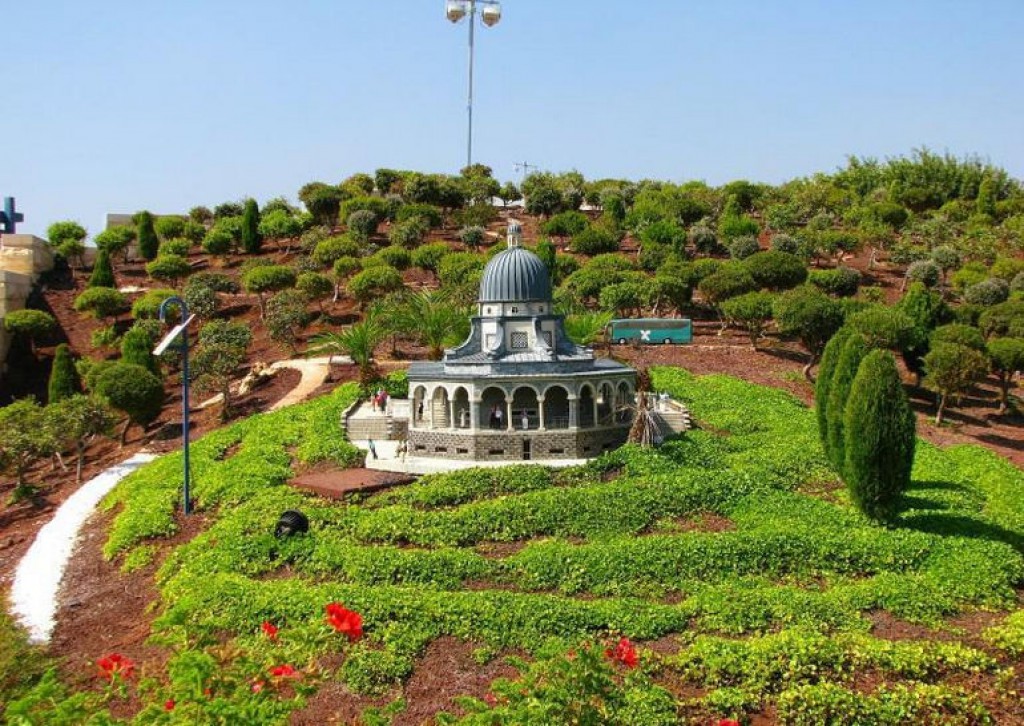
At the northern tip of Lake Kinneret, there is a mountain, from the top of which the Lord Jesus Christ presented to people the essence of His Teachings - a speech about the Sermon on the Mount, which is justly considered the quintessence of all Christianity. Although earlier different, conflicting hypotheses were put forward about the location of this important place for biblical history, the name of the Mount of Beatitudes was eventually awarded to this picturesque hill with slopes covered with mossy boulders.
The mountain, or rather a hill one hundred and ten meters high, is located above the settlement with the Arabic name Tabgha (or Tabga) in the Upper Galilee. Heading to Capernaum, pilgrims unknowingly may not even pay attention to this sublimity, from which, according to the testimony of the Apostle Matthew, the Savior of the world uttered the words of the Gospel beatitudes. And it is completely in vain, because it was here a little less than two thousand years ago that events unfolded, thanks to the Gospel of Matthew, known for centuries to Christians all over the world.
“And many people followed Him from Galilee and Decapolis, and Jerusalem and Judea, and from beyond Jordan. Seeing the people, He went up the mountain; and when he sat down, his disciples came to him. And He opened His mouth and taught them.
- Blessed are the poor in spirit, for theirs is the Kingdom of Heaven.
- Blessed weepers, for they will be comforted.
- Blessed are the meek, for they will inherit the earth.
- Blessed are those who hunger and thirst for righteousness, for they will be satisfied.
- Blessed are the merciful, for they will have mercy.
- Blessed are the pure in heart, for they will see God.
- Blessed are the peacemakers, for they will be called sons of God.
- Blessed are those banished for righteousness, for theirs is the Kingdom of Heaven.
- Blessed are you when they will revile you and persecute you and in every way unrighteously revile you for Me.
Rejoice and rejoice, for great is your reward in heaven: so they persecuted the prophets who were before you. ”(Matthew 5: 1-12).
The mountain from which these, perhaps the most important words for the entire New Testament era, sounded, is like a natural amphitheater over Lake Gennesaret, where the sound of a human voice spreads far in the air. In the holy gospels, Lake Gennesaret is often called the Sea of Galilee - this reservoir was also called the Kinneret, after the name of the ancient city on its northwestern shore.
The Mount of Beatitudes itself is very picturesque. Climbing up the slope, you can enjoy an amazing view that opens up to the eye: the majestic Sea of Galilee - and another sea, green if you observe the local surroundings in summer. Among the greenery - blotches of small bright flowers that grow in abundance in the local mountain landscapes, and besides them, in groups and singly, numerous trees and shrubs.
Russian writer D.S. Merezhkovsky, a deeply religious Christian, with all his heart in love with the Holy Land, in his book 'Jesus the Unknown' begins the chapter on the Sermon on the Mount: “Season is early spring, late March, early April; place - above the Capernaum Seven-Key, in the mountainous heights north-west of Lake Gennesaret. Local residents remember to this day three trees that stood on one of these heights, now felled. Judging by their Arabic name 'al-Mabarakat', 'Blessed', 'Blessed', as well as by the word, also Arabic, 'Deir Makir', probably from the Greek makaris mos, 'bliss', which survived on one of the found here Cyclopean boulders must have come from the ruins of an ancient basilica - judging by these two signs, the most ancient tradition was looking for the Mount of Beatitudes in these places. '
Merezhkovsky's heartfelt narrative was published in 1932 - just a few years before Italian church archaeologists actually discovered traces of a Byzantine basilica with mosaics that once adorned it, as well as the remains of adjoining buildings, which may have been an ancient monastery. The same thoughts are suggested by the cistern carved into the mountain, found just below the slope - judging by its size, it was intended to meet the water needs of a large number of people. Thus, even without being familiar with the written historical evidence, just having been here, it is easy to understand that this place was revered by Christians from early times.
According to the testimonies of pilgrims of the 4th century AD that have come down to us, even then there was a Christian chapel on the hill. In particular, the description of this place of the pilgrim Egeria, who visited here in 380 and speaks about the hill, as exactly about the one on which 'the Lord uttered bliss', has been preserved. She also says in her Descriptions that at the foot of the Mount of Beatitudes on the coast of the Sea of Galilee there was a valley with seven springs and a church - and such a valley really exists in the nearest village mentioned at the very beginning of Tabghe.
Excavations carried out on the mountain in the mid-thirties of the last century by Benedictine researchers under the guidance of the master of biblical history and archeology Bellarmino Bagatti confirmed the words of the pilgrims who visited here at the very end of the ancient era. A native of Pisa, a graduate of the Pontifical Bible Institute, and later - a professor at the Jerusalem Bible School, Father Bellarmino and his like-minded people found the remains of a rather miniature - 4.48x7.20 meters - chapel, erected in the early Byzantine period and destroyed, as it was established, in 645.
However, for the construction of the Church of the Sermon on the Mount, the Benedictines chose another place on the Mount of Beatitudes, at a distance of a kilometer and higher along the slope - in fact, with the completion of the construction of this temple, its now generally accepted name was fixed behind the mountain. The construction of the temple was financed by the Italian Missionary Association. By the way, the Italian Duce Mussolini also contributed to the building of temples (one must think, considerable) - this is evidenced by the inscription on the altar, which is covered from overly inquisitive eyes with a patterned glance. But, of course, the main donors to the cause of the Missionary Association were the believers in Italy and other Christian countries.
The architect of the new grandiose project in the Holy Land was the famous Antonio Barluzzi, known for his non-trivial approach to the construction of temples and other buildings. According to the project, the temple on the Mount of Beatitudes is octagonal at its base, and should be crowned by a large copper dome. Experts classify the general style of the building as Neo-Renaissance.
Black basalt and white limestone, contrasting with each other, were chosen as materials for the construction of the church. The number eight, played in an architectural solution, how easy it is guess, symbolizes the eight gospel beatitudes spoken by the Savior during the Sermon on the Mount - each of them is inscribed on one of the dome windows.
Although the temple is surrounded by an impressive open gallery, the overall structure is simple, perhaps even somewhat unusual for a Catholic church. But on closer acquaintance with the church, you begin to understand that its grandeur lies not in the details, but in the general design as such. The windows of the temple offer a view of the places on which Jesus Christ walked, talking with people and disciples. We can say that views of the surroundings here replace the hand-made holy images, and the windows and other details of the temple only frame them, emphasizing the greatness of what was created by the Creator. By the way, Barluzzi will resort to this technique later, when in the Dominus Flevit Church on the Mount of Olives in Jerusalem, instead of an altar icon, he will place a window overlooking the Temple Mount.
However, let's return to the Church of the Sermon on the Mount on the Mount of Beatitudes. In the center of the rotunda there is an altar by A. Mistrutsia. It is made of marble and trimmed with semi-precious stones. Lifting your head up, you can see the cross, as well as scenes of the Crucifixion and Ascension of the Lord. And looking down - to distinguish the symbols of the seven virtues, which imply the bliss listed in the Mount Sermons. These are Justice, Kindness, Providence, Faith, Courage, Hope and Modesty. The figure of the Most Pronounced Beatitude is a kind of center of the altar composition - the image of the Savior is enclosed in an oval made of onyx. At the level of the windows on the walls there are paintings by d'Acciardi; at each - one of the stops on the Way of the Cross of the Son of God going to Calvary ... Mosaics on the floor and gold mosaics on the dome of the temple, it seems, can be looked at endlessly.
Around the Church of the Sermon on the Mount, there is a picturesque park, the alleys of which are lovingly groomed by the sisters of the Franciscan Order of the Immaculate Heart of the Holy Virgin Mary, founded in the nineteenth century by Saint Antonio Maria Claret, a native of the city of Sallente in Spain.
Here, in the park, there is also a hotel for pilgrims, a considerable number of whom annually visit the Mount of Beatitudes and the temple that stands on it. The entire temple complex, together with the park and the hotel, belongs to the Italian Catholic Society. Through his efforts, the area around the church was thoroughly landscaped: shops, parking and many other amenities appeared here. Not far from here, a stone was laid in the foundation of the future center for Christian explorers and pilgrims - with the blessing of Pope John Paul II, it was specially delivered here in 1998 from Rome, from the grave of the holy Primate Apostle Peter. And a little earlier than two decades earlier, another head of the Western Church, Paul VI, visited these places. Upon entering the church, you can see the items of his vestments left by the Pope during his visit. By the way, the aforementioned John Paul II also visited the Church of the Sermon on the Mount and also left something for him in prayer memory.
However, not only the princes of the Church, but also ordinary pilgrims visiting the Holy Land should definitely visit the Mount of Beatitudes and the Temple of the Sermon on the Mount. To do this, if you are traveling by car, from Tiberias you need to follow the highway number 90. Having passed the Kfar-Nakhum intersection, the dome of the church will open to your eyes on the right side of the mountain. Turn to country road # 8177 - and now you are at its gates. Do not forget that the temple is open to everyone, but you will have to pay for a parking space. From October to March, the Church of the Beatitudes is open to the public from 8:00 to 12:30 and then from 14:30 to 17:00, and from April to September only from 8:00 to 12:00. Enjoy your pilgrimage!
The mountain, or rather a hill one hundred and ten meters high, is located above the settlement with the Arabic name Tabgha (or Tabga) in the Upper Galilee. Heading to Capernaum, pilgrims unknowingly may not even pay attention to this sublimity, from which, according to the testimony of the Apostle Matthew, the Savior of the world uttered the words of the Gospel beatitudes. And it is completely in vain, because it was here a little less than two thousand years ago that events unfolded, thanks to the Gospel of Matthew, known for centuries to Christians all over the world.
“And many people followed Him from Galilee and Decapolis, and Jerusalem and Judea, and from beyond Jordan. Seeing the people, He went up the mountain; and when he sat down, his disciples came to him. And He opened His mouth and taught them.
- Blessed are the poor in spirit, for theirs is the Kingdom of Heaven.
- Blessed weepers, for they will be comforted.
- Blessed are the meek, for they will inherit the earth.
- Blessed are those who hunger and thirst for righteousness, for they will be satisfied.
- Blessed are the merciful, for they will have mercy.
- Blessed are the pure in heart, for they will see God.
- Blessed are the peacemakers, for they will be called sons of God.
- Blessed are those banished for righteousness, for theirs is the Kingdom of Heaven.
- Blessed are you when they will revile you and persecute you and in every way unrighteously revile you for Me.
Rejoice and rejoice, for great is your reward in heaven: so they persecuted the prophets who were before you. ”(Matthew 5: 1-12).
The mountain from which these, perhaps the most important words for the entire New Testament era, sounded, is like a natural amphitheater over Lake Gennesaret, where the sound of a human voice spreads far in the air. In the holy gospels, Lake Gennesaret is often called the Sea of Galilee - this reservoir was also called the Kinneret, after the name of the ancient city on its northwestern shore.
The Mount of Beatitudes itself is very picturesque. Climbing up the slope, you can enjoy an amazing view that opens up to the eye: the majestic Sea of Galilee - and another sea, green if you observe the local surroundings in summer. Among the greenery - blotches of small bright flowers that grow in abundance in the local mountain landscapes, and besides them, in groups and singly, numerous trees and shrubs.
Russian writer D.S. Merezhkovsky, a deeply religious Christian, with all his heart in love with the Holy Land, in his book 'Jesus the Unknown' begins the chapter on the Sermon on the Mount: “Season is early spring, late March, early April; place - above the Capernaum Seven-Key, in the mountainous heights north-west of Lake Gennesaret. Local residents remember to this day three trees that stood on one of these heights, now felled. Judging by their Arabic name 'al-Mabarakat', 'Blessed', 'Blessed', as well as by the word, also Arabic, 'Deir Makir', probably from the Greek makaris mos, 'bliss', which survived on one of the found here Cyclopean boulders must have come from the ruins of an ancient basilica - judging by these two signs, the most ancient tradition was looking for the Mount of Beatitudes in these places. '
Merezhkovsky's heartfelt narrative was published in 1932 - just a few years before Italian church archaeologists actually discovered traces of a Byzantine basilica with mosaics that once adorned it, as well as the remains of adjoining buildings, which may have been an ancient monastery. The same thoughts are suggested by the cistern carved into the mountain, found just below the slope - judging by its size, it was intended to meet the water needs of a large number of people. Thus, even without being familiar with the written historical evidence, just having been here, it is easy to understand that this place was revered by Christians from early times.
According to the testimonies of pilgrims of the 4th century AD that have come down to us, even then there was a Christian chapel on the hill. In particular, the description of this place of the pilgrim Egeria, who visited here in 380 and speaks about the hill, as exactly about the one on which 'the Lord uttered bliss', has been preserved. She also says in her Descriptions that at the foot of the Mount of Beatitudes on the coast of the Sea of Galilee there was a valley with seven springs and a church - and such a valley really exists in the nearest village mentioned at the very beginning of Tabghe.
Excavations carried out on the mountain in the mid-thirties of the last century by Benedictine researchers under the guidance of the master of biblical history and archeology Bellarmino Bagatti confirmed the words of the pilgrims who visited here at the very end of the ancient era. A native of Pisa, a graduate of the Pontifical Bible Institute, and later - a professor at the Jerusalem Bible School, Father Bellarmino and his like-minded people found the remains of a rather miniature - 4.48x7.20 meters - chapel, erected in the early Byzantine period and destroyed, as it was established, in 645.
However, for the construction of the Church of the Sermon on the Mount, the Benedictines chose another place on the Mount of Beatitudes, at a distance of a kilometer and higher along the slope - in fact, with the completion of the construction of this temple, its now generally accepted name was fixed behind the mountain. The construction of the temple was financed by the Italian Missionary Association. By the way, the Italian Duce Mussolini also contributed to the building of temples (one must think, considerable) - this is evidenced by the inscription on the altar, which is covered from overly inquisitive eyes with a patterned glance. But, of course, the main donors to the cause of the Missionary Association were the believers in Italy and other Christian countries.
The architect of the new grandiose project in the Holy Land was the famous Antonio Barluzzi, known for his non-trivial approach to the construction of temples and other buildings. According to the project, the temple on the Mount of Beatitudes is octagonal at its base, and should be crowned by a large copper dome. Experts classify the general style of the building as Neo-Renaissance.
Black basalt and white limestone, contrasting with each other, were chosen as materials for the construction of the church. The number eight, played in an architectural solution, how easy it is guess, symbolizes the eight gospel beatitudes spoken by the Savior during the Sermon on the Mount - each of them is inscribed on one of the dome windows.
Although the temple is surrounded by an impressive open gallery, the overall structure is simple, perhaps even somewhat unusual for a Catholic church. But on closer acquaintance with the church, you begin to understand that its grandeur lies not in the details, but in the general design as such. The windows of the temple offer a view of the places on which Jesus Christ walked, talking with people and disciples. We can say that views of the surroundings here replace the hand-made holy images, and the windows and other details of the temple only frame them, emphasizing the greatness of what was created by the Creator. By the way, Barluzzi will resort to this technique later, when in the Dominus Flevit Church on the Mount of Olives in Jerusalem, instead of an altar icon, he will place a window overlooking the Temple Mount.
However, let's return to the Church of the Sermon on the Mount on the Mount of Beatitudes. In the center of the rotunda there is an altar by A. Mistrutsia. It is made of marble and trimmed with semi-precious stones. Lifting your head up, you can see the cross, as well as scenes of the Crucifixion and Ascension of the Lord. And looking down - to distinguish the symbols of the seven virtues, which imply the bliss listed in the Mount Sermons. These are Justice, Kindness, Providence, Faith, Courage, Hope and Modesty. The figure of the Most Pronounced Beatitude is a kind of center of the altar composition - the image of the Savior is enclosed in an oval made of onyx. At the level of the windows on the walls there are paintings by d'Acciardi; at each - one of the stops on the Way of the Cross of the Son of God going to Calvary ... Mosaics on the floor and gold mosaics on the dome of the temple, it seems, can be looked at endlessly.
Around the Church of the Sermon on the Mount, there is a picturesque park, the alleys of which are lovingly groomed by the sisters of the Franciscan Order of the Immaculate Heart of the Holy Virgin Mary, founded in the nineteenth century by Saint Antonio Maria Claret, a native of the city of Sallente in Spain.
Here, in the park, there is also a hotel for pilgrims, a considerable number of whom annually visit the Mount of Beatitudes and the temple that stands on it. The entire temple complex, together with the park and the hotel, belongs to the Italian Catholic Society. Through his efforts, the area around the church was thoroughly landscaped: shops, parking and many other amenities appeared here. Not far from here, a stone was laid in the foundation of the future center for Christian explorers and pilgrims - with the blessing of Pope John Paul II, it was specially delivered here in 1998 from Rome, from the grave of the holy Primate Apostle Peter. And a little earlier than two decades earlier, another head of the Western Church, Paul VI, visited these places. Upon entering the church, you can see the items of his vestments left by the Pope during his visit. By the way, the aforementioned John Paul II also visited the Church of the Sermon on the Mount and also left something for him in prayer memory.
However, not only the princes of the Church, but also ordinary pilgrims visiting the Holy Land should definitely visit the Mount of Beatitudes and the Temple of the Sermon on the Mount. To do this, if you are traveling by car, from Tiberias you need to follow the highway number 90. Having passed the Kfar-Nakhum intersection, the dome of the church will open to your eyes on the right side of the mountain. Turn to country road # 8177 - and now you are at its gates. Do not forget that the temple is open to everyone, but you will have to pay for a parking space. From October to March, the Church of the Beatitudes is open to the public from 8:00 to 12:30 and then from 14:30 to 17:00, and from April to September only from 8:00 to 12:00. Enjoy your pilgrimage!
Share: