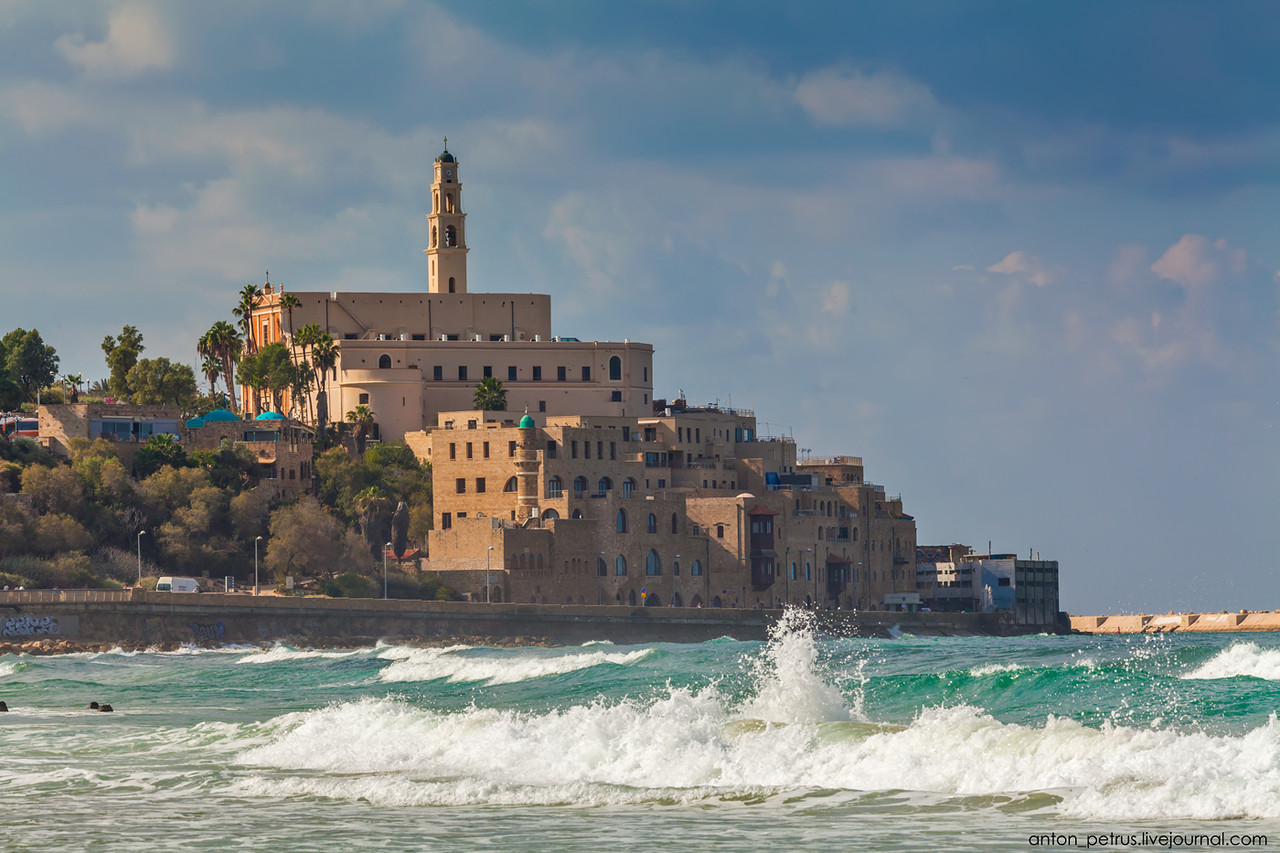
Ancient Jaffa: the city of Japheth and the Apostle Peter
24 November 2018
Jaffa, aka ancient Iopia, is one of the oldest cities on the planet, inhabited continuously. Since the middle of the last century, this city has been part of the same administrative district with Tel Aviv, since then it has become, in fact, its suburb. For hundreds of years before that, Jaffa remained the sea gateway to the Holy Land and its first city seen by Christian pilgrims who stayed in Palestine for worship - and followed from here on foot to Jerusalem, Bethlehem and Nazareth.In Jaffa itself, there are also Christian shrines - they are connected primarily in the life and deeds of the holy supreme apostle Peter. Since ancient times, Jaffa (Jaffa) on the shores of the Mediterranean Sea has been a fortified port and the object of desire of many ancient kings and rulers. Remains of the oldest fortifications that surrounded the hill on which the city stands date back to the eighteenth century BC, and traces of the oldest residential buildings date back to the seventeenth and sixteenth centuries. The first written mention of the city - or, rather, the whole story 'The Taking of Juppa', dates back to the fifteenth century BC. This manuscript, which has survived to this day, tells how the general of Pharaoh by cunning captured Joppa.
During the time of ancient Rome, the port city grew and became richer - before, during the Jewish War, local rebels did not come to the city to cut off the sea communications of the empire. The attempt was unsuccessful, and the fate of Jerusalem awaited Joppa: as punishment for the rebellious province, the Romans did not leave what is called a stone unturned from the city. After a while, under Vespasian, the port city will be rebuilt by order of the emperor and its history will continue - albeit under a somewhat modified name: Flavia Joppa. The growth of the city's population and its prosperity also increased in the Byzantine period - until the capture of the city by the Arabs in 638. Under the Muslim saber, the once brilliant Joppa withers, for four centuries remaining only a kind of berth for ships of pilgrims who professed both Christianity and Judaism. The crusaders who appeared under the walls of the fortress in 1100 brought great revival to the local life. The city turns into a huge supply base, 'the port of Jerusalem,' as the knights call it - providing all the Christ-loving army that is fighting throughout Palestine. Muslims and Jews are expelled from the city, and it itself becomes the center of the newly formed County of Jaffa and Ascalon. The growing number of soldiers arriving in the city attracts traders from Europe and Asia. The city is being built, gaining more and more economic and political significance. In 1191 it is captured by the troops of Saladin, but a year later, Richard the Lionheart frees Jaffa. Later, the crusaders leave the city, and their attempts to reclaim it end in nothing. Finally, in 1268, the Mamluk Sultan Baybars completely destroys Jaffa as the object of the claims of European Christians - and for the next four hundred years it ceases to exist as a port altogether. Only in modern times, starting from the 17th century, the city is gradually being rebuilt and again finds itself on the pages of world history. In 1799, after a six-day siege, Jaffa was captured by Napoleon Bonaparte. But all these are events in the history of socio-political; it would be appropriate to say also about the church, correlated with Holy Scripture and Tradition. The very name of this place is associated with the name of Noah's son - Japheth, who, according to the Holy Scriptures, founded the first settlement here. According to some versions, it was here on the eve of the Flood that the Ark was launched.
During the conquest of the land of Canaan by Joshua, Jaffa remains in the possession of the 'peoples of the sea': the Philistines and others. When land is distributed among the tribes of Israel, the city turns out to be on the territory of Dan, but the Israelites fail to take Jaffa away from the Philistines. In 701 BC Jaffa is captured by the king of Assyria Sennacherib. In 586-332 BC. Persian rule in the city: Darius I handed over Jaffa to the king of Sidon and his descendants, who established a Phoenician colony here. In the Hellenistic era, Jaffa was either an autonomous city or a part of the Samaria district. During the national liberation struggle of the Maccabees and in the Hasmonean period (144-132 BC), the Jews sometimes seize the city, then they are expelled from it by the pagans, then they liberate it again - which, of course, does not contribute to interfaith understanding in Jaffa. In the Holy Scriptures of the New Testament, Jaffa-Joppa is associated primarily with the name of St. Peter. He himself was not a local native - nevertheless, it was here that events took place with him, thanks to which Christianity is known today as a world religion. Saint Peter, who was in a neighboring city, was summoned by fellow believers to Jaffa, where a virtuous Christian woman named Tabitha died. Through the fervent prayer of the apostle, the woman was resurrected. The incident so shocked the townspeople that many of them themselves began to confess Christ. Among those who converted, there were many wealthy people who invited Peter to stay in their homes - however, the apostle chose a home during his stay in Jaffa a simple tanner named Simon: obviously, the life and life of an ordinary person who earned a living for his family with hard work, were more understandable to him. It was in this house, or rather, on its roof, that the holy apostle experienced a mystical experience, thanks to which Christianity from the faith of a small part of the Jewish people became a supranational religion.
As the book of Acts narrates, going up to the roof of the house to pray, Peter suddenly felt hungry. Following this, the apostle was rewarded with a vision: a vessel with animals ritually unclean for a Jew ('all four-legged earthly animals, animals, reptiles and birds of the air') descended from heaven to him, and a voice came: 'Get up, Peter, kill and eat.' Since Peter, who adhered to the principles of Judaism, refused to eat unclean things, the voice commanded him: “What God has cleansed, you do not consider unclean” (Acts 10:15). Then the vision disappeared. While Peter was pondering how to understand what he saw, three people approached the door of the tanner's house and conveyed to the apostle an invitation from the Roman centurion Cornelius to visit him. Peter, who was forbidden by Jewish law to visit the houses of the Gentiles, and even more so to share a meal with them, he slowed down with an answer - but the Holy Spirit told him to go to the Roman without any doubt, which the apostle did. In the house of the Roman officer, Peter saw many of his relatives and friends - and for a long time preached the teachings of Christ to them. When Peter finished, the meaning of the vision on the roof of the tanner's house became perfectly clear to him: it indicated the mission of the apostles to carry the word of Christ to all ends of the inhabited world, to different peoples inhabiting it. Simon's flat-roofed tanner's house is shown to pilgrims in Jaffa today. True, after one incident that took place here, it is impossible to enter it, but this does not bother the pilgrims. They walk to a house on a narrow street near a striped lighthouse to stand at the door of a building that the sign says belongs to the Zakarian family. Those who managed to visit here earlier say that in the courtyard there is an ancient well where the tanner Simon collected water for his craft - as well as a stone sarcophagus that the Apostle Peter himself allegedly carved for himself. By the way, special importance was attached to this house even when the Muslims ruled in these places: in one of such periods a minaret was erected on its roof.
The main Orthodox shrine of ancient Jaffa is the Church of St. Peter in the courtyard of righteous Tabitha, which belongs to the Russian spiritual mission. To be precise, the temple was consecrated in honor of the feast of the Adoration of the Honest Chains of the Apostle Peter, and its northern side-altar - in the name of the righteous Tabitha, whose burial became the main shrine of the entire temple complex. Above the tomb of the righteous woman, decorated with early Byzantine mosaics, the architects built a special chapel. Even before the construction of the temple on a plot of land with the burial of righteous Tabitha, acquired by Archimandrite Antonin (Kapustin) for the Russian spiritual mission in the middle of the 19th century, a hospice was erected for pilgrims who arrived by sea to Jaffa. Here a well was dug and a garden with fruit and ornamental trees was laid out: Russian pilgrims in the courtyard were met by thickets of citrus, shady avenues of cypresses, eucalyptus, pines, olives ...
By the early 80s of the XIX century, a railway began to operate, connecting Jaffa with Jerusalem. And in 1988, on the site in Jaffa, in the presence of representatives of the Russian imperial family, he was like They would say today that the construction of the temple has started, to the construction of which both Italian and local masters had a hand - and the icons for it were painted by the Russian artist A. Ledakov. In early 1994, the church was consecrated by Patriarch Gerasim of Jerusalem, who was co-served by Metropolitan Peter of Arabia and Archbishop of Jordan, as well as the already mentioned Archimandrite Antonin. Unfortunately, the godless 20th century left its mark on the temple complex. The temple and the buildings of the courtyard, left without support from Russia, fell into disrepair and required a thorough reconstruction and repair. The restoration work began in 1995 and took fifteen long years. As a result, the temple was returned to its original appearance, which is characterized by the features of Greco-Byzantine architecture. The revived Imperial Orthodox Palestinian Society presented the temple with a white two-tiered iconostasis, in which the altarpiece 'The Resurrection of Tabitha' takes its proper place. As for the wall paintings made in 1905 by the masters of the Pochaev Lavra, a significant part of them has been meticulously restored in our time. The frescoes of the church depict the holy apostles Paul and Peter, as well as scenes from the life of the latter; images of other apostles from among the Twelve are also present here.
There is another church in Jaffa, consecrated in the name of the Apostle Peter - Roman Catholic, which, according to the Franciscan brothers (it is under the jurisdiction of their order), stands on the site of the original home of Simon the tanner. Whether it is true or not, it is impossible to confirm or deny today. Be that as it may, this 17th century church with a bright orange facade and a high bell tower is of interest already because it was erected on the foundations of a medieval fortress, erected here by the order of Emperor Frederick II, and after the destruction by Muslims, rebuilt by the French king Louis IX in the middle XIII century and named after this monarch. The Church of St. Peter the Apostle was also destroyed twice in the 18th century - and each time it was rebuilt. The building took its current form in the period from 1888 to 1894; the reconstruction of 1903 added something to its appearance. The architecture of the church is sustained in the spirit of European Catholic cathedrals - vaulted ceilings, stained glass windows, marble walls. The stained glass windows of the temple by the famous Munich master Franz Xavier Zettler reflect New Testament events, a participant which was the apostle Peter: fishing with the Teacher, handing over the keys, the Transfiguration of the Lord and washing the feet at the Last Supper. Of course, there is also a scene of the resurrection of Tabitha, the Immaculate Conception and the image of Francis of Assisi - and the rest of the stained-glass windows are images of Spanish saints (the current church building was built with Spanish money).
In the two circular rooms of the church with low ceilings, located near the sacristy, visitors can see what remains of the fortress of St. Louis, which stood here in the 13th century. Local tradition assures that it was in these premises that Napoleon Bonaparte lodged in 1799, during his Egyptian-Syrian campaign. In ancient Jaffa, although it has become a part of modern Tel Aviv, there is still a place for prayer solitude and acquaintance with the spiritual and artistic culture of the place, the origin of which is lost in the mists of time. The city center, where many people of creative professions live, is replete with workshops of artists, exhibition galleries, flea markets (one of them, as local residents assure, is the oldest in the world). And having turned to the sea, it is quite possible to accidentally step on a stone, which two thousand years ago were touched by the sandals of the saint. the apostle Peter. Since then, the city has been destroyed and rebuilt more than once - but after all, ancient artifacts, like manuscripts, do not disappear anywhere: remaining hidden until the time, after centuries and millennia, they again fall into the eyes of people. V. Sergienko
Ancient Jaffa: the city of Japheth and the Apostle PeterAncient Jaffa: the city of Japheth and the Apostle Peter Jaffa, aka ancient Iopia, is one of the oldest cities on the planet, inhabited continuously. Since the middle of the last century, this city has been part of the same administrative district with Tel Aviv, since then it has become, in fact, its suburb. For hundreds of years before that, Jaffa remained the sea gateway to the Holy Land and its first city seen by Christian pilgrims who stayed in Palestine for worship - and followed from here on foot to Jerusalem, Bethlehem and Nazareth. In Jaffa itself, there are also Christian shrines - they are connected primarily in the life and deeds of the holy supreme apostle Peter. Since ancient times, Jaffa (Jaffa) on the shores of the Mediterranean Sea has been a fortified port and the object of desire of many ancient kings and rulers. Remains of the oldest fortifications that surrounded the hill on which the city stands date back to the eighteenth century BC, and traces of the oldest residential buildings date back to the seventeenth and sixteenth centuries. The first written mention of the city - or, rather, the whole story 'The Taking of Juppa', dates back to the fifteenth century BC. This manuscript, which has survived to this day, tells how the general of Pharaoh by cunning captured Joppa. During the time of ancient Rome, the port city grew and became richer - before, during the Jewish War, local rebels did not come to the city to cut off the sea communications of the empire. The attempt was unsuccessful, and the fate of Jerusalem awaited Joppa: as punishment for the rebellious province, the Romans did not leave what is called a stone unturned from the city. After a while, under Vespasian, the port city will be rebuilt by order of the emperor and its history will continue - albeit under a somewhat modified name: Flavia Joppa. The growth of the city's population and its prosperity also increased in the Byzantine period - until the capture of the city by the Arabs in 638. Under the Muslim saber, the once brilliant Joppa withers, for four centuries remaining only a kind of berth for ships of pilgrims who professed both Christianity and Judaism. The crusaders who appeared under the walls of the fortress in 1100 brought great revival to the local life. The city turns into a huge supply base, 'the port of Jerusalem,' as the knights call it - providing all the Christ-loving army that is fighting throughout Palestine. Muslims and Jews are expelled from the city, and it itself becomes the center of the newly formed County of Jaffa and Ascalon. The growing number of soldiers arriving in the city attracts traders from Europe and Asia. The city is being built, gaining more and more economic and political significance. In 1191 it is captured by the troops of Saladin, but a year later, Richard the Lionheart frees Jaffa. Later, the crusaders leave the city, and their attempts to reclaim it end in nothing. Finally, in 1268, the Mamluk Sultan Baybars completely destroys Jaffa as the object of the claims of European Christians - and for the next four hundred years it ceases to exist as a port altogether. Only in modern times, starting from the 17th century, the city is gradually being rebuilt and again finds itself on the pages of world history. In 1799, after a six-day siege, Jaffa was captured by Napoleon Bonaparte. But all these are events in the history of socio-political; it would be appropriate to say also about the church, correlated with Holy Scripture and Tradition. The very name of this place is associated with the name of Noah's son - Japheth, who, according to the Holy Scriptures, founded the first settlement here. According to some versions, it was here on the eve of the Flood that the Ark was launched. During the conquest of the land of Canaan by Joshua, Jaffa remains in the possession of the 'peoples of the sea': the Philistines and others. When land is distributed among the tribes of Israel, the city turns out to be on the territory of Dan, but the Israelites fail to take Jaffa away from the Philistines. In 701 BC Jaffa is captured by the king of Assyria Sennacherib. In 586-332 BC. Persian rule in the city: Darius I handed over Jaffa to the king of Sidon and his descendants, who established a Phoenician colony here. In the Hellenistic era, Jaffa was either an autonomous city or a part of the Samaria district. During the national liberation struggle of the Maccabees and in the Hasmonean period (144-132 BC), the Jews sometimes seize the city, then they are expelled from it by the pagans, then they liberate it again - which, of course, does not contribute to interfaith understanding in Jaffa. In the Holy Scriptures of the New Testament, Jaffa-Joppa is associated primarily with the name of St. Peter. He himself was not a local native - nevertheless, it was here that events took place with him, thanks to which Christianity is known today as a world religion. Saint Peter, who was in a neighboring city, was summoned by fellow believers to Jaffa, where a virtuous Christian woman named Tabitha died. Through the fervent prayer of the apostle, the woman was resurrected. The incident so shocked the townspeople that many of them themselves began to confess Christ. Among those who converted, there were many wealthy people who invited Peter to stay in their homes - however, the apostle chose a home during his stay in Jaffa a simple tanner named Simon: obviously, the life and life of an ordinary person who earned a living for his family with hard work, were more understandable to him. It was in this house, or rather, on its roof, that the holy apostle experienced a mystical experience, thanks to which Christianity from the faith of a small part of the Jewish people became a supranational religion. As the book of Acts narrates, going up to the roof of the house to pray, Peter suddenly felt hungry. Following this, the apostle was rewarded with a vision: a vessel with animals ritually unclean for a Jew ('all four-legged earthly animals, animals, reptiles and birds of the air') descended from heaven to him, and a voice came: 'Get up, Peter, kill and eat.' Since Peter, who adhered to the principles of Judaism, refused to eat unclean things, the voice commanded him: “What God has cleansed, you do not consider unclean” (Acts 10:15). Then the vision disappeared. While Peter was pondering how to understand what he saw, three people approached the door of the tanner's house and conveyed to the apostle an invitation from the Roman centurion Cornelius to visit him. Peter, who was forbidden by Jewish law to visit the houses of the Gentiles, and even more so to share a meal with them, he slowed down with an answer - but the Holy Spirit told him to go to the Roman without any doubt, which the apostle did. In the house of the Roman officer, Peter saw many of his relatives and friends - and for a long time preached the teachings of Christ to them. When Peter finished, the meaning of the vision on the roof of the tanner's house became perfectly clear to him: it indicated the mission of the apostles to carry the word of Christ to all ends of the inhabited world, to different peoples inhabiting it. Simon's flat-roofed tanner's house is shown to pilgrims in Jaffa today. True, after one incident that took place here, it is impossible to enter it, but this does not bother the pilgrims. They walk to a house on a narrow street near a striped lighthouse to stand at the door of a building that the sign says belongs to the Zakarian family. Those who managed to visit here earlier say that in the courtyard there is an ancient well where the tanner Simon collected water for his craft - as well as a stone sarcophagus that the Apostle Peter himself allegedly carved for himself. By the way, special importance was attached to this house even when the Muslims ruled in these places: in one of such periods a minaret was erected on its roof. The main Orthodox shrine of ancient Jaffa is the Church of St. Peter in the courtyard of righteous Tabitha, which belongs to the Russian spiritual mission. To be precise, the temple was consecrated in honor of the feast of the Adoration of the Honest Chains of the Apostle Peter, and its northern side-altar - in the name of the righteous Tabitha, whose burial became the main shrine of the entire temple complex. Above the tomb of the righteous woman, decorated with early Byzantine mosaics, the architects built a special chapel. Even before the construction of the temple on a plot of land with the burial of righteous Tabitha, acquired by Archimandrite Antonin (Kapustin) for the Russian spiritual mission in the middle of the 19th century, a hospice was erected for pilgrims who arrived by sea to Jaffa. Here a well was dug and a garden with fruit and ornamental trees was laid out: Russian pilgrims in the courtyard were met by thickets of citrus, shady avenues of cypresses, eucalyptus, pines, olives ... By the early 80s of the XIX century, a railway began to operate, connecting Jaffa with Jerusalem. And in 1988, on the site in Jaffa, in the presence of representatives of the Russian imperial family, he was like They would say today that the construction of the temple has started, to the construction of which both Italian and local masters had a hand - and the icons for it were painted by the Russian artist A. Ledakov. In early 1994, the church was consecrated by Patriarch Gerasim of Jerusalem, who was co-served by Metropolitan Peter of Arabia and Archbishop of Jordan, as well as the already mentioned Archimandrite Antonin. Unfortunately, the godless 20th century left its mark on the temple complex. The temple and the buildings of the courtyard, left without support from Russia, fell into disrepair and required a thorough reconstruction and repair. The restoration work began in 1995 and took fifteen long years. As a result, the temple was returned to its original appearance, which is characterized by the features of Greco-Byzantine architecture. The revived Imperial Orthodox Palestinian Society presented the temple with a white two-tiered iconostasis, in which the altarpiece 'The Resurrection of Tabitha' takes its proper place. As for the wall paintings made in 1905 by the masters of the Pochaev Lavra, a significant part of them has been meticulously restored in our time. The frescoes of the church depict the holy apostles Paul and Peter, as well as scenes from the life of the latter; images of other apostles from among the Twelve are also present here. There is another church in Jaffa, consecrated in the name of the Apostle Peter - Roman Catholic, which, according to the Franciscan brothers (it is under the jurisdiction of their order), stands on the site of the original home of Simon the tanner. Whether it is true or not, it is impossible to confirm or deny today. Be that as it may, this 17th century church with a bright orange facade and a high bell tower is of interest already because it was erected on the foundations of a medieval fortress, erected here by the order of Emperor Frederick II, and after the destruction by Muslims, rebuilt by the French king Louis IX in the middle XIII century and named after this monarch. The Church of St. Peter the Apostle was also destroyed twice in the 18th century - and each time it was rebuilt. The building took its current form in the period from 1888 to 1894; the reconstruction of 1903 added something to its appearance. The architecture of the church is sustained in the spirit of European Catholic cathedrals - vaulted ceilings, stained glass windows, marble walls. The stained glass windows of the temple by the famous Munich master Franz Xavier Zettler reflect New Testament events, a participant which was the apostle Peter: fishing with the Teacher, handing over the keys, the Transfiguration of the Lord and washing the feet at the Last Supper. Of course, there is also a scene of the resurrection of Tabitha, the Immaculate Conception and the image of Francis of Assisi - and the rest of the stained-glass windows are images of Spanish saints (the current church building was built with Spanish money). In the two circular rooms of the church with low ceilings, located near the sacristy, visitors can see what remains of the fortress of St. Louis, which stood here in the 13th century. Local tradition assures that it was in these premises that Napoleon Bonaparte lodged in 1799, during his Egyptian-Syrian campaign. In ancient Jaffa, although it has become a part of modern Tel Aviv, there is still a place for prayer solitude and acquaintance with the spiritual and artistic culture of the place, the origin of which is lost in the mists of time. The city center, where many people of creative professions live, is replete with workshops of artists, exhibition galleries, flea markets (one of them, as local residents assure, is the oldest in the world). And having turned to the sea, it is quite possible to accidentally step on a stone, which two thousand years ago were touched by the sandals of the saint. the apostle Peter. Since then, the city has been destroyed and rebuilt more than once - but after all, ancient artifacts, like manuscripts, do not disappear anywhere: remaining hidden until the time, after centuries and millennia, they again fall into the eyes of people. V. SergienkoСвеча Иерусалима -en
Jaffa, aka ancient Iopia, is one of the oldest cities on the planet, inhabited continuously. Since the middle of the last century, this city has been part of the same administrative district with Tel Aviv, since then it has become, in fact, its suburb. For hundreds of years before that, Jaffa remained the sea gateway to the Holy Land and its first city seen by Christian pilgrims who stayed in Palestine for worship - and followed from here on foot to Jerusalem, Bethlehem and Nazareth. In Jaffa itself, there are also Christian shrines - they are connected primarily in the life and deeds of the holy supreme apostle Peter. Since ancient times, Jaffa (Jaffa) on the shores of the Mediterranean Sea has been a fortified port and the object of desire of many ancient kings and rulers. Remains of the oldest fortifications that surrounded the hill on which the city stands date back to the eighteenth century BC, and traces of the oldest residential buildings date back to the seventeenth and sixteenth centuries. The first written mention of the city - or, rather, the whole story 'The Taking of Juppa', dates back to the fifteenth century BC. This manuscript, which has survived to this day, tells how the general of Pharaoh by cunning captured Joppa. During the time of ancient Rome, the port city grew and became richer - before, during the Jewish War, local rebels did not come to the city to cut off the sea communications of the empire. The attempt was unsuccessful, and the fate of Jerusalem awaited Joppa: as punishment for the rebellious province, the Romans did not leave what is called a stone unturned from the city. After a while, under Vespasian, the port city will be rebuilt by order of the emperor and its history will continue - albeit under a somewhat modified name: Flavia Joppa. The growth of the city's population and its prosperity also increased in the Byzantine period - until the capture of the city by the Arabs in 638. Under the Muslim saber, the once brilliant Joppa withers, for four centuries remaining only a kind of berth for ships of pilgrims who professed both Christianity and Judaism. The crusaders who appeared under the walls of the fortress in 1100 brought great revival to the local life. The city turns into a huge supply base, 'the port of Jerusalem,' as the knights call it - providing all the Christ-loving army that is fighting throughout Palestine. Muslims and Jews are expelled from the city, and it itself becomes the center of the newly formed County of Jaffa and Ascalon. The growing number of soldiers arriving in the city attracts traders from Europe and Asia. The city is being built, gaining more and more economic and political significance. In 1191 it is captured by the troops of Saladin, but a year later, Richard the Lionheart frees Jaffa. Later, the crusaders leave the city, and their attempts to reclaim it end in nothing. Finally, in 1268, the Mamluk Sultan Baybars completely destroys Jaffa as the object of the claims of European Christians - and for the next four hundred years it ceases to exist as a port altogether. Only in modern times, starting from the 17th century, the city is gradually being rebuilt and again finds itself on the pages of world history. In 1799, after a six-day siege, Jaffa was captured by Napoleon Bonaparte. But all these are events in the history of socio-political; it would be appropriate to say also about the church, correlated with Holy Scripture and Tradition. The very name of this place is associated with the name of Noah's son - Japheth, who, according to the Holy Scriptures, founded the first settlement here. According to some versions, it was here on the eve of the Flood that the Ark was launched. During the conquest of the land of Canaan by Joshua, Jaffa remains in the possession of the 'peoples of the sea': the Philistines and others. When land is distributed among the tribes of Israel, the city turns out to be on the territory of Dan, but the Israelites fail to take Jaffa away from the Philistines. In 701 BC Jaffa is captured by the king of Assyria Sennacherib. In 586-332 BC. Persian rule in the city: Darius I handed over Jaffa to the king of Sidon and his descendants, who established a Phoenician colony here. In the Hellenistic era, Jaffa was either an autonomous city or a part of the Samaria district. During the national liberation struggle of the Maccabees and in the Hasmonean period (144-132 BC), the Jews sometimes seize the city, then they are expelled from it by the pagans, then they liberate it again - which, of course, does not contribute to interfaith understanding in Jaffa. In the Holy Scriptures of the New Testament, Jaffa-Joppa is associated primarily with the name of St. Peter. He himself was not a local native - nevertheless, it was here that events took place with him, thanks to which Christianity is known today as a world religion. Saint Peter, who was in a neighboring city, was summoned by fellow believers to Jaffa, where a virtuous Christian woman named Tabitha died. Through the fervent prayer of the apostle, the woman was resurrected. The incident so shocked the townspeople that many of them themselves began to confess Christ. Among those who converted, there were many wealthy people who invited Peter to stay in their homes - however, the apostle chose a home during his stay in Jaffa a simple tanner named Simon: obviously, the life and life of an ordinary person who earned a living for his family with hard work, were more understandable to him. It was in this house, or rather, on its roof, that the holy apostle experienced a mystical experience, thanks to which Christianity from the faith of a small part of the Jewish people became a supranational religion. As the book of Acts narrates, going up to the roof of the house to pray, Peter suddenly felt hungry. Following this, the apostle was rewarded with a vision: a vessel with animals ritually unclean for a Jew ('all four-legged earthly animals, animals, reptiles and birds of the air') descended from heaven to him, and a voice came: 'Get up, Peter, kill and eat.' Since Peter, who adhered to the principles of Judaism, refused to eat unclean things, the voice commanded him: “What God has cleansed, you do not consider unclean” (Acts 10:15). Then the vision disappeared. While Peter was pondering how to understand what he saw, three people approached the door of the tanner's house and conveyed to the apostle an invitation from the Roman centurion Cornelius to visit him. Peter, who was forbidden by Jewish law to visit the houses of the Gentiles, and even more so to share a meal with them, he slowed down with an answer - but the Holy Spirit told him to go to the Roman without any doubt, which the apostle did. In the house of the Roman officer, Peter saw many of his relatives and friends - and for a long time preached the teachings of Christ to them. When Peter finished, the meaning of the vision on the roof of the tanner's house became perfectly clear to him: it indicated the mission of the apostles to carry the word of Christ to all ends of the inhabited world, to different peoples inhabiting it. Simon's flat-roofed tanner's house is shown to pilgrims in Jaffa today. True, after one incident that took place here, it is impossible to enter it, but this does not bother the pilgrims. They walk to a house on a narrow street near a striped lighthouse to stand at the door of a building that the sign says belongs to the Zakarian family. Those who managed to visit here earlier say that in the courtyard there is an ancient well where the tanner Simon collected water for his craft - as well as a stone sarcophagus that the Apostle Peter himself allegedly carved for himself. By the way, special importance was attached to this house even when the Muslims ruled in these places: in one of such periods a minaret was erected on its roof. The main Orthodox shrine of ancient Jaffa is the Church of St. Peter in the courtyard of righteous Tabitha, which belongs to the Russian spiritual mission. To be precise, the temple was consecrated in honor of the feast of the Adoration of the Honest Chains of the Apostle Peter, and its northern side-altar - in the name of the righteous Tabitha, whose burial became the main shrine of the entire temple complex. Above the tomb of the righteous woman, decorated with early Byzantine mosaics, the architects built a special chapel. Even before the construction of the temple on a plot of land with the burial of righteous Tabitha, acquired by Archimandrite Antonin (Kapustin) for the Russian spiritual mission in the middle of the 19th century, a hospice was erected for pilgrims who arrived by sea to Jaffa. Here a well was dug and a garden with fruit and ornamental trees was laid out: Russian pilgrims in the courtyard were met by thickets of citrus, shady avenues of cypresses, eucalyptus, pines, olives ... By the early 80s of the XIX century, a railway began to operate, connecting Jaffa with Jerusalem. And in 1988, on the site in Jaffa, in the presence of representatives of the Russian imperial family, he was like They would say today that the construction of the temple has started, to the construction of which both Italian and local masters had a hand - and the icons for it were painted by the Russian artist A. Ledakov. In early 1994, the church was consecrated by Patriarch Gerasim of Jerusalem, who was co-served by Metropolitan Peter of Arabia and Archbishop of Jordan, as well as the already mentioned Archimandrite Antonin. Unfortunately, the godless 20th century left its mark on the temple complex. The temple and the buildings of the courtyard, left without support from Russia, fell into disrepair and required a thorough reconstruction and repair. The restoration work began in 1995 and took fifteen long years. As a result, the temple was returned to its original appearance, which is characterized by the features of Greco-Byzantine architecture. The revived Imperial Orthodox Palestinian Society presented the temple with a white two-tiered iconostasis, in which the altarpiece 'The Resurrection of Tabitha' takes its proper place. As for the wall paintings made in 1905 by the masters of the Pochaev Lavra, a significant part of them has been meticulously restored in our time. The frescoes of the church depict the holy apostles Paul and Peter, as well as scenes from the life of the latter; images of other apostles from among the Twelve are also present here. There is another church in Jaffa, consecrated in the name of the Apostle Peter - Roman Catholic, which, according to the Franciscan brothers (it is under the jurisdiction of their order), stands on the site of the original home of Simon the tanner. Whether it is true or not, it is impossible to confirm or deny today. Be that as it may, this 17th century church with a bright orange facade and a high bell tower is of interest already because it was erected on the foundations of a medieval fortress, erected here by the order of Emperor Frederick II, and after the destruction by Muslims, rebuilt by the French king Louis IX in the middle XIII century and named after this monarch. The Church of St. Peter the Apostle was also destroyed twice in the 18th century - and each time it was rebuilt. The building took its current form in the period from 1888 to 1894; the reconstruction of 1903 added something to its appearance. The architecture of the church is sustained in the spirit of European Catholic cathedrals - vaulted ceilings, stained glass windows, marble walls. The stained glass windows of the temple by the famous Munich master Franz Xavier Zettler reflect New Testament events, a participant which was the apostle Peter: fishing with the Teacher, handing over the keys, the Transfiguration of the Lord and washing the feet at the Last Supper. Of course, there is also a scene of the resurrection of Tabitha, the Immaculate Conception and the image of Francis of Assisi - and the rest of the stained-glass windows are images of Spanish saints (the current church building was built with Spanish money). In the two circular rooms of the church with low ceilings, located near the sacristy, visitors can see what remains of the fortress of St. Louis, which stood here in the 13th century. Local tradition assures that it was in these premises that Napoleon Bonaparte lodged in 1799, during his Egyptian-Syrian campaign. In ancient Jaffa, although it has become a part of modern Tel Aviv, there is still a place for prayer solitude and acquaintance with the spiritual and artistic culture of the place, the origin of which is lost in the mists of time. The city center, where many people of creative professions live, is replete with workshops of artists, exhibition galleries, flea markets (one of them, as local residents assure, is the oldest in the world). And having turned to the sea, it is quite possible to accidentally step on a stone, which two thousand years ago were touched by the sandals of the saint. the apostle Peter. Since then, the city has been destroyed and rebuilt more than once - but after all, ancient artifacts, like manuscripts, do not disappear anywhere: remaining hidden until the time, after centuries and millennia, they again fall into the eyes of people. V. Sergienko