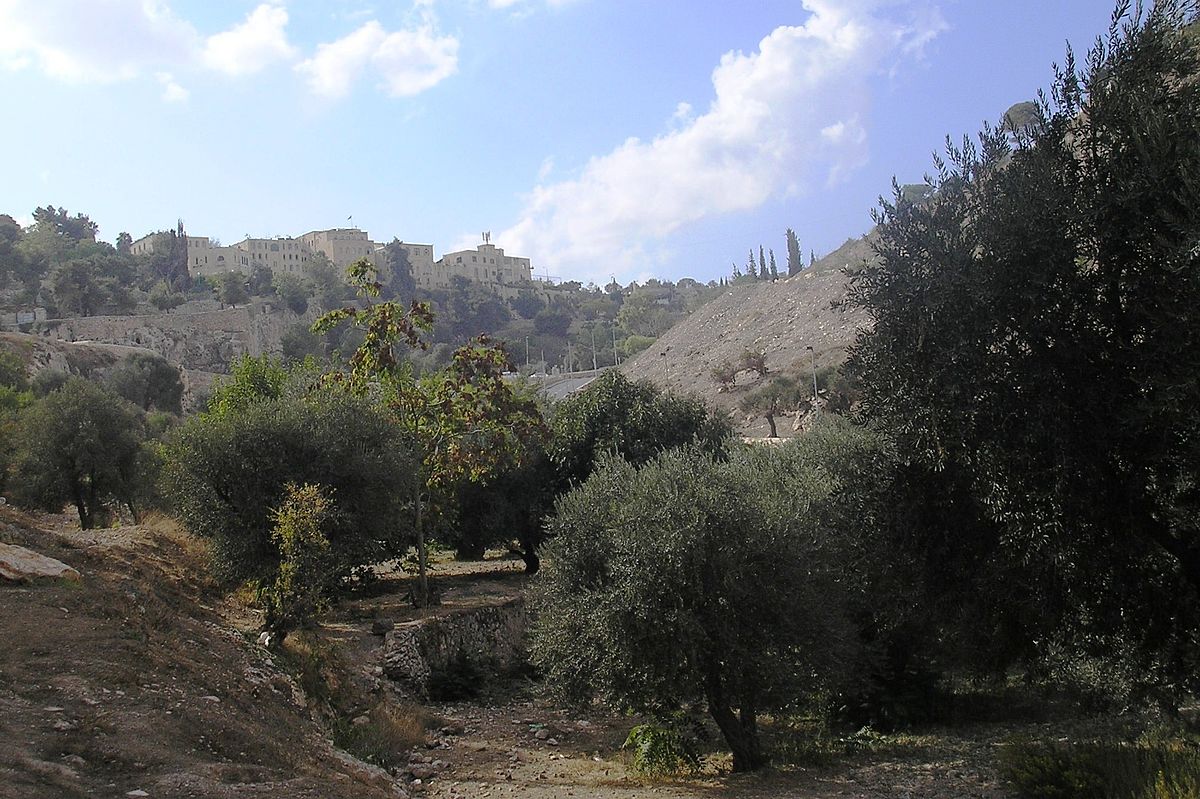
Valley of Hinnom. Monastery of Onuphrius the Great in Akeldam
18 November 2018
To the south-west of the Old City in Jerusalem is a place that served as the prototype for the popular expression 'fire hell', well known even to those who have never read the Bible and have never been to the Holy Land. This is the valley of Hinnom or the valley of the sons of Hinnom, 'Gai Ben Annom', which got its name in honor of the ancient people who once lived here, the origin of which is not known for certain. Almost immediately after the Jaffa Gate of Old Jerusalem, the Hinnom Valley begins. Adjoining the city wall, it turns to the left, and below Mount Zion it merges with the Kidron valley. The name of this particular place, inhabited in ancient times by the 'sons of Hinnom', later became synonymous with an inextinguishable flame bringing retribution to sinners - and, as the excavations carried out in this place have confirmed, there were reasons. This, of course, is not about the remains of the Byzantine church found here, and not even about the Roman military crematorium (in 63 BC, the military camp of Pompey was located in this place), which was also located here - the valley earned its ominous glory in much earlier times ...
Long before the era of Roman rule local residents burned garbage and dead animals in the valley. (Looking ahead, we note that there is a lot of garbage here even today, decaying corpses of animals, mainly cats, are also found, but today no one is in a hurry to collect and dispose of all this.) Archaeologists have discovered a large number of ancient graves in the valley, as well as bone wells - ossuaries - into which everything that remained after a rather primitive ancient cremation was dumped. In addition to human remains, archaeologists managed to find here and much more. For example, gold and silver jewelry from different eras, the finest silver scrolls with the text 'blessings of the Cohens' in Hebrew, and even one of the oldest coins in the world. It should be noted that a considerable number of valuable finds in these places were made by accident, during the preparatory work for the construction of roads. In the Old Testament, in the book of Joshua, this area is referred to as the division between the lands of the tribe of Judah and the tribe of Benjamin. For a long time (some researchers talk about the era of Solomon, others about the years of the reign of King Ahaz), Jews who fell away from the law of Moses and inclined towards paganism brought human sacrifices here to the bloodthirsty deity of the Canaanites Moloch, whose cult required the ritual murder of the firstborn and the subsequent burning. All the time of the savage rite, its participants performed frantic chants in chorus so that the screams of the unfortunate child would not be heard in the vicinity (the acoustics are peculiar here, and the sounds often echo). It was then that for the faithful Jews this place became an object of hatred and disgust ...
Under King Josiah, the Hinnom Valley became a kind of modern sanitary landfills, but taking into account the peculiarities of the era. Now, not only garbage and corpses of animals were taken down here, but also the bodies of killed enemies and executed criminals, who were left without burial. In order to prevent the infection and stench of putrefaction from spreading in Jerusalem and the surrounding area, a fire constantly burned in the valley of Hinnom - it devoured impurities, and clouds of smoke rose to the sky. Most likely, it was when contemplating this ominous picture that the Jerusalemites came up with associations with the fate of sinners beyond the grave where 'the worm does not die and the fire does not go out.' Later, Christianity also adopted the image of 'fiery hell' as a synonym for the underworld: the first of its adherents, mainly Jews, were well aware of the Old Testament prophecies about the 'place of murder', where wild beasts and birds of prey would torment the remains of people who were destroying each other - and the Teacher's words about 'Unquenchable fire' and hell for them is not demanded an explanation. Today, the ravines, caves and rocky cliffs of the Hinnoma Valley are attractive only for those who like extreme recreation, who come here from all over the country in search of thrills. Apart from them, this area is hardly anyone capable of inspiring. Stones, pipes, remnants of reinforced concrete structures and other construction waste are scattered everywhere. However, not only construction: plastic bags and bags, broken furniture and unusable household items - all this is in abundance here. Trails through the valley run from Jerusalem towards nearby Arab villages, unambiguously indicating the source of the garbage. The corpses of animals are not uncommon here: animals come to die under the booths and fences erected here for some unknown reason, exuding an incredible stench and attracting swarms of flies and beetles. Nearby, live cats hunt for rodents or scavenge in garbage. In order to prevent water from accumulating in the valley during winter rains, special drains are arranged. The vegetation here also matches the place identified with the underworld: crooked trees, thorny bushes and faded grasses ... In general, you don't want to stay here for a long time - it is much better to cross the valley and get to the Hakel-Dam (Akeldam) area, known in the New Testament as the Field Blood or Earth potter. The Gospel Akeldam is the same plot that was purchased for thirty-three pieces of silver, thrown before the high priests by Judas Iscariot, who fell into despair after the Teacher's betrayal. With this money - the price paid for the most terrible betrayal in the world - a plot was acquired, where from then until the beginning of the century before last they buried aliens and people whose identity could not be established. According to the Gospel of Matthew, according to the Jewish law, it was impossible to return the “price of blood” to the storehouse - that is why such a use was found for this amount (Matthew, 27, 6-8). This is exactly how the prophet Zechariah said about the coming Messiah came true: “And they will weigh thirty pieces of silver in payment to Me. And the Lord said to me: Throw them into the church storehouse, - a high price, at which they valued Me! And I took thirty pieces of silver and threw them into the house of the Lord for the potter ”(Zech 11: 12-13). Tradition also connects Akeldam with the place of Judas' suicide, referring to the New Testament “Acts of the Apostles”: “... He acquired the land with unrighteous bribery, and when he fell down, his belly split open, and all his insides fell out; and this became known to all the inhabitants of Jerusalem, so that the land in their native tongue is called Akeldam, that is, the land of blood ”(Acts 1, 18-19). In the notes of the pilgrims, who visited the Holy Land, Akeldam is mentioned many times over the centuries. The Russian abbot Daniel, who visited Palestine at the very beginning of the twelfth century, describes this place as follows: “It was bought for the price for which Judas sold to Christ, for the burial of pilgrims. The village is located south of Zion, one arrow from the gorge, under the mountain. On this side of the mountain you can see many caves carved into stones, and at the bottom of these caves, coffins are wondrously and wonderfully arranged. Here pilgrims are buried free of charge, since this place was redeemed by the blood of Christ. ' Looking at the soil in this place, you understand why Akeldam is a 'potter's field': in this land, there is an abundance of fatty clay, which is excellent for the production of ceramics.
Akeldam is closely associated with the name of the great Christian ascetic of the fourth century - the Monk Onuphrius the Great. It is his name that bears an Orthodox nunnery, which stands on a terrace in the southeastern part of the Hinnom valley, next to the place where it joins with another valley - the Kidron valley. Church tradition asserts that the Monk Onuphrius spent several years here, who asceticised in these places in prayer and ascetic deeds. The life of Saint Onuphrius is known to us mainly from the retelling of another reverend father - Paphnutius, who met an ascetic shortly before his departure to the Lord, listened to his story about the sixty years lived by the hermit, and after that, when he died, he gave his ashes to the earth. Some sources refer to the Monk Onuphrius as the son of the king of Persia, whom the angel inspired to give the child to be raised by Christian monks - which the monarch did. At first, Onuphrius asceticised in Egypt, in the Thebaid monastery near Hermopolis - however, having learned about the hermit fathers, he decided to test himself in this field. In the wilderness, he met a mentor who strengthened him in his thoughts about the hermit's path. In the monastery in Akeldam, visitors today are shown the cave where the Monk Onuphrius spent his time with strict fasting and prayer.
There is also another cave, the so-called Apostolic cave. Tradition also connects it with the place where the apostles hid after the crucifixion of the Lord Jesus Christ. And historians say that in these places, soon after the death of the Monk Onuphrius, a Byzantine church was built. However, according to historical standards, it did not last long: before the invasion of the Persians in the seventh century, who destroyed the Christian temple to its foundations. Later, this place was also not empty: next to the holy monastery, archaeologists discovered ancient burials, as well as a well, into which Muslims dumped the bodies of crusaders, who fought here for the right of Christians to possess the Holy Land during the High Middle Ages.
Although the present buildings of the monastery of the Monk Onuphrius the Great date back to the second half of the nineteenth century, the temple of the monastery is very ancient. It is located in a cave carved into the rock with burial niches on the walls. Later, the space of the church was expanded, adding an aboveground one to the underground space. There is a lid in the floor of the temple, opening which, you can collect water from an underground source, revered as a saint. It is believed that it was from the local burial cave, turned into a temple, that the Orthodox tradition began to consecrate the churches in the cemeteries in the name of the Monk Onuphrius. Although, of course, the Holy Onuphrius churches, including in Russia, are not only in cemeteries.
The sisters of the Monastery of the Monk Onuphrius in Akeldam are very welcoming and benevolent to pilgrims: they will readily show the main shrines of the monastery even to a lone traveler - and, seeing off, they will present an icon of the patron saint of this place for prayer memory. However, the community of the monastery is small, and no one is on duty outside the metal gates - therefore, to get inside, you may have to knock for a long time and persistently. And even better - heading to Akeldam, standing on the edge of the Hinnom valley, pray in advance to the Monk Onuphrius, so that he himself will manage everything: the places here are still special! V. Sergienko
Valley of Hinnom. Monastery of Onuphrius the Great in AkeldamValley of Hinnom. Monastery of Onuphrius the Great in Akeldam To the south-west of the Old City in Jerusalem is a place that served as the prototype for the popular expression 'fire hell', well known even to those who have never read the Bible and have never been to the Holy Land. This is the valley of Hinnom or the valley of the sons of Hinnom, 'Gai Ben Annom', which got its name in honor of the ancient people who once lived here, the origin of which is not known for certain. Almost immediately after the Jaffa Gate of Old Jerusalem, the Hinnom Valley begins. Adjoining the city wall, it turns to the left, and below Mount Zion it merges with the Kidron valley. The name of this particular place, inhabited in ancient times by the 'sons of Hinnom', later became synonymous with an inextinguishable flame bringing retribution to sinners - and, as the excavations carried out in this place have confirmed, there were reasons. This, of course, is not about the remains of the Byzantine church found here, and not even about the Roman military crematorium (in 63 BC, the military camp of Pompey was located in this place), which was also located here - the valley earned its ominous glory in much earlier times ... Long before the era of Roman rule local residents burned garbage and dead animals in the valley. (Looking ahead, we note that there is a lot of garbage here even today, decaying corpses of animals, mainly cats, are also found, but today no one is in a hurry to collect and dispose of all this.) Archaeologists have discovered a large number of ancient graves in the valley, as well as bone wells - ossuaries - into which everything that remained after a rather primitive ancient cremation was dumped. In addition to human remains, archaeologists managed to find here and much more. For example, gold and silver jewelry from different eras, the finest silver scrolls with the text 'blessings of the Cohens' in Hebrew, and even one of the oldest coins in the world. It should be noted that a considerable number of valuable finds in these places were made by accident, during the preparatory work for the construction of roads. In the Old Testament, in the book of Joshua, this area is referred to as the division between the lands of the tribe of Judah and the tribe of Benjamin. For a long time (some researchers talk about the era of Solomon, others about the years of the reign of King Ahaz), Jews who fell away from the law of Moses and inclined towards paganism brought human sacrifices here to the bloodthirsty deity of the Canaanites Moloch, whose cult required the ritual murder of the firstborn and the subsequent burning. All the time of the savage rite, its participants performed frantic chants in chorus so that the screams of the unfortunate child would not be heard in the vicinity (the acoustics are peculiar here, and the sounds often echo). It was then that for the faithful Jews this place became an object of hatred and disgust ...Under King Josiah, the Hinnom Valley became a kind of modern sanitary landfills, but taking into account the peculiarities of the era. Now, not only garbage and corpses of animals were taken down here, but also the bodies of killed enemies and executed criminals, who were left without burial. In order to prevent the infection and stench of putrefaction from spreading in Jerusalem and the surrounding area, a fire constantly burned in the valley of Hinnom - it devoured impurities, and clouds of smoke rose to the sky. Most likely, it was when contemplating this ominous picture that the Jerusalemites came up with associations with the fate of sinners beyond the grave where 'the worm does not die and the fire does not go out.' Later, Christianity also adopted the image of 'fiery hell' as a synonym for the underworld: the first of its adherents, mainly Jews, were well aware of the Old Testament prophecies about the 'place of murder', where wild beasts and birds of prey would torment the remains of people who were destroying each other - and the Teacher's words about 'Unquenchable fire' and hell for them is not demanded an explanation. Today, the ravines, caves and rocky cliffs of the Hinnoma Valley are attractive only for those who like extreme recreation, who come here from all over the country in search of thrills. Apart from them, this area is hardly anyone capable of inspiring. Stones, pipes, remnants of reinforced concrete structures and other construction waste are scattered everywhere. However, not only construction: plastic bags and bags, broken furniture and unusable household items - all this is in abundance here. Trails through the valley run from Jerusalem towards nearby Arab villages, unambiguously indicating the source of the garbage. The corpses of animals are not uncommon here: animals come to die under the booths and fences erected here for some unknown reason, exuding an incredible stench and attracting swarms of flies and beetles. Nearby, live cats hunt for rodents or scavenge in garbage. In order to prevent water from accumulating in the valley during winter rains, special drains are arranged. The vegetation here also matches the place identified with the underworld: crooked trees, thorny bushes and faded grasses ... In general, you don't want to stay here for a long time - it is much better to cross the valley and get to the Hakel-Dam (Akeldam) area, known in the New Testament as the Field Blood or Earth potter. The Gospel Akeldam is the same plot that was purchased for thirty-three pieces of silver, thrown before the high priests by Judas Iscariot, who fell into despair after the Teacher's betrayal. With this money - the price paid for the most terrible betrayal in the world - a plot was acquired, where from then until the beginning of the century before last they buried aliens and people whose identity could not be established. According to the Gospel of Matthew, according to the Jewish law, it was impossible to return the “price of blood” to the storehouse - that is why such a use was found for this amount (Matthew, 27, 6-8). This is exactly how the prophet Zechariah said about the coming Messiah came true: “And they will weigh thirty pieces of silver in payment to Me. And the Lord said to me: Throw them into the church storehouse, - a high price, at which they valued Me! And I took thirty pieces of silver and threw them into the house of the Lord for the potter ”(Zech 11: 12-13). Tradition also connects Akeldam with the place of Judas' suicide, referring to the New Testament “Acts of the Apostles”: “... He acquired the land with unrighteous bribery, and when he fell down, his belly split open, and all his insides fell out; and this became known to all the inhabitants of Jerusalem, so that the land in their native tongue is called Akeldam, that is, the land of blood ”(Acts 1, 18-19). In the notes of the pilgrims, who visited the Holy Land, Akeldam is mentioned many times over the centuries. The Russian abbot Daniel, who visited Palestine at the very beginning of the twelfth century, describes this place as follows: “It was bought for the price for which Judas sold to Christ, for the burial of pilgrims. The village is located south of Zion, one arrow from the gorge, under the mountain. On this side of the mountain you can see many caves carved into stones, and at the bottom of these caves, coffins are wondrously and wonderfully arranged. Here pilgrims are buried free of charge, since this place was redeemed by the blood of Christ. ' Looking at the soil in this place, you understand why Akeldam is a 'potter's field': in this land, there is an abundance of fatty clay, which is excellent for the production of ceramics. Akeldam is closely associated with the name of the great Christian ascetic of the fourth century - the Monk Onuphrius the Great. It is his name that bears an Orthodox nunnery, which stands on a terrace in the southeastern part of the Hinnom valley, next to the place where it joins with another valley - the Kidron valley. Church tradition asserts that the Monk Onuphrius spent several years here, who asceticised in these places in prayer and ascetic deeds. The life of Saint Onuphrius is known to us mainly from the retelling of another reverend father - Paphnutius, who met an ascetic shortly before his departure to the Lord, listened to his story about the sixty years lived by the hermit, and after that, when he died, he gave his ashes to the earth. Some sources refer to the Monk Onuphrius as the son of the king of Persia, whom the angel inspired to give the child to be raised by Christian monks - which the monarch did. At first, Onuphrius asceticised in Egypt, in the Thebaid monastery near Hermopolis - however, having learned about the hermit fathers, he decided to test himself in this field. In the wilderness, he met a mentor who strengthened him in his thoughts about the hermit's path. In the monastery in Akeldam, visitors today are shown the cave where the Monk Onuphrius spent his time with strict fasting and prayer. There is also another cave, the so-called Apostolic cave. Tradition also connects it with the place where the apostles hid after the crucifixion of the Lord Jesus Christ. And historians say that in these places, soon after the death of the Monk Onuphrius, a Byzantine church was built. However, according to historical standards, it did not last long: before the invasion of the Persians in the seventh century, who destroyed the Christian temple to its foundations. Later, this place was also not empty: next to the holy monastery, archaeologists discovered ancient burials, as well as a well, into which Muslims dumped the bodies of crusaders, who fought here for the right of Christians to possess the Holy Land during the High Middle Ages. Although the present buildings of the monastery of the Monk Onuphrius the Great date back to the second half of the nineteenth century, the temple of the monastery is very ancient. It is located in a cave carved into the rock with burial niches on the walls. Later, the space of the church was expanded, adding an aboveground one to the underground space. There is a lid in the floor of the temple, opening which, you can collect water from an underground source, revered as a saint. It is believed that it was from the local burial cave, turned into a temple, that the Orthodox tradition began to consecrate the churches in the cemeteries in the name of the Monk Onuphrius. Although, of course, the Holy Onuphrius churches, including in Russia, are not only in cemeteries. The sisters of the Monastery of the Monk Onuphrius in Akeldam are very welcoming and benevolent to pilgrims: they will readily show the main shrines of the monastery even to a lone traveler - and, seeing off, they will present an icon of the patron saint of this place for prayer memory. However, the community of the monastery is small, and no one is on duty outside the metal gates - therefore, to get inside, you may have to knock for a long time and persistently. And even better - heading to Akeldam, standing on the edge of the Hinnom valley, pray in advance to the Monk Onuphrius, so that he himself will manage everything: the places here are still special! V. SergienkoСвеча Иерусалима -en
To the south-west of the Old City in Jerusalem is a place that served as the prototype for the popular expression 'fire hell', well known even to those who have never read the Bible and have never been to the Holy Land. This is the valley of Hinnom or the valley of the sons of Hinnom, 'Gai Ben Annom', which got its name in honor of the ancient people who once lived here, the origin of which is not known for certain. Almost immediately after the Jaffa Gate of Old Jerusalem, the Hinnom Valley begins. Adjoining the city wall, it turns to the left, and below Mount Zion it merges with the Kidron valley. The name of this particular place, inhabited in ancient times by the 'sons of Hinnom', later became synonymous with an inextinguishable flame bringing retribution to sinners - and, as the excavations carried out in this place have confirmed, there were reasons. This, of course, is not about the remains of the Byzantine church found here, and not even about the Roman military crematorium (in 63 BC, the military camp of Pompey was located in this place), which was also located here - the valley earned its ominous glory in much earlier times ... Long before the era of Roman rule local residents burned garbage and dead animals in the valley. (Looking ahead, we note that there is a lot of garbage here even today, decaying corpses of animals, mainly cats, are also found, but today no one is in a hurry to collect and dispose of all this.) Archaeologists have discovered a large number of ancient graves in the valley, as well as bone wells - ossuaries - into which everything that remained after a rather primitive ancient cremation was dumped. In addition to human remains, archaeologists managed to find here and much more. For example, gold and silver jewelry from different eras, the finest silver scrolls with the text 'blessings of the Cohens' in Hebrew, and even one of the oldest coins in the world. It should be noted that a considerable number of valuable finds in these places were made by accident, during the preparatory work for the construction of roads. In the Old Testament, in the book of Joshua, this area is referred to as the division between the lands of the tribe of Judah and the tribe of Benjamin. For a long time (some researchers talk about the era of Solomon, others about the years of the reign of King Ahaz), Jews who fell away from the law of Moses and inclined towards paganism brought human sacrifices here to the bloodthirsty deity of the Canaanites Moloch, whose cult required the ritual murder of the firstborn and the subsequent burning. All the time of the savage rite, its participants performed frantic chants in chorus so that the screams of the unfortunate child would not be heard in the vicinity (the acoustics are peculiar here, and the sounds often echo). It was then that for the faithful Jews this place became an object of hatred and disgust ...Under King Josiah, the Hinnom Valley became a kind of modern sanitary landfills, but taking into account the peculiarities of the era. Now, not only garbage and corpses of animals were taken down here, but also the bodies of killed enemies and executed criminals, who were left without burial. In order to prevent the infection and stench of putrefaction from spreading in Jerusalem and the surrounding area, a fire constantly burned in the valley of Hinnom - it devoured impurities, and clouds of smoke rose to the sky. Most likely, it was when contemplating this ominous picture that the Jerusalemites came up with associations with the fate of sinners beyond the grave where 'the worm does not die and the fire does not go out.' Later, Christianity also adopted the image of 'fiery hell' as a synonym for the underworld: the first of its adherents, mainly Jews, were well aware of the Old Testament prophecies about the 'place of murder', where wild beasts and birds of prey would torment the remains of people who were destroying each other - and the Teacher's words about 'Unquenchable fire' and hell for them is not demanded an explanation. Today, the ravines, caves and rocky cliffs of the Hinnoma Valley are attractive only for those who like extreme recreation, who come here from all over the country in search of thrills. Apart from them, this area is hardly anyone capable of inspiring. Stones, pipes, remnants of reinforced concrete structures and other construction waste are scattered everywhere. However, not only construction: plastic bags and bags, broken furniture and unusable household items - all this is in abundance here. Trails through the valley run from Jerusalem towards nearby Arab villages, unambiguously indicating the source of the garbage. The corpses of animals are not uncommon here: animals come to die under the booths and fences erected here for some unknown reason, exuding an incredible stench and attracting swarms of flies and beetles. Nearby, live cats hunt for rodents or scavenge in garbage. In order to prevent water from accumulating in the valley during winter rains, special drains are arranged. The vegetation here also matches the place identified with the underworld: crooked trees, thorny bushes and faded grasses ... In general, you don't want to stay here for a long time - it is much better to cross the valley and get to the Hakel-Dam (Akeldam) area, known in the New Testament as the Field Blood or Earth potter. The Gospel Akeldam is the same plot that was purchased for thirty-three pieces of silver, thrown before the high priests by Judas Iscariot, who fell into despair after the Teacher's betrayal. With this money - the price paid for the most terrible betrayal in the world - a plot was acquired, where from then until the beginning of the century before last they buried aliens and people whose identity could not be established. According to the Gospel of Matthew, according to the Jewish law, it was impossible to return the “price of blood” to the storehouse - that is why such a use was found for this amount (Matthew, 27, 6-8). This is exactly how the prophet Zechariah said about the coming Messiah came true: “And they will weigh thirty pieces of silver in payment to Me. And the Lord said to me: Throw them into the church storehouse, - a high price, at which they valued Me! And I took thirty pieces of silver and threw them into the house of the Lord for the potter ”(Zech 11: 12-13). Tradition also connects Akeldam with the place of Judas' suicide, referring to the New Testament “Acts of the Apostles”: “... He acquired the land with unrighteous bribery, and when he fell down, his belly split open, and all his insides fell out; and this became known to all the inhabitants of Jerusalem, so that the land in their native tongue is called Akeldam, that is, the land of blood ”(Acts 1, 18-19). In the notes of the pilgrims, who visited the Holy Land, Akeldam is mentioned many times over the centuries. The Russian abbot Daniel, who visited Palestine at the very beginning of the twelfth century, describes this place as follows: “It was bought for the price for which Judas sold to Christ, for the burial of pilgrims. The village is located south of Zion, one arrow from the gorge, under the mountain. On this side of the mountain you can see many caves carved into stones, and at the bottom of these caves, coffins are wondrously and wonderfully arranged. Here pilgrims are buried free of charge, since this place was redeemed by the blood of Christ. ' Looking at the soil in this place, you understand why Akeldam is a 'potter's field': in this land, there is an abundance of fatty clay, which is excellent for the production of ceramics. Akeldam is closely associated with the name of the great Christian ascetic of the fourth century - the Monk Onuphrius the Great. It is his name that bears an Orthodox nunnery, which stands on a terrace in the southeastern part of the Hinnom valley, next to the place where it joins with another valley - the Kidron valley. Church tradition asserts that the Monk Onuphrius spent several years here, who asceticised in these places in prayer and ascetic deeds. The life of Saint Onuphrius is known to us mainly from the retelling of another reverend father - Paphnutius, who met an ascetic shortly before his departure to the Lord, listened to his story about the sixty years lived by the hermit, and after that, when he died, he gave his ashes to the earth. Some sources refer to the Monk Onuphrius as the son of the king of Persia, whom the angel inspired to give the child to be raised by Christian monks - which the monarch did. At first, Onuphrius asceticised in Egypt, in the Thebaid monastery near Hermopolis - however, having learned about the hermit fathers, he decided to test himself in this field. In the wilderness, he met a mentor who strengthened him in his thoughts about the hermit's path. In the monastery in Akeldam, visitors today are shown the cave where the Monk Onuphrius spent his time with strict fasting and prayer. There is also another cave, the so-called Apostolic cave. Tradition also connects it with the place where the apostles hid after the crucifixion of the Lord Jesus Christ. And historians say that in these places, soon after the death of the Monk Onuphrius, a Byzantine church was built. However, according to historical standards, it did not last long: before the invasion of the Persians in the seventh century, who destroyed the Christian temple to its foundations. Later, this place was also not empty: next to the holy monastery, archaeologists discovered ancient burials, as well as a well, into which Muslims dumped the bodies of crusaders, who fought here for the right of Christians to possess the Holy Land during the High Middle Ages. Although the present buildings of the monastery of the Monk Onuphrius the Great date back to the second half of the nineteenth century, the temple of the monastery is very ancient. It is located in a cave carved into the rock with burial niches on the walls. Later, the space of the church was expanded, adding an aboveground one to the underground space. There is a lid in the floor of the temple, opening which, you can collect water from an underground source, revered as a saint. It is believed that it was from the local burial cave, turned into a temple, that the Orthodox tradition began to consecrate the churches in the cemeteries in the name of the Monk Onuphrius. Although, of course, the Holy Onuphrius churches, including in Russia, are not only in cemeteries. The sisters of the Monastery of the Monk Onuphrius in Akeldam are very welcoming and benevolent to pilgrims: they will readily show the main shrines of the monastery even to a lone traveler - and, seeing off, they will present an icon of the patron saint of this place for prayer memory. However, the community of the monastery is small, and no one is on duty outside the metal gates - therefore, to get inside, you may have to knock for a long time and persistently. And even better - heading to Akeldam, standing on the edge of the Hinnom valley, pray in advance to the Monk Onuphrius, so that he himself will manage everything: the places here are still special! V. Sergienko