For people who are behind the church fence or are simply far from parish life, a blessing is sometimes something abstract, incomprehensible. For parishioners of Orthodox churches, this word most often means extremely specific things: the permission of the priest to take some action or even a direct order to carry it out; sometimes a request to bless remains nothing more than an accepted form of greeting a clergyman. The word, which can be easily divided into understandable parts 'good' and 'word', is at the same time very ambiguous: rarely does anyone succeed in short and succinctly, as in a dictionary entry, to convey the fullness of its meanings and meanings. 'Father, bless' - and the priest, realizing that they greeted him, turns around, says 'God bless!' and baptizes a person or the palms of his hands folded crosswise.
What happens at this moment? Maybe one thing, maybe another. A person who had nothing on his mind but to pay tribute to one of the forms of parish etiquette can immediately start a conversation on any abstract topic. And a person who remembered at this moment about the role played by the priesthood in the Church may receive God's blessing for the whole day ahead. Not because a minister of the Church is holy, but because he acts in accordance with the authority given to him at ordination. And he resolves sins after confession with the same authority, although this is already another, separate conversation. Thus, blessing, in a broad sense, is the invocation of God's grace on a person. And of course, turning it into a simple greeting means diminishing its power, which in no case should be done. People will forgive blessings from priests and bishops for the most important things in their lives: for building a house, for a pilgrimage to the Holy Land, for a new job, for an operation, and much more. They ask him for easier things: send the child to a kindergarten, make repairs in the apartment, eat dairy products during fasting due to health conditions, or just visit with a family of old friends who live on the other side of the city, who have not been seen for a long time. Is it right to ask for a blessing for such 'little things'? That's right - with the appropriate internal mood. A believer, asking for blessings, gives the solution of the issue of interest to God. Remember how in the Prayer for the Cup? “Not My will, but Yours be done.” ( Luke 22:42 ) The same is true here. If a person did not get what he wanted, if the planned went, as they say, on a bias - and he fell into irritation, despondency, said to himself: 'eh, but for some reason he took a blessing for this!' - then they have not learned a life lesson, and the blessing is wasted. It did not go anywhere - it just left the person and did not bring him the benefit that he could get. It cannot be otherwise, because blessing is not a guarantee of a result, but a willingness to trust the Lord, no matter what awaits on the way.
However, there is also another extreme. A person needs to make a decision, make a choice - but he does not want to make it. “I’ll tell the priest everything,” he thinks, “as he blesses, so I will.” In no case should you do this. A priest can give advice, but not live his life for a person, in all its many situations. The Lord brought us into the world so that we could find discretion here, learn to apply the knowledge gained. We study, engage in some kind of activity, pray and take communion in church, read the Holy Gospel, spiritual books - and in parallel with all this we analyze and weigh our life, we correlate it with patristic experience. So, year after year, our soul grows. And we must believe that the time of our life is not in vain, that we have already managed to learn something, that we are able to weigh everything, make a decision and bear responsibility for their next steps. Simply put, we must be able to set goals and try to achieve them, and only there - as God willing. And when the decision is made, it's time to ask the priest for God's blessing. He can bless, or, on the contrary, categorically prohibit the implementation of his plans. And then you need to accept what he said as God's will and act without a doubt - or, on the contrary, abandon your plans without regret. And one more important point. Sometimes people, striving to get what they want with a clear conscience, ask for blessings without revealing to the priest all sides of the issue, or even directly hiding important circumstances. Know Father that the children will be alone at home all evening while their mother is taking missionary courses - he would never have blessed her to go there. This approach to blessing is, of course, deceit. It is possible to hide something from a priest, but not from the omnipresent God.
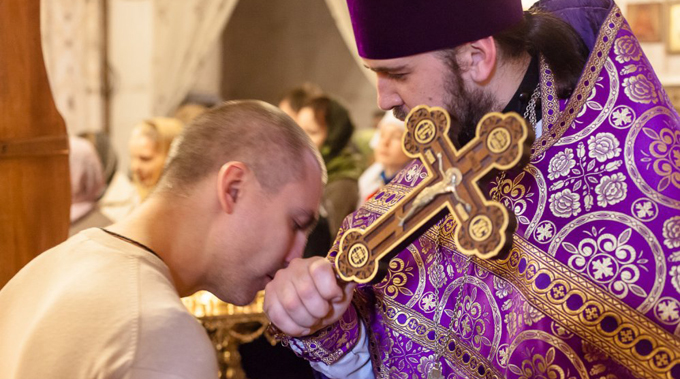
After all, the Lord Jesus Christ Himself blesses us with the hand of a priest. And not only in special cases, but also at certain moments of the divine service, when the priest performing the service calls on those who are praying for peace and blessing - and the believers bow their heads to receive them. Crucifixion blessing - during or after service - more one kind of this blessed action. It is not worth treating it formally or neglecting it, because the liturgical rite has evolved over the centuries, and not approaching the cross at the end of the Sunday liturgy means not receiving full grace from it. The same applies to the blessing with a chalice, the Gospel, an icon that occurs during the service - at such moments you need to be extremely attentive and reverent. Unfortunately, over the years that people go to church, they begin to perform some prayer actions automatically. For example, bow your head to receive a blessing. It is impossible to allow your soul to become so coarse. The whole life of a person, and general prayer in the temple in particular, takes place in the direct presence of God. “It is not man who blesses, but God with his hand and mouth,” St. John Chrysostom reminds us. Is it only the priest who has the right to bless? First of all - a clergyman, but not only him. Among believers, the words 'God bless you!' can be heard quite often. Is such a blessing valid, since this phrase is often pronounced as the equivalent of words of gratitude? Has - if behind him are faith and a sincere desire for good to his neighbor. Therefore, it is unacceptable to pronounce them ironically: invoking the name of God is not just a figure of speech. Even when it comes to the most simple and ordinary things. The father of the family reads a prayer before the common meal, the wife baptizes her husband on the road - we never know in advance how important this may be.
A parental blessing has a special role in the culture of many Christian nations. There are pious folk customs, such as when the kneeling groom and bride are overshadowed by the father of one of the young with an icon, and the mother with a loaf of bread. Parents are people through whom the Lord brought us into the world, people who took care of us while we were growing up - and prayed for us, if, of course, they themselves were taught this. No matter what kind of relationship develops between us, our connection with our parents will never be interrupted, even beyond the line of this life. Parental blessing builds up children at home - even unbelievers are often convinced of the correctness of these words. And believers cannot neglect the blessing of their father and mother. However, in order to sincerely ask for the parental blessing and teach it in all its graceful fullness, you need to live with your parents in peace, fulfilling the commandment of God ... So this is not such a simple thing - a blessing ... But can a person bless himself? At the beginning of a working day or before a trip? Let's remind: God blesses, and man only asks Him for this. In morning and evening prayers, in prayers on the road and before starting a new business, the request for blessing is repeated many times. Therefore, they should be created with faith and hope for God's help - after all, there are no “duty” prayers, and every word addressed to the Lord is important - first of all for the person himself.
And at the end of our reflection - about one more form of blessing, rather rare, and, nevertheless, existing for centuries of Christian history. It's about a blessing to take part in hostilities. Simply put - in a blessing for war. It is this type of blessing that often confuses both non-church and long-time church people. How is it, they think, because in Christianity there is no practice of blessing evil deeds - at the same time, in a war, one person, whether he wants it or not, has to kill others, at least in order to survive ... Blessing to fight in the Christian sense does not mean permission to kill other people. In this case, we are talking about how to survive on your own and adequately fulfill the military duty imposed on a person by the Motherland. Mercenarism as participation in hostilities for money in the Christian tradition is not blessed: from the epistle of St. Paul To the Corinthians, we remember that neither the tati, nor the predators of the Kingdom of God will inherit (1 Cor. 6: 9). Seeking blessings before going to war, a Christian - soldier, officer or military leader - asks first of all to survive among her vicissitudes on his own - and not do anything beyond what his military duty will require of him. V. Sergienko
What is Christian BlessingWhat is Christian Blessing For people who are behind the church fence or are simply far from parish life, a blessing is sometimes something abstract, incomprehensible. For parishioners of Orthodox churches, this word most often means extremely specific things: the permission of the priest to take some action or even a direct order to carry it out; sometimes a request to bless remains nothing more than an accepted form of greeting a clergyman. The word, which can be easily divided into understandable parts 'good' and 'word', is at the same time very ambiguous: rarely does anyone succeed in short and succinctly, as in a dictionary entry, to convey the fullness of its meanings and meanings. 'Father, bless' - and the priest, realizing that they greeted him, turns around, says 'God bless!' and baptizes a person or the palms of his hands folded crosswise. What happens at this moment? Maybe one thing, maybe another. A person who had nothing on his mind but to pay tribute to one of the forms of parish etiquette can immediately start a conversation on any abstract topic. And a person who remembered at this moment about the role played by the priesthood in the Church may receive God's blessing for the whole day ahead. Not because a minister of the Church is holy, but because he acts in accordance with the authority given to him at ordination. And he resolves sins after confession with the same authority, although this is already another, separate conversation. Thus, blessing, in a broad sense, is the invocation of God's grace on a person. And of course, turning it into a simple greeting means diminishing its power, which in no case should be done. People will forgive blessings from priests and bishops for the most important things in their lives: for building a house, for a pilgrimage to the Holy Land, for a new job, for an operation, and much more. They ask him for easier things: send the child to a kindergarten, make repairs in the apartment, eat dairy products during fasting due to health conditions, or just visit with a family of old friends who live on the other side of the city, who have not been seen for a long time. Is it right to ask for a blessing for such 'little things'? That's right - with the appropriate internal mood. A believer, asking for blessings, gives the solution of the issue of interest to God. Remember how in the Prayer for the Cup? “Not My will, but Yours be done.” ( Luke 22:42 ) The same is true here. If a person did not get what he wanted, if the planned went, as they say, on a bias - and he fell into irritation, despondency, said to himself: 'eh, but for some reason he took a blessing for this!' - then they have not learned a life lesson, and the blessing is wasted. It did not go anywhere - it just left the person and did not bring him the benefit that he could get. It cannot be otherwise, because blessing is not a guarantee of a result, but a willingness to trust the Lord, no matter what awaits on the way. However, there is also another extreme. A person needs to make a decision, make a choice - but he does not want to make it. “I’ll tell the priest everything,” he thinks, “as he blesses, so I will.” In no case should you do this. A priest can give advice, but not live his life for a person, in all its many situations. The Lord brought us into the world so that we could find discretion here, learn to apply the knowledge gained. We study, engage in some kind of activity, pray and take communion in church, read the Holy Gospel, spiritual books - and in parallel with all this we analyze and weigh our life, we correlate it with patristic experience. So, year after year, our soul grows. And we must believe that the time of our life is not in vain, that we have already managed to learn something, that we are able to weigh everything, make a decision and bear responsibility for their next steps. Simply put, we must be able to set goals and try to achieve them, and only there - as God willing. And when the decision is made, it's time to ask the priest for God's blessing. He can bless, or, on the contrary, categorically prohibit the implementation of his plans. And then you need to accept what he said as God's will and act without a doubt - or, on the contrary, abandon your plans without regret. And one more important point. Sometimes people, striving to get what they want with a clear conscience, ask for blessings without revealing to the priest all sides of the issue, or even directly hiding important circumstances. Know Father that the children will be alone at home all evening while their mother is taking missionary courses - he would never have blessed her to go there. This approach to blessing is, of course, deceit. It is possible to hide something from a priest, but not from the omnipresent God. After all, the Lord Jesus Christ Himself blesses us with the hand of a priest. And not only in special cases, but also at certain moments of the divine service, when the priest performing the service calls on those who are praying for peace and blessing - and the believers bow their heads to receive them. Crucifixion blessing - during or after service - more one kind of this blessed action. It is not worth treating it formally or neglecting it, because the liturgical rite has evolved over the centuries, and not approaching the cross at the end of the Sunday liturgy means not receiving full grace from it. The same applies to the blessing with a chalice, the Gospel, an icon that occurs during the service - at such moments you need to be extremely attentive and reverent. Unfortunately, over the years that people go to church, they begin to perform some prayer actions automatically. For example, bow your head to receive a blessing. It is impossible to allow your soul to become so coarse. The whole life of a person, and general prayer in the temple in particular, takes place in the direct presence of God. “It is not man who blesses, but God with his hand and mouth,” St. John Chrysostom reminds us. Is it only the priest who has the right to bless? First of all - a clergyman, but not only him. Among believers, the words 'God bless you!' can be heard quite often. Is such a blessing valid, since this phrase is often pronounced as the equivalent of words of gratitude? Has - if behind him are faith and a sincere desire for good to his neighbor. Therefore, it is unacceptable to pronounce them ironically: invoking the name of God is not just a figure of speech. Even when it comes to the most simple and ordinary things. The father of the family reads a prayer before the common meal, the wife baptizes her husband on the road - we never know in advance how important this may be. A parental blessing has a special role in the culture of many Christian nations. There are pious folk customs, such as when the kneeling groom and bride are overshadowed by the father of one of the young with an icon, and the mother with a loaf of bread. Parents are people through whom the Lord brought us into the world, people who took care of us while we were growing up - and prayed for us, if, of course, they themselves were taught this. No matter what kind of relationship develops between us, our connection with our parents will never be interrupted, even beyond the line of this life. Parental blessing builds up children at home - even unbelievers are often convinced of the correctness of these words. And believers cannot neglect the blessing of their father and mother. However, in order to sincerely ask for the parental blessing and teach it in all its graceful fullness, you need to live with your parents in peace, fulfilling the commandment of God ... So this is not such a simple thing - a blessing ... But can a person bless himself? At the beginning of a working day or before a trip? Let's remind: God blesses, and man only asks Him for this. In morning and evening prayers, in prayers on the road and before starting a new business, the request for blessing is repeated many times. Therefore, they should be created with faith and hope for God's help - after all, there are no “duty” prayers, and every word addressed to the Lord is important - first of all for the person himself. And at the end of our reflection - about one more form of blessing, rather rare, and, nevertheless, existing for centuries of Christian history. It's about a blessing to take part in hostilities. Simply put - in a blessing for war. It is this type of blessing that often confuses both non-church and long-time church people. How is it, they think, because in Christianity there is no practice of blessing evil deeds - at the same time, in a war, one person, whether he wants it or not, has to kill others, at least in order to survive ... Blessing to fight in the Christian sense does not mean permission to kill other people. In this case, we are talking about how to survive on your own and adequately fulfill the military duty imposed on a person by the Motherland. Mercenarism as participation in hostilities for money in the Christian tradition is not blessed: from the epistle of St. Paul To the Corinthians, we remember that neither the tati, nor the predators of the Kingdom of God will inherit (1 Cor. 6: 9). Seeking blessings before going to war, a Christian - soldier, officer or military leader - asks first of all to survive among her vicissitudes on his own - and not do anything beyond what his military duty will require of him. V. SergienkoСвеча Иерусалима -en
For people who are behind the church fence or are simply far from parish life, a blessing is sometimes something abstract, incomprehensible. For parishioners of Orthodox churches, this word most often means extremely specific things: the permission of the priest to take some action or even a direct order to carry it out; sometimes a request to bless remains nothing more than an accepted form of greeting a clergyman. The word, which can be easily divided into understandable parts 'good' and 'word', is at the same time very ambiguous: rarely does anyone succeed in short and succinctly, as in a dictionary entry, to convey the fullness of its meanings and meanings. 'Father, bless' - and the priest, realizing that they greeted him, turns around, says 'God bless!' and baptizes a person or the palms of his hands folded crosswise. What happens at this moment? Maybe one thing, maybe another. A person who had nothing on his mind but to pay tribute to one of the forms of parish etiquette can immediately start a conversation on any abstract topic. And a person who remembered at this moment about the role played by the priesthood in the Church may receive God's blessing for the whole day ahead. Not because a minister of the Church is holy, but because he acts in accordance with the authority given to him at ordination. And he resolves sins after confession with the same authority, although this is already another, separate conversation. Thus, blessing, in a broad sense, is the invocation of God's grace on a person. And of course, turning it into a simple greeting means diminishing its power, which in no case should be done. People will forgive blessings from priests and bishops for the most important things in their lives: for building a house, for a pilgrimage to the Holy Land, for a new job, for an operation, and much more. They ask him for easier things: send the child to a kindergarten, make repairs in the apartment, eat dairy products during fasting due to health conditions, or just visit with a family of old friends who live on the other side of the city, who have not been seen for a long time. Is it right to ask for a blessing for such 'little things'? That's right - with the appropriate internal mood. A believer, asking for blessings, gives the solution of the issue of interest to God. Remember how in the Prayer for the Cup? “Not My will, but Yours be done.” ( Luke 22:42 ) The same is true here. If a person did not get what he wanted, if the planned went, as they say, on a bias - and he fell into irritation, despondency, said to himself: 'eh, but for some reason he took a blessing for this!' - then they have not learned a life lesson, and the blessing is wasted. It did not go anywhere - it just left the person and did not bring him the benefit that he could get. It cannot be otherwise, because blessing is not a guarantee of a result, but a willingness to trust the Lord, no matter what awaits on the way. However, there is also another extreme. A person needs to make a decision, make a choice - but he does not want to make it. “I’ll tell the priest everything,” he thinks, “as he blesses, so I will.” In no case should you do this. A priest can give advice, but not live his life for a person, in all its many situations. The Lord brought us into the world so that we could find discretion here, learn to apply the knowledge gained. We study, engage in some kind of activity, pray and take communion in church, read the Holy Gospel, spiritual books - and in parallel with all this we analyze and weigh our life, we correlate it with patristic experience. So, year after year, our soul grows. And we must believe that the time of our life is not in vain, that we have already managed to learn something, that we are able to weigh everything, make a decision and bear responsibility for their next steps. Simply put, we must be able to set goals and try to achieve them, and only there - as God willing. And when the decision is made, it's time to ask the priest for God's blessing. He can bless, or, on the contrary, categorically prohibit the implementation of his plans. And then you need to accept what he said as God's will and act without a doubt - or, on the contrary, abandon your plans without regret. And one more important point. Sometimes people, striving to get what they want with a clear conscience, ask for blessings without revealing to the priest all sides of the issue, or even directly hiding important circumstances. Know Father that the children will be alone at home all evening while their mother is taking missionary courses - he would never have blessed her to go there. This approach to blessing is, of course, deceit. It is possible to hide something from a priest, but not from the omnipresent God. After all, the Lord Jesus Christ Himself blesses us with the hand of a priest. And not only in special cases, but also at certain moments of the divine service, when the priest performing the service calls on those who are praying for peace and blessing - and the believers bow their heads to receive them. Crucifixion blessing - during or after service - more one kind of this blessed action. It is not worth treating it formally or neglecting it, because the liturgical rite has evolved over the centuries, and not approaching the cross at the end of the Sunday liturgy means not receiving full grace from it. The same applies to the blessing with a chalice, the Gospel, an icon that occurs during the service - at such moments you need to be extremely attentive and reverent. Unfortunately, over the years that people go to church, they begin to perform some prayer actions automatically. For example, bow your head to receive a blessing. It is impossible to allow your soul to become so coarse. The whole life of a person, and general prayer in the temple in particular, takes place in the direct presence of God. “It is not man who blesses, but God with his hand and mouth,” St. John Chrysostom reminds us. Is it only the priest who has the right to bless? First of all - a clergyman, but not only him. Among believers, the words 'God bless you!' can be heard quite often. Is such a blessing valid, since this phrase is often pronounced as the equivalent of words of gratitude? Has - if behind him are faith and a sincere desire for good to his neighbor. Therefore, it is unacceptable to pronounce them ironically: invoking the name of God is not just a figure of speech. Even when it comes to the most simple and ordinary things. The father of the family reads a prayer before the common meal, the wife baptizes her husband on the road - we never know in advance how important this may be. A parental blessing has a special role in the culture of many Christian nations. There are pious folk customs, such as when the kneeling groom and bride are overshadowed by the father of one of the young with an icon, and the mother with a loaf of bread. Parents are people through whom the Lord brought us into the world, people who took care of us while we were growing up - and prayed for us, if, of course, they themselves were taught this. No matter what kind of relationship develops between us, our connection with our parents will never be interrupted, even beyond the line of this life. Parental blessing builds up children at home - even unbelievers are often convinced of the correctness of these words. And believers cannot neglect the blessing of their father and mother. However, in order to sincerely ask for the parental blessing and teach it in all its graceful fullness, you need to live with your parents in peace, fulfilling the commandment of God ... So this is not such a simple thing - a blessing ... But can a person bless himself? At the beginning of a working day or before a trip? Let's remind: God blesses, and man only asks Him for this. In morning and evening prayers, in prayers on the road and before starting a new business, the request for blessing is repeated many times. Therefore, they should be created with faith and hope for God's help - after all, there are no “duty” prayers, and every word addressed to the Lord is important - first of all for the person himself. And at the end of our reflection - about one more form of blessing, rather rare, and, nevertheless, existing for centuries of Christian history. It's about a blessing to take part in hostilities. Simply put - in a blessing for war. It is this type of blessing that often confuses both non-church and long-time church people. How is it, they think, because in Christianity there is no practice of blessing evil deeds - at the same time, in a war, one person, whether he wants it or not, has to kill others, at least in order to survive ... Blessing to fight in the Christian sense does not mean permission to kill other people. In this case, we are talking about how to survive on your own and adequately fulfill the military duty imposed on a person by the Motherland. Mercenarism as participation in hostilities for money in the Christian tradition is not blessed: from the epistle of St. Paul To the Corinthians, we remember that neither the tati, nor the predators of the Kingdom of God will inherit (1 Cor. 6: 9). Seeking blessings before going to war, a Christian - soldier, officer or military leader - asks first of all to survive among her vicissitudes on his own - and not do anything beyond what his military duty will require of him. V. Sergienko