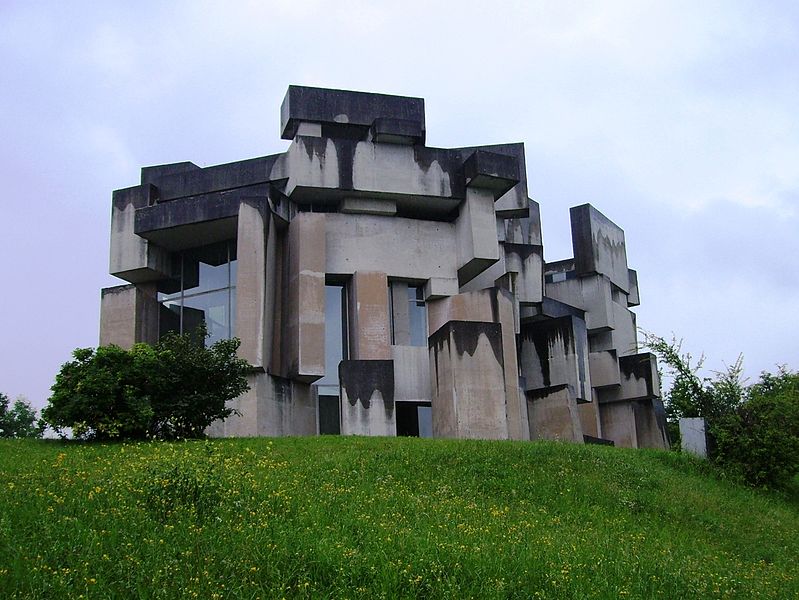
Modernism? Brutalism? Monumental abstraction? Experts find it difficult to define exactly the style in which the Church of the Holy Trinity in Vienna was built. Despite its unusual and perhaps even slightly shocking appearance, inside it is a rather traditional temple, which is under the jurisdiction of the Roman Catholic Church. The capital of Austria, a city with an imperial past, is filled with magnificent temples - masterpieces of church architecture from different styles and eras. However, there is a church in Vienna that looks completely unusual even against the background of local diversity. It is as if the Church of the Holy Trinity (Kirche Zur Heiligsten Dreifaltigkeit) is deliberately located away from the glittering historical center of the city. It was built on Mount Sankt Georgenberg by the famous Austrian artist and architect of the last century Fritz Wotruba (1907-1975). The Church of the Holy Trinity is the most famous creation of the master, who, unfortunately, did not live to see the completion of the construction: another architect, Fritz Mayr, was brought in to complete the work. From a distance, the church looks like a cube, however, approaching it, you notice that in fact, it was built from a large number asymmetrically arranged concrete blocks of different sizes. There are a total of 152 of these blocks, the weight of each of them is from 2 to 141 tons, the volume is from 0, 84 to 64 square meters. Together they, like a fancy constructor for a giant, fold into an impressive structure with dimensions (length / width / height) 30x22x15.4 meters. The church of Votruba resembles a bizarre megalith erected by an unknown ancient master - Votruba's hobbies for cubism and archaism were fully embodied in this building. Outside, it looks more like an art object, but inside the church looks quite traditional - it is unusual for a Catholic church to look here only windows of different heights through which light penetrates. What did the author want to express by such a discrepancy between the external and the internal? What message did he want to convey? Franz Wotruba, who conceived the idea of starting a church back in 1964, said that he wants to “create something that shows that poverty is not ugliness; that poverty in the world around, despite its simplicity, is beautiful and also makes you happy. ' Whether he succeeded or not, everyone who has been here will decide for himself (it is known that the construction of the building was accompanied by some discontent of local residents). At a minimum, the interior of the building looks very light, cozy and harmonious - even without the texture of raw concrete. Votruba Church is located on the border with the world famous Vienna Woods. Nearby there are vast vineyards that are pleasing to the eye. The place is very picturesque and deserves the brush of an artist. To get here from the center of Vienna, you need to get to the Speising station (S80), then continue from there by tram 60 to Maurer Lange Gasse - and then walk a little. There is another road: to the Leasing station (S1, S2, S3, S4) - it takes about half an hour to walk from it to the church; however, part of this path, three or four stops, can be done by bus 254. You can admire the Votruba church on any day of the week, but you can get inside only on weekends: on Saturday the church is open from 14 to 20 hours, and on Sunday - from 9 am to 4:30 pm. V. Sergienko
Church of the Holy Trinity, built by WotrubaChurch of the Holy Trinity, built by WotrubaModernism? Brutalism? Monumental abstraction? Experts find it difficult to define exactly the style in which the Church of the Holy Trinity in Vienna was built. Despite its unusual and perhaps even slightly shocking appearance, inside it is a rather traditional temple, which is under the jurisdiction of the Roman Catholic Church. The capital of Austria, a city with an imperial past, is filled with magnificent temples - masterpieces of church architecture from different styles and eras. However, there is a church in Vienna that looks completely unusual even against the background of local diversity. It is as if the Church of the Holy Trinity (Kirche Zur Heiligsten Dreifaltigkeit) is deliberately located away from the glittering historical center of the city. It was built on Mount Sankt Georgenberg by the famous Austrian artist and architect of the last century Fritz Wotruba (1907-1975). The Church of the Holy Trinity is the most famous creation of the master, who, unfortunately, did not live to see the completion of the construction: another architect, Fritz Mayr, was brought in to complete the work. From a distance, the church looks like a cube, however, approaching it, you notice that in fact, it was built from a large number asymmetrically arranged concrete blocks of different sizes. There are a total of 152 of these blocks, the weight of each of them is from 2 to 141 tons, the volume is from 0, 84 to 64 square meters. Together they, like a fancy constructor for a giant, fold into an impressive structure with dimensions (length / width / height) 30x22x15.4 meters. The church of Votruba resembles a bizarre megalith erected by an unknown ancient master - Votruba's hobbies for cubism and archaism were fully embodied in this building. Outside, it looks more like an art object, but inside the church looks quite traditional - it is unusual for a Catholic church to look here only windows of different heights through which light penetrates. What did the author want to express by such a discrepancy between the external and the internal? What message did he want to convey? Franz Wotruba, who conceived the idea of starting a church back in 1964, said that he wants to “create something that shows that poverty is not ugliness; that poverty in the world around, despite its simplicity, is beautiful and also makes you happy. ' Whether he succeeded or not, everyone who has been here will decide for himself (it is known that the construction of the building was accompanied by some discontent of local residents). At a minimum, the interior of the building looks very light, cozy and harmonious - even without the texture of raw concrete. Votruba Church is located on the border with the world famous Vienna Woods. Nearby there are vast vineyards that are pleasing to the eye. The place is very picturesque and deserves the brush of an artist. To get here from the center of Vienna, you need to get to the Speising station (S80), then continue from there by tram 60 to Maurer Lange Gasse - and then walk a little. There is another road: to the Leasing station (S1, S2, S3, S4) - it takes about half an hour to walk from it to the church; however, part of this path, three or four stops, can be done by bus 254. You can admire the Votruba church on any day of the week, but you can get inside only on weekends: on Saturday the church is open from 14 to 20 hours, and on Sunday - from 9 am to 4:30 pm. V. SergienkoСвеча Иерусалима -en
Modernism? Brutalism? Monumental abstraction? Experts find it difficult to define exactly the style in which the Church of the Holy Trinity in Vienna was built. Despite its unusual and perhaps even slightly shocking appearance, inside it is a rather traditional temple, which is under the jurisdiction of the Roman Catholic Church. The capital of Austria, a city with an imperial past, is filled with magnificent temples - masterpieces of church architecture from different styles and eras. However, there is a church in Vienna that looks completely unusual even against the background of local diversity. It is as if the Church of the Holy Trinity (Kirche Zur Heiligsten Dreifaltigkeit) is deliberately located away from the glittering historical center of the city. It was built on Mount Sankt Georgenberg by the famous Austrian artist and architect of the last century Fritz Wotruba (1907-1975). The Church of the Holy Trinity is the most famous creation of the master, who, unfortunately, did not live to see the completion of the construction: another architect, Fritz Mayr, was brought in to complete the work. From a distance, the church looks like a cube, however, approaching it, you notice that in fact, it was built from a large number asymmetrically arranged concrete blocks of different sizes. There are a total of 152 of these blocks, the weight of each of them is from 2 to 141 tons, the volume is from 0, 84 to 64 square meters. Together they, like a fancy constructor for a giant, fold into an impressive structure with dimensions (length / width / height) 30x22x15.4 meters. The church of Votruba resembles a bizarre megalith erected by an unknown ancient master - Votruba's hobbies for cubism and archaism were fully embodied in this building. Outside, it looks more like an art object, but inside the church looks quite traditional - it is unusual for a Catholic church to look here only windows of different heights through which light penetrates. What did the author want to express by such a discrepancy between the external and the internal? What message did he want to convey? Franz Wotruba, who conceived the idea of starting a church back in 1964, said that he wants to “create something that shows that poverty is not ugliness; that poverty in the world around, despite its simplicity, is beautiful and also makes you happy. ' Whether he succeeded or not, everyone who has been here will decide for himself (it is known that the construction of the building was accompanied by some discontent of local residents). At a minimum, the interior of the building looks very light, cozy and harmonious - even without the texture of raw concrete. Votruba Church is located on the border with the world famous Vienna Woods. Nearby there are vast vineyards that are pleasing to the eye. The place is very picturesque and deserves the brush of an artist. To get here from the center of Vienna, you need to get to the Speising station (S80), then continue from there by tram 60 to Maurer Lange Gasse - and then walk a little. There is another road: to the Leasing station (S1, S2, S3, S4) - it takes about half an hour to walk from it to the church; however, part of this path, three or four stops, can be done by bus 254. You can admire the Votruba church on any day of the week, but you can get inside only on weekends: on Saturday the church is open from 14 to 20 hours, and on Sunday - from 9 am to 4:30 pm. V. Sergienko