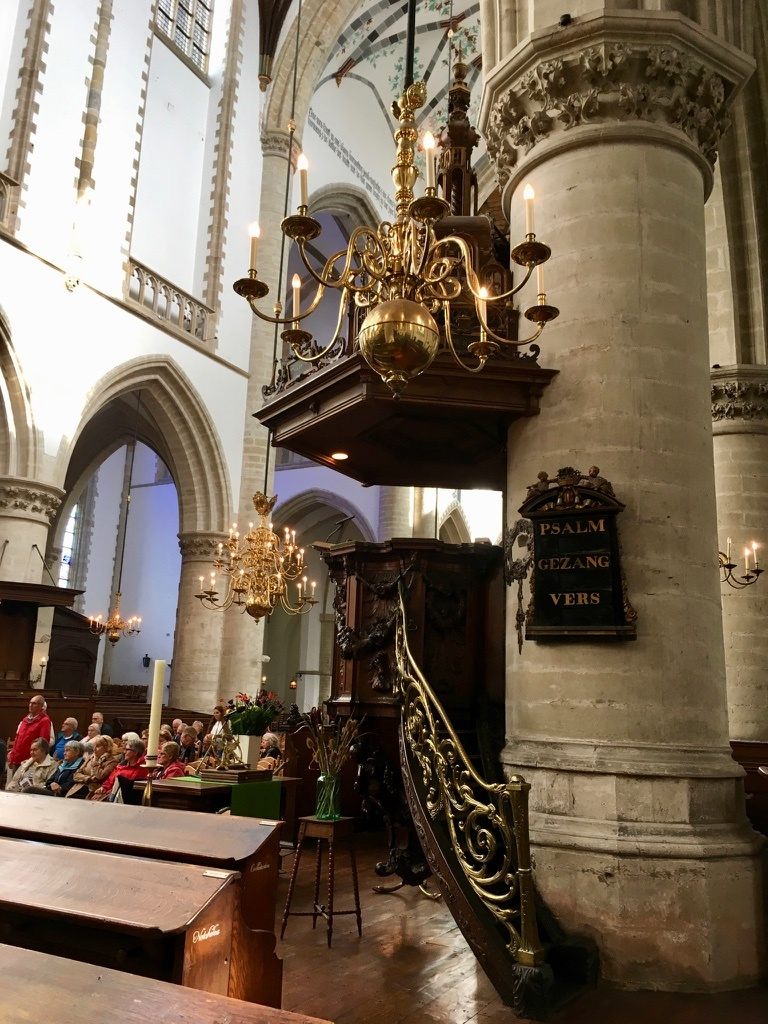
In the past - a Catholic cathedral, and now - the Protestant church Grote Kerk, otherwise called St. Bavoker, is located on the main market square of the Dutch city of Haarlem at Grote Markt, 22. Catholic basilica, named after St. Bavo (Kathedrale Basiliek Sint Bavo) in this city also exists, which is why tourists who are far from confessional subtleties often confuse one with the other. But today we will talk about the one that is now Protestant - although both of these churches undoubtedly deserve a story because of their beauty and rich history. The first documentary mention of the Grotto Kerk (literally - 'large church') refers to 1307 - however, then it was wooden and compared to the current size, it was very modest. In the fourteenth and fifteenth centuries, the church underwent several reconstructions, became completely stone - and, finally, in 1559, it received the status of a Catholic cathedral. But it did not stay in it for long: the Reformation was marching across Europe, and less than twenty years later Grote Kerk became Protestant, which it remains to this day. The townspeople took care of the authentic medieval appearance of the church - despite the fact that the appearance of the Grote Kerk has undergone major changes at least twice. At first, the numerous statues that were in them were removed from the outer niches of the building - they say, they did not need a Protestant church. Then, at the end of the century before last, they decided to give the structure an even more Gothic look (although, it would seem, much more?), Placing false ridges along the edge of its roof.
As any guidebook will tell you, the most striking feature of the Grote Kerk is its unique stained glass windows. In the turbulent history of the Netherlands during the late Middle Ages, new and modern times, they have had a lot of trials. However, Haarlem was the traditional center of glass-blowing production, and after all new social upheavals, the lost part of the stained-glass windows was patiently restored each time. Or they simply inserted others into the windows instead of the old stained-glass windows, transporting them from churches with a more modest status. As a result, experts today unconditionally recognize only one stained glass window, dating back to 1679, as authentically historical, made specifically for the Grote Kerk. However, this fact does not spoil the whole picture that opens before the visitor of the church. No less than expressive stained-glass windows, the attraction of this church in Haarlem is its organ. It is famous mainly for the fact that in different years Handel, Mendelssohn and other great composers played on it - including ten-year-old Mozart, whose performance on the wall of this church was heard in 1766. However, the local organ itself is far from ordinary. It was created in 1730 by the Amsterdam craftsman Christian Müller, and the instrument was finished by the famous Jan van Logteren. However, we will finish this short story about the Harlem Kerk Grotto, after all, not on a sound wave, but on a color wave - because the creation of unusual stained-glass windows for this church continues today. It is a great honor for modern masters to place your work in one of its windows, next to the works of recognized masters. And in the Grotto of Kerk, their works are presented, which are quite worthy to coexist with the masterpieces created by their predecessors. For example, in 2008, a blue stained glass window appeared on the north side of the church, perfectly visible from the street: the figures depicted on it symbolize Peace and Harmony (this is what this work is called). For it, the master Michel van Overbeeke who created the stained glass window was awarded a special prize ten years ago. By the way, this master, possessing a bright, recognizable technique, has performed many wonderful works (from stained glass windows to chandeliers) for other churches in Holland. V. Sergienko
Grote Kerk Church in Haarlem (Netherlands)Grote Kerk Church in Haarlem (Netherlands)In the past - a Catholic cathedral, and now - the Protestant church Grote Kerk, otherwise called St. Bavoker, is located on the main market square of the Dutch city of Haarlem at Grote Markt, 22. Catholic basilica, named after St. Bavo (Kathedrale Basiliek Sint Bavo) in this city also exists, which is why tourists who are far from confessional subtleties often confuse one with the other. But today we will talk about the one that is now Protestant - although both of these churches undoubtedly deserve a story because of their beauty and rich history. The first documentary mention of the Grotto Kerk (literally - 'large church') refers to 1307 - however, then it was wooden and compared to the current size, it was very modest. In the fourteenth and fifteenth centuries, the church underwent several reconstructions, became completely stone - and, finally, in 1559, it received the status of a Catholic cathedral. But it did not stay in it for long: the Reformation was marching across Europe, and less than twenty years later Grote Kerk became Protestant, which it remains to this day. The townspeople took care of the authentic medieval appearance of the church - despite the fact that the appearance of the Grote Kerk has undergone major changes at least twice. At first, the numerous statues that were in them were removed from the outer niches of the building - they say, they did not need a Protestant church. Then, at the end of the century before last, they decided to give the structure an even more Gothic look (although, it would seem, much more?), Placing false ridges along the edge of its roof. As any guidebook will tell you, the most striking feature of the Grote Kerk is its unique stained glass windows. In the turbulent history of the Netherlands during the late Middle Ages, new and modern times, they have had a lot of trials. However, Haarlem was the traditional center of glass-blowing production, and after all new social upheavals, the lost part of the stained-glass windows was patiently restored each time. Or they simply inserted others into the windows instead of the old stained-glass windows, transporting them from churches with a more modest status. As a result, experts today unconditionally recognize only one stained glass window, dating back to 1679, as authentically historical, made specifically for the Grote Kerk. However, this fact does not spoil the whole picture that opens before the visitor of the church. No less than expressive stained-glass windows, the attraction of this church in Haarlem is its organ. It is famous mainly for the fact that in different years Handel, Mendelssohn and other great composers played on it - including ten-year-old Mozart, whose performance on the wall of this church was heard in 1766. However, the local organ itself is far from ordinary. It was created in 1730 by the Amsterdam craftsman Christian Müller, and the instrument was finished by the famous Jan van Logteren. However, we will finish this short story about the Harlem Kerk Grotto, after all, not on a sound wave, but on a color wave - because the creation of unusual stained-glass windows for this church continues today. It is a great honor for modern masters to place your work in one of its windows, next to the works of recognized masters. And in the Grotto of Kerk, their works are presented, which are quite worthy to coexist with the masterpieces created by their predecessors. For example, in 2008, a blue stained glass window appeared on the north side of the church, perfectly visible from the street: the figures depicted on it symbolize Peace and Harmony (this is what this work is called). For it, the master Michel van Overbeeke who created the stained glass window was awarded a special prize ten years ago. By the way, this master, possessing a bright, recognizable technique, has performed many wonderful works (from stained glass windows to chandeliers) for other churches in Holland. V. SergienkoСвеча Иерусалима -en
In the past - a Catholic cathedral, and now - the Protestant church Grote Kerk, otherwise called St. Bavoker, is located on the main market square of the Dutch city of Haarlem at Grote Markt, 22. Catholic basilica, named after St. Bavo (Kathedrale Basiliek Sint Bavo) in this city also exists, which is why tourists who are far from confessional subtleties often confuse one with the other. But today we will talk about the one that is now Protestant - although both of these churches undoubtedly deserve a story because of their beauty and rich history. The first documentary mention of the Grotto Kerk (literally - 'large church') refers to 1307 - however, then it was wooden and compared to the current size, it was very modest. In the fourteenth and fifteenth centuries, the church underwent several reconstructions, became completely stone - and, finally, in 1559, it received the status of a Catholic cathedral. But it did not stay in it for long: the Reformation was marching across Europe, and less than twenty years later Grote Kerk became Protestant, which it remains to this day. The townspeople took care of the authentic medieval appearance of the church - despite the fact that the appearance of the Grote Kerk has undergone major changes at least twice. At first, the numerous statues that were in them were removed from the outer niches of the building - they say, they did not need a Protestant church. Then, at the end of the century before last, they decided to give the structure an even more Gothic look (although, it would seem, much more?), Placing false ridges along the edge of its roof. As any guidebook will tell you, the most striking feature of the Grote Kerk is its unique stained glass windows. In the turbulent history of the Netherlands during the late Middle Ages, new and modern times, they have had a lot of trials. However, Haarlem was the traditional center of glass-blowing production, and after all new social upheavals, the lost part of the stained-glass windows was patiently restored each time. Or they simply inserted others into the windows instead of the old stained-glass windows, transporting them from churches with a more modest status. As a result, experts today unconditionally recognize only one stained glass window, dating back to 1679, as authentically historical, made specifically for the Grote Kerk. However, this fact does not spoil the whole picture that opens before the visitor of the church. No less than expressive stained-glass windows, the attraction of this church in Haarlem is its organ. It is famous mainly for the fact that in different years Handel, Mendelssohn and other great composers played on it - including ten-year-old Mozart, whose performance on the wall of this church was heard in 1766. However, the local organ itself is far from ordinary. It was created in 1730 by the Amsterdam craftsman Christian Müller, and the instrument was finished by the famous Jan van Logteren. However, we will finish this short story about the Harlem Kerk Grotto, after all, not on a sound wave, but on a color wave - because the creation of unusual stained-glass windows for this church continues today. It is a great honor for modern masters to place your work in one of its windows, next to the works of recognized masters. And in the Grotto of Kerk, their works are presented, which are quite worthy to coexist with the masterpieces created by their predecessors. For example, in 2008, a blue stained glass window appeared on the north side of the church, perfectly visible from the street: the figures depicted on it symbolize Peace and Harmony (this is what this work is called). For it, the master Michel van Overbeeke who created the stained glass window was awarded a special prize ten years ago. By the way, this master, possessing a bright, recognizable technique, has performed many wonderful works (from stained glass windows to chandeliers) for other churches in Holland. V. Sergienko