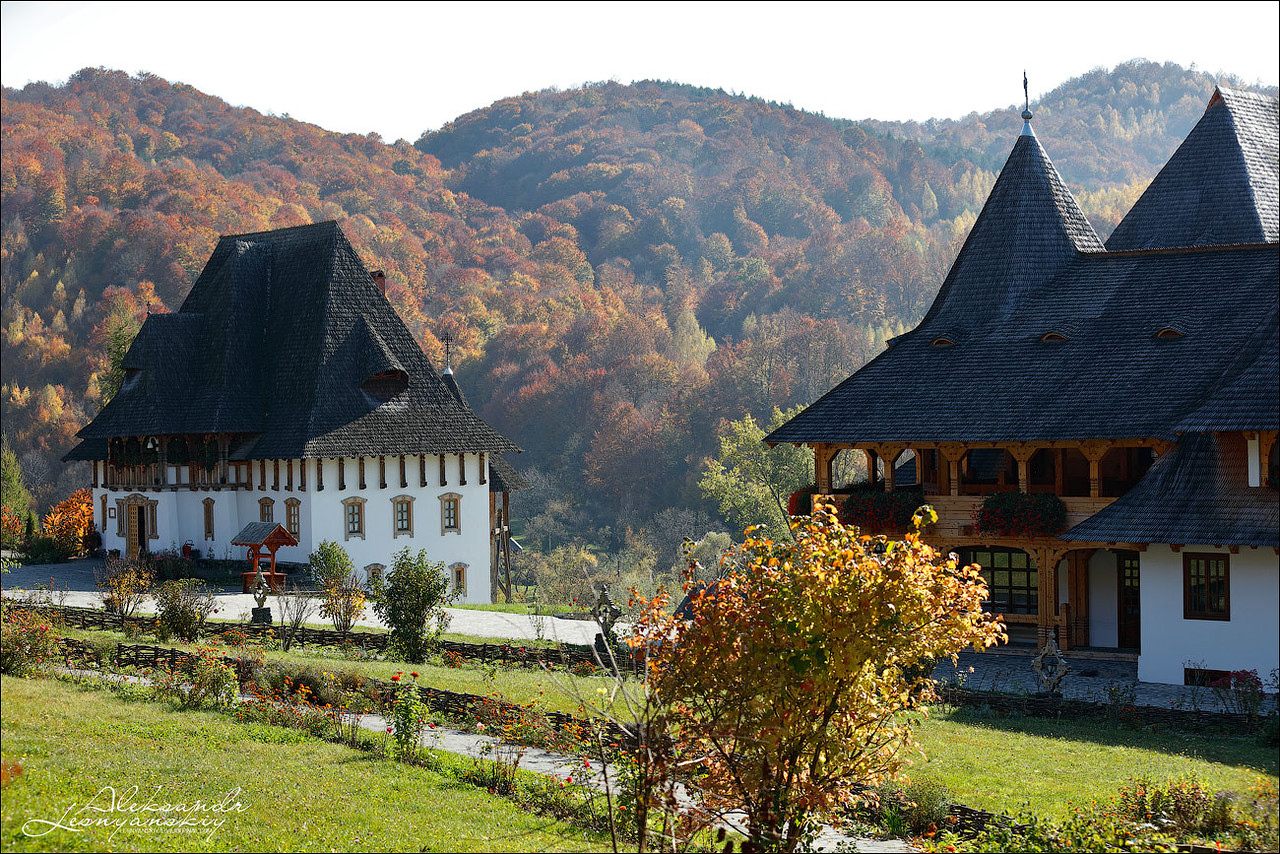
The word 'Transylvania' in a foreigner can evoke a variety of associations - but in the last place they will be associated with a monastic residence. And completely in vain! Because it is in northern Transylvania, in the valley of the Isla River, that an amazing monastery is located. Its origin, according to documents, dates back to the XIV century, but most of the buildings now located here are modern ... But what! The Barsana Orthodox monastery in Romania is a whole complex of amazing buildings, built mainly of wood. It got its name from the name of the village at the highest point of which it is located. 'Birsan' in Romanian means 'shepherd' - but not a shepherd in general, but a professional of a rather narrow specialization: one who raises sheep for the subsequent shearing of wool. The surname Barsan was very common in medieval Romania; it is not uncommon even now. The history of Brsana, founded no later than the first quarter of the fourteenth century, has several centuries, during which the buildings of the monastery, which even then amazed pilgrims with their unusual appearance, were repeatedly reconstructed and moved from place to place. In our time, this is a women's monastery - sixteen sisters live and work in the holy monastery. The current they began to write a page in the history of the holy monastery after the fall of the godless regime in Romania at the very end of the eighties of the last century. Already in the nineties, the monastery, abandoned in 1970, began to be rebuilt anew - and in 1993 the first temple was consecrated here. In just a few years, it is possible not only to revive the monastery - Brsana again becomes one of the most famous cultural and spiritual centers in the country. Interestingly, the old monastery church in Barsan, 57 meters high, until recently was considered to be the tallest wooden building in Europe. The first documentary mention of the monastery dates back to 1390, and the next one - the deed of ownership, in which the phrase 'monastery field' is present - to 1405. During the fifteenth century, the monastery of Brsana is already mentioned in royal papers many times. As the legend says, at first the monastery was built on the left bank of the Izla River - and after that it was moved to the right one, where it is now. In the 16th century, the monastery stood on lands that belonged to princes from the noble family of Dragos. Consecrated in the name of St. Nicholas the Wonderworker, he monastery was the seat of local Orthodox bishops. At the end of the eighteenth century, or to be precise - in 1790, the Habsburgs took possession of the local lands - and Byrsan monastery, respectively, too. The secularization of the property of the Orthodox Church began. At that time, according to documents, only two monks remained in the monastery. Some of the unused wooden buildings of the monastery were confiscated, dismantled and taken to the city - this happened in 1802. In 1998, the already mentioned old monastery church of Barsana, along with seven other sites located in the Maramures region, was included by UNESCO in the list of world cultural heritage sites. Although the outside of the church without windows has turned badly black, inside it there are amazing murals, to see which many pilgrims and tourists come to see. The monastery has icon-painting workshops, where many impressive examples of traditional spiritual painting are created. The temple is located on a picturesque hill surrounded by orchards. In fact, this hill is man-made: it is a mound over the burials, densely overgrown with grass. The summer church is also very colorful, decorated with paintings from floor to ceiling. It is very small and very cozy. The construction of the wooden buildings in Brsana is based on massive oak beams oriented horizontally. Each of the buildings, be it temples or cell buildings, stands on a solid stone foundation. If speak about stylistics of buildings, they carry the features of both Byzantine and traditional architecture for the Balkan countries, and at the same time - Western European Gothic. However, the very material chosen by the architects, wood, is such that what is created from it does not produce the painful impression on the contemplating that comes from the stone Gothic. The monastic ensemble of Brsana looks light, light and joyful - and at the same time some kind of unearthly. To a large extent, this effect is created due to the high two-tiered roofs of buildings: they are covered with shingles and have a double “hem” - the roof is, as it were, duplicated by an ornamental skirt. But the carved gates or the carved porch, which is found almost everywhere here, so striking foreigners with its appearance, are quite familiar to the sight of pilgrims from Russia, Ukraine or Belarus. But how did local architects reach such heights in wooden construction? It happened forcibly. The fact is that back in the thirteenth century, the Hungarian nobles who ruled in these places forbade the Orthodox to build churches of stone. And then the local residents - the descendants of those who professed Christianity since the time of the Roman Empire - learned to erect wooden churches - fortunately, there was as much of this building material around. Churches were then built by parish communities to the taste of local residents - therefore, to this day, wooden churches in different parts of the country are somewhat different. And Barsana differs from all of them put together. The monastery, buried in flowers and greenery during the warm season, offers stunning views of the village and its surroundings. Mormoshan - as the local residents are called - are very proud of the shrine and do not miss a single solemn event in the life of the monastery. So at the consecration of the third temple in Barsan, which took place in 2012, more than five thousand people gathered here. Of course, in addition to local residents, there were also many visitors from all over the country and from abroad. Mormoshans try to present the local everyday culture in all its diversity to pilgrims and tourists. In the souvenir shop located next to the entrance to the monastery, you can buy a variety of handicrafts - most often people take with them from here baptismal shirts with colorful local embroidery. It is difficult to say what Brsana looks like more - a monastery or a fairy garden. But no less than the appearance, the very atmosphere of this place is amazing - prayerful and very peaceful. For hours, the ringing silence of living nature reigns here, only occasionally broken by the clatter of an ax - an instrument that local residents masterfully master. It was their skill that allowed for a relatively short period of time to recreate all the beauty that was previously created over the centuries.
Share: