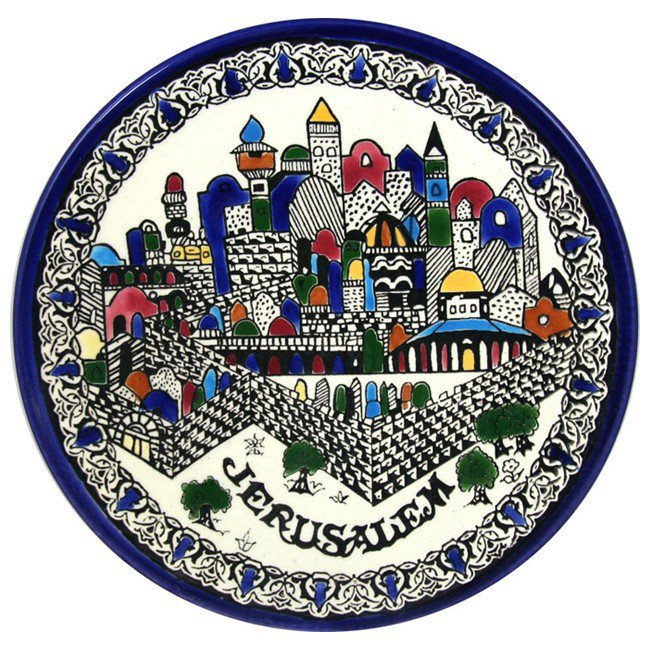
Although it is more often said about the Armenian ceramics of Jerusalem, this is not entirely true. Craftsmen who create impressive pieces of art in this area of art and artisans who make colorful tableware and souvenirs do not live only in the Armenian Quarter of the Old City. And two exhibitions held in 1986 and 2000 in Tel Aviv helped to open Armenian ceramics to the whole world. The Armenian quarter of the Holy City is the only one of the four, fenced off with a wall, and its massive doors are firmly locked at night. Of course, not because inhospitable people live behind them: until the beginning of the last century, a man's monastery was located here, which was fenced off by a wall. And the laity appeared here only in 1915 - mainly families who fled from the Ottoman massacre in Turkey. Together with them, a tradition came to Jerusalem, which was polished by the hands of Armenian craftsmen for centuries: it is well known that even in the 16th-17th centuries, the works of the best of them adorned the most beautiful mosques of the Ottoman Empire.
David Hovhannisyan
Nshan Balyan
The most famous of the masters came to the Holy City by invitation British authorities. Among them, first of all, it is necessary to name the artists David Hovhannisyan and Mkrtich Karakashyan, as well as the potter Nshan Balyan, who came to Jerusalem to carry out work on the restoration of the famous Dome of the Rock mosque: the tiles that adorned it dated back to the 16th century and required renovation for a long time. However, the secretary of the 'Pro-Jerusalem' society, the architect Charles Ashby, who invited them, had much more far-sighted plans for the Armenian craftsmen: his dream was to revive the traditional crafts of the Holy Land, in which Armenians constituted a considerable part of the population since Byzantine times. According to the British plan, Hovhannisyan was to become one of those who would help return Jerusalem to the status of the pearl of the East, multinational and multi-confessional. Of course, David Hovhannisyan's personal acquaintance with Sir Mark Sykes, a British diplomat who once ordered tiles from an Armenian master for his estate in England, played a role here. And in continental Europe, he was a fairly recognizable figure: his articles and interviews often appeared in print media in different countries. However, here it is necessary to clarify that if for the Europeans, Armenian ceramics were only handicrafts, albeit very beautiful, then in the Middle East their authors were considered Masters with a capital letter, each of which had its own recognizable handwriting. The same Hovhannisyan, according to family legends, carried out work on the restoration of tiles in the cities of Muslim shrines - Mecca and Medina; it is obvious that a simple artisan, even the best, would not be entrusted with this. And now the internee from Turkey with his family and who lived in Aleppo until the end of the war, Hovhannisyan, at the invitation of the British authorities, arrived in the Holy City and took up the restoration of the tiles of the Dome of the Rock mosque.
When work on the restoration of the ancient mosque was suspended due to lack of funding, David Hovhannisyan opened his own workshop on Via Dolorosa (and Balyan and Karakashyan - their own, on Nalbus Street). In the workshop, Hovhannisyan works as an artist, and also teaches Armenian orphans from Turkey, controlling at every stage the work they do, whether it be tiles or dishes. He works incessantly throughout his stay in Jerusalem, fulfilling orders for Christians. Muslims and Judaists. Here is how the professor of Tel Aviv University, art critic Nurit Kenan-Kedar characterizes his style in one of his articles: “In his work, Oganesyan depicts trees (mainly cypresses) and flowers, based on samples of the harem painting in Istanbul's Topkapi Palace. Its rich shades of color, surrounded by contours, are characterized by the ratio of bright blue on a white background, variants of red and black. (...) Hovhannisyan transformed the traditional pictorial language into a universal Christian form suitable for Jerusalem buildings. 'His artistic solutions are sometimes quite unexpected. Thus, the fountain in the Basilica of St. Andrew complements the mihrab with a memorial decorated in the style of a prayer niche, which is quite in the Middle East. spirit, unless, of course, take into account that it was erected in memory of the Scottish soldiers who died in the battles with the Turks for Palestine Another outstanding work of the master - mosaic panels in the gallery of the Armenian cemetery, where Hovhannisyan was inspired by traditional Armenian crosses - khachkars.
It is impossible not to mention the work of the master on the creation of new paints and glazes, which he took up when the imported raw materials ran out. “Hovhannisyan is an old-style artist, a connoisseur of the great tradition that has been carried down to our days. Not a single bowl, vase or tile will go outside the gate until it is completely finished by hand until the colors of the painting are mixed and covered with glaze in front of his eyes, ”writes the Palestine Post about Hovhannisyan's workshop in 1944. Archaeological finds made in the Holy Land leave an imprint on his style - in particular, this concerns the motifs of the 6th century Armenian mosaic with birds and vines, discovered in Jerusalem in 1894. Armenian ceramics is traditionally a family business. Unfortunately, none of the descendants of David Hovhannisyan continued his work. However, a whole galaxy of students, which he brought up while the workshop was working (until it was closed in 1948), developed the traditions of the art school he founded. The master himself left Jerusalem and died a few years later in Beirut. And Mkrtich Karakashyan and Nshan Balyan, whose paths parted with Hovhannisyan back in 1922, found their own workshop called 'Palestinian ceramics'. Here, a large number of ceramic tiles and tableware are made with paintings that have an emphatically Christian character. For the Armenian cemetery on Mount Zion, their workshop makes four monumental panels, in the center of each of which there is a cross as a symbol of the coming resurrection of the dead. Of course, these two masters are also inspired by the Armenian antiquity of Jerusalem - in particular, the mosaics of the 6th century from the chapel-crypt excavated by archaeologists and another, somewhat later, in the Umayyad palace, not far from Jericho. All their plant and animal elements - vines, birds, fruits, fallow deer, etc. - have a very specific Christian symbolism. Often, not only tiles are made in the style of these mosaics, but also dishes - for example, vases. The last large-scale work of the Karakashyan-Balyan workshop dates back to 1963 - this is the facade of the Armenian Cathedral of St. James. In the center of each of the two panels, decorated with crosses and located on the sides of the entrance, there are niches with latticed doors. Although large works like the aforementioned ones have been produced by many people who worked in the workshop, each of them has a unique style of its founders. At first, artists made drawings on paper - then they were transferred to tiles and painted by students under their supervision. Of course, the artists themselves often painted directly on the dishes, and such objects later became role models.
Hovhannisyan, Karakashyan and Balyan laid the foundation of the Jerusalem school of Armenian ceramics, to which many remarkable masters belong. Undoubtedly one of the most striking figures in it - Marie Balian, who started by painting individual tiles and went on to create large panels in a recognizable style, characterized by a large number of birds, fish and gazelles. Each of the representatives of the animal world, whether it is depicted on a large panel or a miniature dishware, Marie gave a characteristic dynamic - so that birds and animals depicted in motion sometimes seemed alive. The beginning, without exaggeration, of the worldwide fame of the Armenian ceramics of the Holy Land was laid in 1986, when the exhibition 'Armenian Ceramics of Jerusalem' was opened in Tel Aviv, in the Haaretz Museum. The curator of the exhibition, Yael Olenik, presented the works of two generations of masters, starting in 1922, their tools, paints and much more. And in 2000, the Eretz Yisrael Tel Aviv Museum organized the 'Birds of Paradise' exhibition dedicated to the work of Marie Balyan. The works of the founders of the Jerusalem School of Armenian Ceramics still inspire hundreds of craftsmen living in the Holy Land. First of all - in the Armenian quarter of the Old City, as well as in other places on the map of Israel. It is not for nothing that there is a joke here that a considerable part of the Armenian ceramics, which are exhibited in the shops and souvenir shops of Jerusalem, 'is made in Hebron, on Malaya Arnautskaya'. One way or another, all of it has a characteristic Jerusalem style - and most importantly, it is carried out exclusively by hand using traditional technology: no mass production in this case is inconceivable.
Often there is a workshop next to the shop, where everything displayed in the windows is done. In this case, you may be invited to see with your own eyes how a bright, delightful painting appears on a plate and a vase: buildings of the Holy City, trees, animals and birds ... If you pay attention, you will learn to distinguish real Armenian ceramics from numerous stampings designed for undemanding tourist, of which, unfortunately, there are many in the souvenir shops of Jerusalem. Of course, the original Armenian ceramics are not cheap compared to mass-produced products. And the last thing. If you decide to visit the Armenian quarter of the Old City and buy something from traditional ceramics, you shouldn't do it on Sunday. On this day, you definitely will not buy anything worthwhile here. All Armenian masters are Christians; both those who make dishes and those who sell them rest on Sunday. And this is, of course, correct. V.Sergienko
Armenian ceramics in the Holy LandArmenian ceramics in the Holy Land Although it is more often said about the Armenian ceramics of Jerusalem, this is not entirely true. Craftsmen who create impressive pieces of art in this area of art and artisans who make colorful tableware and souvenirs do not live only in the Armenian Quarter of the Old City. And two exhibitions held in 1986 and 2000 in Tel Aviv helped to open Armenian ceramics to the whole world. The Armenian quarter of the Holy City is the only one of the four, fenced off with a wall, and its massive doors are firmly locked at night. Of course, not because inhospitable people live behind them: until the beginning of the last century, a man's monastery was located here, which was fenced off by a wall. And the laity appeared here only in 1915 - mainly families who fled from the Ottoman massacre in Turkey. Together with them, a tradition came to Jerusalem, which was polished by the hands of Armenian craftsmen for centuries: it is well known that even in the 16th-17th centuries, the works of the best of them adorned the most beautiful mosques of the Ottoman Empire. David Hovhannisyan Nshan Balyan The most famous of the masters came to the Holy City by invitation British authorities. Among them, first of all, it is necessary to name the artists David Hovhannisyan and Mkrtich Karakashyan, as well as the potter Nshan Balyan, who came to Jerusalem to carry out work on the restoration of the famous Dome of the Rock mosque: the tiles that adorned it dated back to the 16th century and required renovation for a long time. However, the secretary of the 'Pro-Jerusalem' society, the architect Charles Ashby, who invited them, had much more far-sighted plans for the Armenian craftsmen: his dream was to revive the traditional crafts of the Holy Land, in which Armenians constituted a considerable part of the population since Byzantine times. According to the British plan, Hovhannisyan was to become one of those who would help return Jerusalem to the status of the pearl of the East, multinational and multi-confessional. Of course, David Hovhannisyan's personal acquaintance with Sir Mark Sykes, a British diplomat who once ordered tiles from an Armenian master for his estate in England, played a role here. And in continental Europe, he was a fairly recognizable figure: his articles and interviews often appeared in print media in different countries. However, here it is necessary to clarify that if for the Europeans, Armenian ceramics were only handicrafts, albeit very beautiful, then in the Middle East their authors were considered Masters with a capital letter, each of which had its own recognizable handwriting. The same Hovhannisyan, according to family legends, carried out work on the restoration of tiles in the cities of Muslim shrines - Mecca and Medina; it is obvious that a simple artisan, even the best, would not be entrusted with this. And now the internee from Turkey with his family and who lived in Aleppo until the end of the war, Hovhannisyan, at the invitation of the British authorities, arrived in the Holy City and took up the restoration of the tiles of the Dome of the Rock mosque. Свеча Иерусалима -en
Although it is more often said about the Armenian ceramics of Jerusalem, this is not entirely true. Craftsmen who create impressive pieces of art in this area of art and artisans who make colorful tableware and souvenirs do not live only in the Armenian Quarter of the Old City. And two exhibitions held in 1986 and 2000 in Tel Aviv helped to open Armenian ceramics to the whole world. The Armenian quarter of the Holy City is the only one of the four, fenced off with a wall, and its massive doors are firmly locked at night. Of course, not because inhospitable people live behind them: until the beginning of the last century, a man's monastery was located here, which was fenced off by a wall. And the laity appeared here only in 1915 - mainly families who fled from the Ottoman massacre in Turkey. Together with them, a tradition came to Jerusalem, which was polished by the hands of Armenian craftsmen for centuries: it is well known that even in the 16th-17th centuries, the works of the best of them adorned the most beautiful mosques of the Ottoman Empire. David Hovhannisyan Nshan Balyan The most famous of the masters came to the Holy City by invitation British authorities. Among them, first of all, it is necessary to name the artists David Hovhannisyan and Mkrtich Karakashyan, as well as the potter Nshan Balyan, who came to Jerusalem to carry out work on the restoration of the famous Dome of the Rock mosque: the tiles that adorned it dated back to the 16th century and required renovation for a long time. However, the secretary of the 'Pro-Jerusalem' society, the architect Charles Ashby, who invited them, had much more far-sighted plans for the Armenian craftsmen: his dream was to revive the traditional crafts of the Holy Land, in which Armenians constituted a considerable part of the population since Byzantine times. According to the British plan, Hovhannisyan was to become one of those who would help return Jerusalem to the status of the pearl of the East, multinational and multi-confessional. Of course, David Hovhannisyan's personal acquaintance with Sir Mark Sykes, a British diplomat who once ordered tiles from an Armenian master for his estate in England, played a role here. And in continental Europe, he was a fairly recognizable figure: his articles and interviews often appeared in print media in different countries. However, here it is necessary to clarify that if for the Europeans, Armenian ceramics were only handicrafts, albeit very beautiful, then in the Middle East their authors were considered Masters with a capital letter, each of which had its own recognizable handwriting. The same Hovhannisyan, according to family legends, carried out work on the restoration of tiles in the cities of Muslim shrines - Mecca and Medina; it is obvious that a simple artisan, even the best, would not be entrusted with this. And now the internee from Turkey with his family and who lived in Aleppo until the end of the war, Hovhannisyan, at the invitation of the British authorities, arrived in the Holy City and took up the restoration of the tiles of the Dome of the Rock mosque.