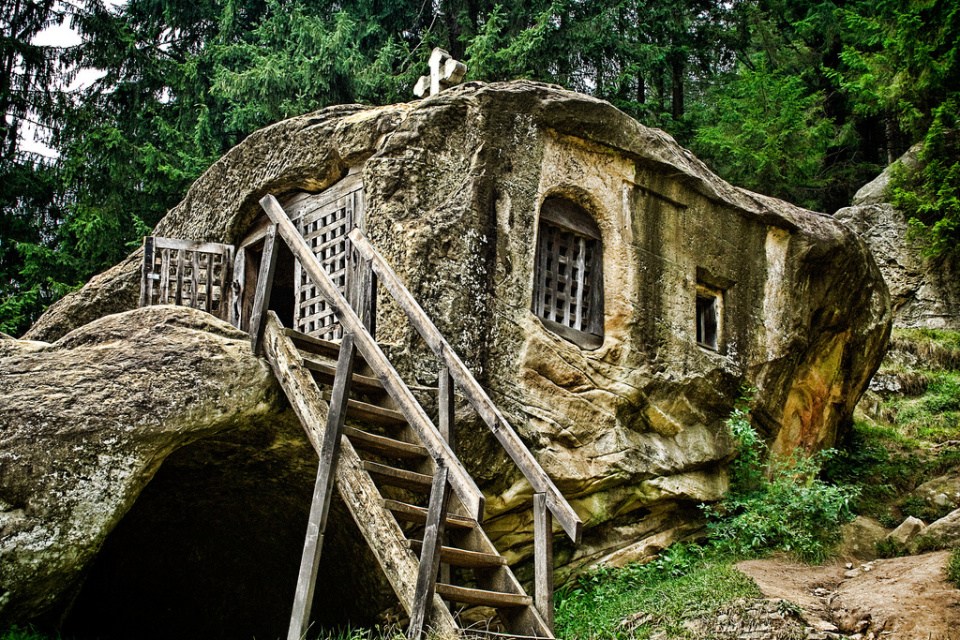
Reading the lives of hermits and monks who lived in remote monasteries or hermitages with strict rules, we often come across the word cell or cell. As a rule, it means a separate room in a brotherly building or even a cave carved into the rock. However, the cells are different. For example, the Monk Daniel Sikhasrul - a Romanian ascetic who asceticised as a hesychast - for many years of solitude, with the help of a hammer and chisel, he carved a real house in solid rock, which today attracts thousands of pilgrims and tourists. Actually, the very word 'hesyhia' indicates a person who 'keeps the incorporeal within the confines of the bodily home' (from the Greek hesyhia, which means peace, silence, solitude). Hesychasm is a mystical movement in monasticism that teaches “smart doing”: external and internal silence in the ceaseless Jesus prayer: “ Lord Jesus Christ, the Son of God. Have mercy on me, a sinner! '. Hesychasts - ascetic monastics spread in the XIV century in Byzantium, and then in other countries; the ultimate goal of their practice was the unification of man with God: his gaining grace and contemplation of the 'uncreated light' of Divine energies.
The Romanian monk Daniel Sikhasrul also followed this mystical teaching. He was born at the beginning of the 15th century in a Romanian village near the city. Radauci. He embarked on the monastic path as a sixteen-year-old youth - with the blessing of the abbot of the monastery, St. Nicholas the Wonderworker. Here, after several years spent in study and prayer, the confessor of this holy monastery ordained him to the priesthood. Later, Daniel went to another monastery - St. Lawrence, which is near the village of Verkhniy Vikovu. The years passed. The once young hieromonk became a notable devotee of piety, for advice and blessing to whom people came hundreds of miles away. Soon, a great multitude began to arrive, seeking spiritual guidance and advice. To satisfy each of them, Daniel would not have to celebrate the liturgy, not eat, not sleep, not pray. Every day he would answer questions of people around the clock: other monks, priests and ordinary laymen! Daniel's heart did not want it at all. Therefore, entrusting the care of the monastic brethren of all who came to him, he became a hermit in a bear's corner far from roads and cities, where it would be incredibly difficult for people to get - even if they knew exactly where Daniel lives. In a mountainous area near the Vitau River, Daniel spent days and nights in silent inner prayer and unceasing labors. Day after day he carved himself a hermit cell - but not a hole in the rock, but a real house with doors, windows and cross on the roof. More than twenty years elapsed from the moment he first hit the stone with a chisel until the day the monastic dwelling was completed. The house built by the Monk Daniel Sihasrul more than five hundred years ago (the Church canonized the ascetic in 1992, shortly after the fall of the godless regime in Romania) has survived to this day. God saved it during the devastating wars and troubled eras in the history of the country - and today this miracle, manually carved into the rock, comes to see thousands of people from all over the world. Just a kilometer away is another famous pilgrimage site - the Putna Monastery. Most of those who come here want to see with their own eyes an unusual house, carved out by a single person for twenty years spent in ceaseless prayer of Jesus. As for the place of this amazing dwelling in the history of the country, the house of St. Daniel Sihasrul is included in the list of historical monuments of the Suceava county and is protected by the law of the Republic of Romania.
The Romanian monk Daniel Sikhasrul also followed this mystical teaching. He was born at the beginning of the 15th century in a Romanian village near the city. Radauci. He embarked on the monastic path as a sixteen-year-old youth - with the blessing of the abbot of the monastery, St. Nicholas the Wonderworker. Here, after several years spent in study and prayer, the confessor of this holy monastery ordained him to the priesthood. Later, Daniel went to another monastery - St. Lawrence, which is near the village of Verkhniy Vikovu. The years passed. The once young hieromonk became a notable devotee of piety, for advice and blessing to whom people came hundreds of miles away. Soon, a great multitude began to arrive, seeking spiritual guidance and advice. To satisfy each of them, Daniel would not have to celebrate the liturgy, not eat, not sleep, not pray. Every day he would answer questions of people around the clock: other monks, priests and ordinary laymen! Daniel's heart did not want it at all. Therefore, entrusting the care of the monastic brethren of all who came to him, he became a hermit in a bear's corner far from roads and cities, where it would be incredibly difficult for people to get - even if they knew exactly where Daniel lives. In a mountainous area near the Vitau River, Daniel spent days and nights in silent inner prayer and unceasing labors. Day after day he carved himself a hermit cell - but not a hole in the rock, but a real house with doors, windows and cross on the roof. More than twenty years elapsed from the moment he first hit the stone with a chisel until the day the monastic dwelling was completed. The house built by the Monk Daniel Sihasrul more than five hundred years ago (the Church canonized the ascetic in 1992, shortly after the fall of the godless regime in Romania) has survived to this day. God saved it during the devastating wars and troubled eras in the history of the country - and today this miracle, manually carved into the rock, comes to see thousands of people from all over the world. Just a kilometer away is another famous pilgrimage site - the Putna Monastery. Most of those who come here want to see with their own eyes an unusual house, carved out by a single person for twenty years spent in ceaseless prayer of Jesus. As for the place of this amazing dwelling in the history of the country, the house of St. Daniel Sihasrul is included in the list of historical monuments of the Suceava county and is protected by the law of the Republic of Romania.
Share: