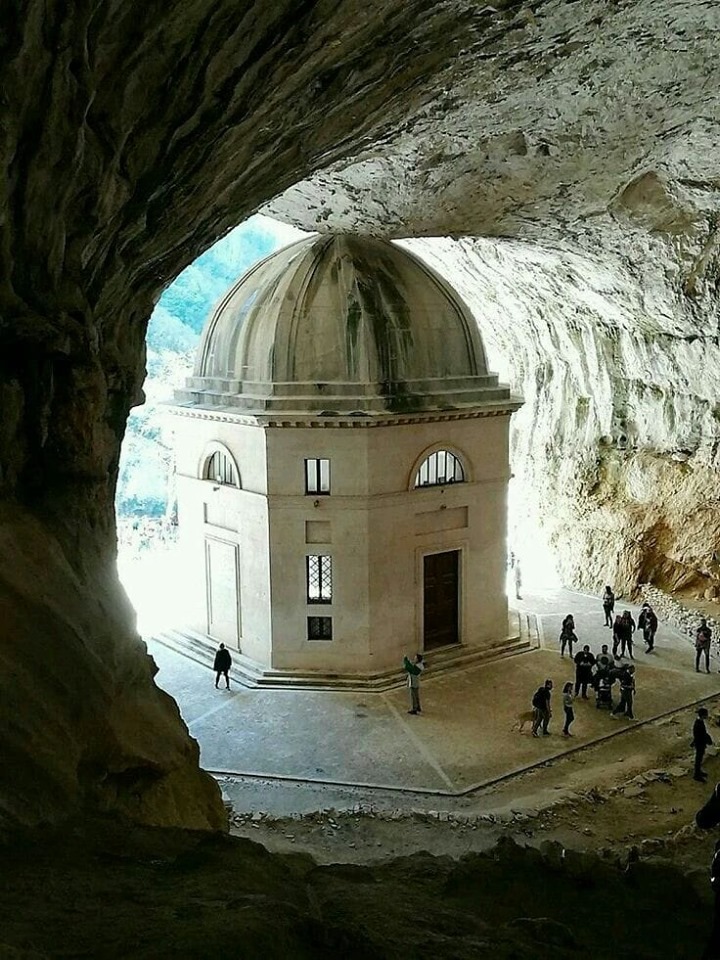
The octagonal temple of travertine (limestone tuff), built right in a cave among the rugged rocks, combines human skill and the beauty of nature. Valadier church in the Italian town of Genga (Genga) is not in vain called a 'haven for the soul.' A miniature temple with a natural limestone roof overhanging its dome is removed from human vanity and the benefits of civilization. It seems impossible to think of a better place to step back from everything and think about the eternal.
The church in the Marche region on the Adriatic coast of Italy got its name from the name of the author who created her project. Starting to work in the twenties of the last century, the official architect of the Vatican Giuseppe Valadier was inspired not only by the amazing beauty of the grotto, inside which it was supposed to build the temple, but also by the rich history of this place. And it goes back to very ancient times: the inhabitants of the town of Jenga, fleeing the invasion of the Hungarian tribes who invaded the Apennine peninsula in the north, more than once found shelter in a spacious but reliably hidden cave from prying eyes. To get into it, you need to overcome a rather steep ascent seven hundred meters long - of course, if you know the necessary path. Already in the tenth century, how reliable it is known that local residents endowed the hidden grotto with mystical protective properties - and, one must think, not in vain: the shelter in the rocks helped more than one generation of people to preserve their lives and the most valuable property.
In preparation for the construction, workers found human bones in the cave, both adults and children, fragments of ovens, pieces of clothing, bronze and iron coins, bags of cereal grains. These findings allow us to conclude that people who took refuge in the grotto stayed here for a long time. The Valadier Church in the cave of the Holy Refuge was erected in 1828 at the direction of Pope Leo XII. Many of those who ascended the Holy See endowed their native places with buildings that would have stood for centuries, perpetuating their memory. Pope Leo XII was no exception in this sense - with the only difference that he approached the choice of the place outside the box. In addition to the temple itself, the architectural complex also includes an old hermitage, in which nuns lived in the midst of a very ascetic environment during the High Middle Ages. The first documentary mention of the skete dates back to the 11th century, and its history is associated with the Catholic Order of the Benedictines. For a long time, in the Valadier Church itself, there was a statue of the Madonna with the Infant God by the great Italian sculptor Antonio Canova. Today on her there is an exact copy - and the original is on display in one of the Jenga museums.
It is interesting that at the beginning of the already mentioned path leading to the temple in the cave, there is a sign with the inscription Santuario della Madonna di Frasassi - literally: 'Sanctuary of the Madonna of Frasassi'. The mysterious intertwining caves of Frasassi are no less impressive than the temple located at the entrance to them, resting with a cross on the dome against the grotto vault. Branched grottoes and galleries, as if carved out in prehistoric times by unknown gnomes, attract not only pilgrims, but also tourists. And yet this place is more spiritual than spiritual: you will not find here neither cafes, nor shops, nor souvenir shops. Another name for the cave of the Holy Refuge, where the temple is located, often found in English-language guidebooks, is Refuge of Sinners. A relatively late local legend says that a person who went up to the temple, having spent some time in a grotto in repentance - and then sincerely turning to the Madonna in front of Her statue, received permission from the sins that weighed upon him. Jenga residents claim that the best time to visit the cave of the Holy Refuge is on Christmas Eve. These days, near the Valadier Church and all the way leading to it, there is a presepe - a dynamic nativity scene, one of the largest in the world. Simply put, it is a pageant a performance that reproduces the events of the Nativity of Christ. Those who are fortunate enough to be here on these days - and this is about five thousand people annually - assure that the spectacle is simply unforgettable. You can get some idea of exactly how the presepe goes on the ascent to the cave of the Holy Refuge by watching the video below. V. Sergienko
The church in the Marche region on the Adriatic coast of Italy got its name from the name of the author who created her project. Starting to work in the twenties of the last century, the official architect of the Vatican Giuseppe Valadier was inspired not only by the amazing beauty of the grotto, inside which it was supposed to build the temple, but also by the rich history of this place. And it goes back to very ancient times: the inhabitants of the town of Jenga, fleeing the invasion of the Hungarian tribes who invaded the Apennine peninsula in the north, more than once found shelter in a spacious but reliably hidden cave from prying eyes. To get into it, you need to overcome a rather steep ascent seven hundred meters long - of course, if you know the necessary path. Already in the tenth century, how reliable it is known that local residents endowed the hidden grotto with mystical protective properties - and, one must think, not in vain: the shelter in the rocks helped more than one generation of people to preserve their lives and the most valuable property.
In preparation for the construction, workers found human bones in the cave, both adults and children, fragments of ovens, pieces of clothing, bronze and iron coins, bags of cereal grains. These findings allow us to conclude that people who took refuge in the grotto stayed here for a long time. The Valadier Church in the cave of the Holy Refuge was erected in 1828 at the direction of Pope Leo XII. Many of those who ascended the Holy See endowed their native places with buildings that would have stood for centuries, perpetuating their memory. Pope Leo XII was no exception in this sense - with the only difference that he approached the choice of the place outside the box. In addition to the temple itself, the architectural complex also includes an old hermitage, in which nuns lived in the midst of a very ascetic environment during the High Middle Ages. The first documentary mention of the skete dates back to the 11th century, and its history is associated with the Catholic Order of the Benedictines. For a long time, in the Valadier Church itself, there was a statue of the Madonna with the Infant God by the great Italian sculptor Antonio Canova. Today on her there is an exact copy - and the original is on display in one of the Jenga museums.
It is interesting that at the beginning of the already mentioned path leading to the temple in the cave, there is a sign with the inscription Santuario della Madonna di Frasassi - literally: 'Sanctuary of the Madonna of Frasassi'. The mysterious intertwining caves of Frasassi are no less impressive than the temple located at the entrance to them, resting with a cross on the dome against the grotto vault. Branched grottoes and galleries, as if carved out in prehistoric times by unknown gnomes, attract not only pilgrims, but also tourists. And yet this place is more spiritual than spiritual: you will not find here neither cafes, nor shops, nor souvenir shops. Another name for the cave of the Holy Refuge, where the temple is located, often found in English-language guidebooks, is Refuge of Sinners. A relatively late local legend says that a person who went up to the temple, having spent some time in a grotto in repentance - and then sincerely turning to the Madonna in front of Her statue, received permission from the sins that weighed upon him. Jenga residents claim that the best time to visit the cave of the Holy Refuge is on Christmas Eve. These days, near the Valadier Church and all the way leading to it, there is a presepe - a dynamic nativity scene, one of the largest in the world. Simply put, it is a pageant a performance that reproduces the events of the Nativity of Christ. Those who are fortunate enough to be here on these days - and this is about five thousand people annually - assure that the spectacle is simply unforgettable. You can get some idea of exactly how the presepe goes on the ascent to the cave of the Holy Refuge by watching the video below. V. Sergienko
Delite: